Saxon Thegn
Saxon Thegn
Logo
Shield

3. The Rise & Decline of Commerce


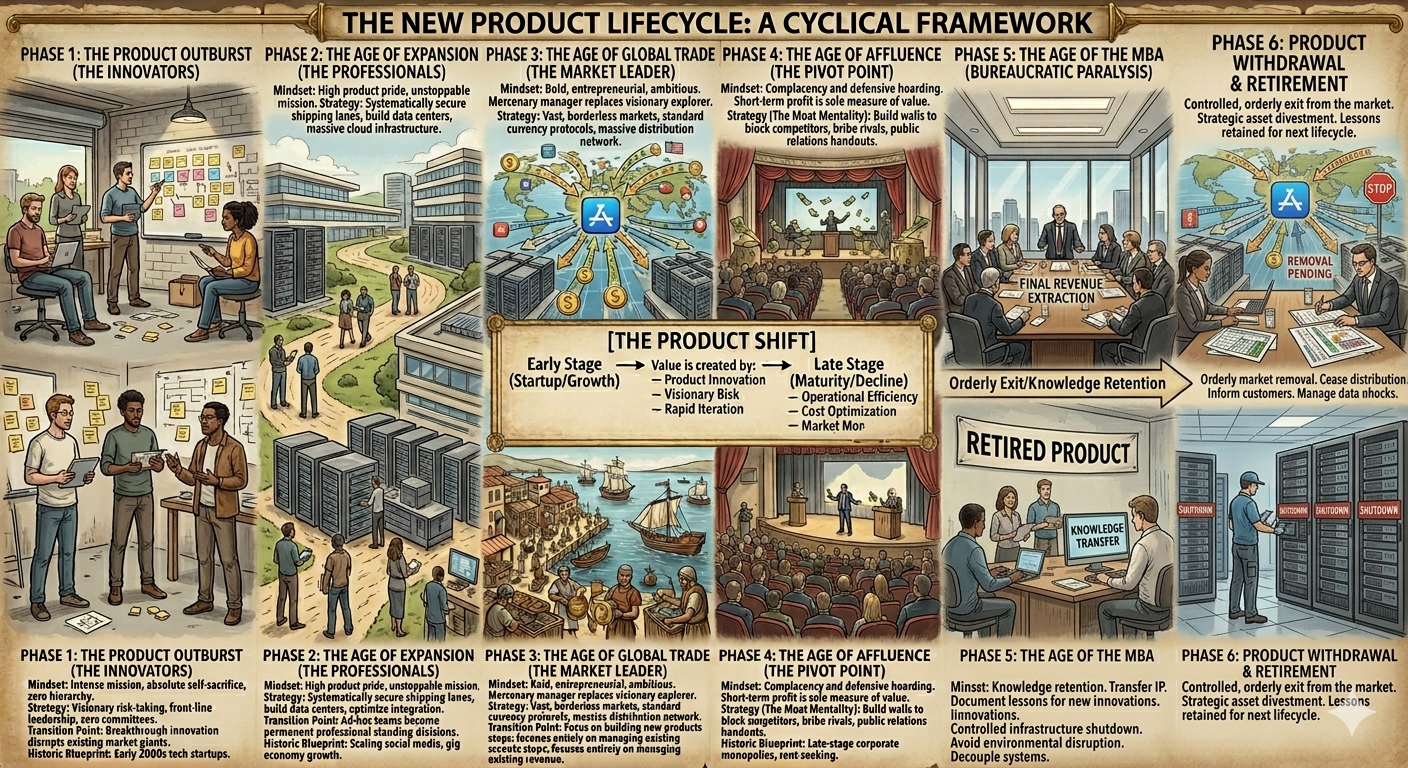
The New Product Lifecycle

New Product Lifecycle
This image has been generated by Gemini AI to give a visual view of the process, there may be spelling errors, so please read the text below for full details.

It fits the exact same shape, almost perfectly. In fact, if you overlay Sir John Glubb's Six Ages of an Empire onto the standard Product Life Cycle (PLC) model used in modern business, the lines match up cleanly.

A product isn't just a piece of plastic or a snippet of software; it is a micro-empire. It conquers a market, defends its territory, grows complacent, extracts wealth, and is eventually destroyed by a hungrier, more innovative competitor.

The standard lifecycle model tracks this exact psychological and economic evolution.

The Parallel Lifecycles: Empire vs. Product


.
Product Phase Corporate Priority The Imperial Equivalent (Glubb) What It Actually Looks Like
1. Development & Introduction R&D, Market Validation Age of Pioneers The "garage startup" phase. High risk, high energy, no profit. Leaders are builders and engineers trying to solve a real, raw problem.
2. Growth Scale & Market Capture Age of Conquests The product works. Sales explode. The company expands rapidly, building its distribution infrastructure and crushing early copycats
3. Maturity Optimization & Efficiency Age of Commerce The peak. The product becomes an industry standard . Costs drop, profits reach their highest point, and the brand is dominant.
4. Saturation Defense & Wealth Extraction Age of Affluence The Pivot Point. Growth slows because everyone already has the product. The focus shifts from improving the product to protecting the monopoly via pricing loops.
5. Decline Cost-Cutting & Legacy Age of Intellect & Decadence The product grows bloated and obsolete. The company stops innovating and relies on legal walls, subscriptions, and financial engineering to survive.
6. Withdrawal Product withdrawn from the market. Age of Decadence & Collapse

The Exact Point of Rot: Maturity to Saturation

In the early phases (Pioneers/Growth), a tech company is run by product people who care intensely about making a tool that works flawlessly.

But once a product hits Maturity and Saturation, the original builders are systematically pushed out of the boardroom. They are replaced by the "Late-Stage Elites": Accountants, MBAs, and Corporate Lawyers.

Early Stage (Growth) ──► Strategy: "How do we make this product so good that everyone wants to buy it?"
Late Stage (Saturation) ──► Strategy: "How do we squeeze 10% more profit out of the users who are already trapped in our ecosystem?"

This is the birth of the Wall Mentality in business. Instead of innovating, the mature company starts using defensive mechanisms:

The Subscription Trap: Forcing users into monthly payment models rather than letting them own the software, ensuring a predictable quarterly report for Wall Street.
Vendor Lock-In: Making it intentionally difficult for customers to export their data or files to rival platforms.
Litigation over Innovation: Suing smaller startups for patent infringement rather than building better features.

The "New Pioneer" Disruptor

While the legacy giant is busy tweaking its subscription tiers and cutting its customer support budget to make the Q4 balance sheet look good (The Age of Intellect), a hungry new pioneer is sitting in a corner somewhere looking at a 10-year horizon.

They build an open-source, lighter, or cheaper alternative. They don't have a bloated bureaucracy or shareholders to please, so they can take risks.

The legacy giant ignores them because the pioneer's early revenue looks microscopic on a quarterly spreadsheet. By the time the giant realizes the threat, the new product has entered its Growth phase, the old product has slipped into Decline, and the corporate empire shatters.

Whether you are looking at a Roman Fort, a Silicon Valley software monopoly, or the agricultural stability of the planet—the shape of the wave never changes. Prosperity breeds complacency, complacency breeds short-term extraction, and extraction invites the crash.


The Legal Evolution of an Empire

The rise and decline of the Legal System
This image has been generated by Gemini AI to give a visual view of the process, there may be spelling errors, so please read the text below for full details.

Phase 1: Development and Introduction (Age of Pioneers)

Law in its earliest form is little more than codified tribal custom. Rudimentary advocate roles emerge organically, and local judiciaries establish the basic definitions of property and legal personhood that allow a society to function beyond the village. There is no bureaucracy, no professional class — just the minimum legal framework needed to hold a fragile new order together.

Phase 2: Growth (Age of Conquests)

As the empire expands, it builds outward from that foundation. A unified imperial code is imposed across conquered territories, judicial training institutes are established, and the sophisticated commercial and contract law that long-distance trade demands begins to take shape. Law becomes infrastructure — as deliberate and load-bearing as the roads being laid across the same landscape.

Phase 3: Maturity (Age of Commerce)

At its height the legal system reaches genuine independence. Courts become capable of checking executive power, doctrines of equity temper the rigidity of statute, and consolidated rights give subjects a legal identity that transcends local allegiance. This is the peak — law as a stabilising force that makes the empire's prosperity feel permanent and self-sustaining.

Phase 4: Saturation (Age of Affluence)

It is precisely this sophistication that plants the seeds of decline. The system that was built to enable commerce is now used to protect monopoly. Legislation multiplies faster than it can be enforced, the judiciary grows corrupt, and the bureaucratic weight of the framework becomes an obstacle to the justice it was designed to deliver. Law shifts from a tool of expansion to a weapon of entrenchment.

Phase 5: Decline (Age of Intellect)

The legal framework becomes completely paralyzed by its own hyper-complexity. Law is no longer an instrument of justice or infrastructure, but an insular game of abstract interpretation, procedural loopholes, and regulatory capture. The system is entirely dominated by a professional caste of lawyers, compliance oligarchs, and financial engineers who weaponize the code to protect dying monopolies. While the courtrooms are locked in endless debates over commas and precedents, the state becomes completely blind to the fact that the general populace has entirely lost faith in the system's legitimacy.

Phase 6: Dissolution and Replacement (Age of Decadence & Collapse)

The brittle, over-regulated imperial framework finally shatters under its own weight. Total institutional gridlock and systemic corruption render the official courts entirely unworkable for ordinary citizens, triggering a mass "legal decoupling." Society completely withdraws from the imperial justice system, instead reverting to parallel, informal systems of tribal arbitration, localized custom, or arbitrary decree. The grand architecture of imperial law dissolves back into the landscape, leaving behind nothing but fragmented boundary marks, obsolete legal terms, and a lawless vacuum waiting for a new pioneer to impose order.


Other Rise and Decline documents


The pages below show links to documents that reference pages concerning Rise and Decline.
For the individual pages please click on the links, new documents will be auto populated as and when these
are written.

   Document Description    
  1. The Rise & Decline of Empires   
  2. The Rise & Decline of Wealth   
  3. The Rise & Decline of Commerce   


Local Interest
Just click an image
Hawkhurst Local History Society
Bexhill Museum
Wadhurst History Society
Roman, Saxon and Norman History of the South East
The Rudes as lots of people call us, are an outdoor touring theatre company specialising in taking new & original theatre to mainly small rural communities and a few towns across the South of England. We were founded in 1998 & first toured in the Summer of 1999. Currently we tour only in the summer performing 50+ times nightly during June, July & August. https://therudemechanicaltheatre.co.uk
A detailed historic site for Hastings
Bexhill Old Town Preservation Society
Ninfield History Group
Sigi
Hastings Rock the place to listen to
Battle Museum of Local History
(Hard to find but worth the Visit)
Wealden Iron Research Group