| 1. The Rise & Decline of Empires |
|---|
| Empires 6 Stages from Rise to Decline ▲ |
|---|
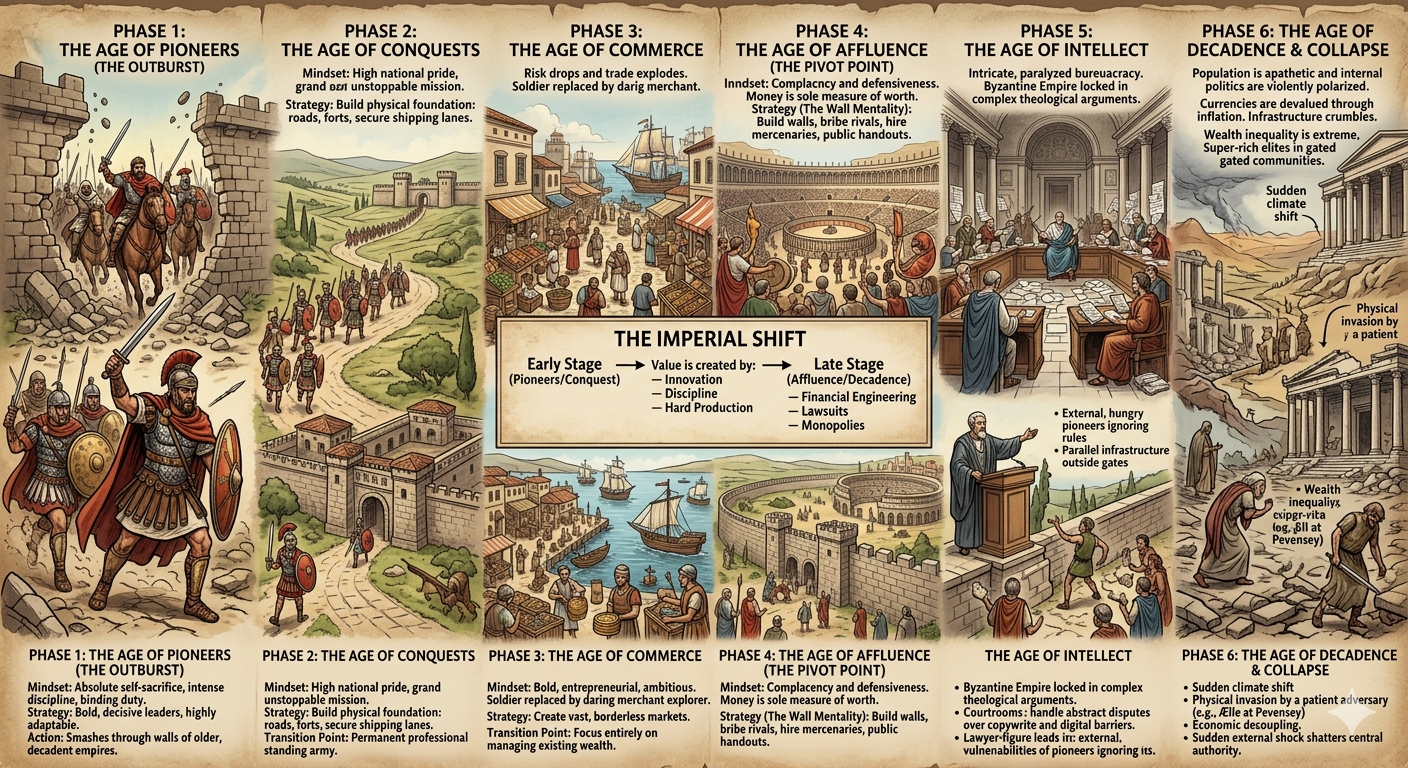
This image has been generated by Gemini AI to give a visual view of the process, there may be spelling errors, so please read the text below for full details.
Phase 1: The Age of Pioneers (The Outburst)
This is the explosion phase. A small, overlooked, or desperate nation—often living in harsh geographic conditions—suddenly finds a spark of unity and erupts outward.
The Mindset: Absolute self-sacrifice, intense discipline, and a binding sense of duty. Personal wealth doesn't exist; individual survival is entirely tied to the survival of the collective.
The Strategy: They are highly adaptable because they have nothing to lose. They don't have "committees" or bloated bureaucracies; they have bold, decisive leaders who lead from the front lines.
The Transition Point: They smash through the borders of older, wealthy, decadent empires that have grown soft and reliant on walls and treaties.
Historic Blueprint: The early Arab conquests of the 7th century, or the rugged early Roman Republic conquering the Italian peninsula.
Phase 2: The Age of Conquests
Having established their initial borders, the pioneers organize their victories. This is the era of systematic, professional expansion.
The Mindset: High national pride and confidence. The citizens see themselves as part of a grand, unstoppable mission.
The Strategy: The empire builds the physical foundation of its future power. They construct military roads, secure strategic shipping lanes, and build massive defensive outposts (like the Romans constructing the early forts around Britain). They don't just conquer; they integrate the lands they take to feed the imperial engine.
The Transition Point: The military stops being a temporary militia of citizens and becomes a highly paid, permanent, professional standing army.
Historic Blueprint: Rome systematically clearing the Mediterranean of rivals like Carthage, or the early British East India Company securing footholds in India.
Phase 3: The Age of Commerce
With the roads built and the borders safe, risk drops and trade explodes. This is the wealthiest, most physically productive era of the empire.
The Mindset: Bold, entrepreneurial, and ambitious. The focus shifts from military glory to commercial enterprise. The heroic soldier is replaced by the daring merchant explorer.
The Strategy: The empire creates vast, borderless markets. They standardise the currency, create banking networks, and build massive merchant fleets. Wealth flows into the capital from every corner of the known world.
The Transition Point: The empire stops focusing on building new things and begins focusing entirely on managing and concentrating the wealth it already has.
Historic Blueprint: The Pax Romana (the Roman Peace) under Augustus, or the Victorian industrial boom of the mid-19th century.
Phase 4: The Age of Affluence (The Pivot Point)
This is the exact structural tipping point where the empire’s internal engine shifts from creation to protection. This is where short-term corporate greed becomes the defining feature of society.
The Mindset: Complacency and defensiveness. Money ceases to be a byproduct of hard work and becomes the sole measure of human worth. The descendants of the pioneers take the empire's dominance for granted, believing it is an unchangeable law of nature.
The Strategy (The Wall Mentality): The empire stops taking risks. Instead of inventing new technology or venturing into new fields, they use their immense wealth to build literal or economic walls to block out competitors. They bribe rivals, hire foreign mercenaries to do their fighting, and buy off internal unrest with public handouts ("bread and circuses").
The Shift in Leadership: Power shifts from builders and explorers to monopolists and financiers. The ultimate goal becomes protecting the existing hoard at all costs.
Historic Blueprint: Late Rome relying on barbarian mercenaries to guard its borders while the senatorial class hoarded vast agricultural estates.
Phase 5: The Age of Intellect
As the real economy of physical production fades, the empire pours its wealth into academics, legal systems, and administrative bureaucracy. On the surface, it looks like a golden era, but it is actually a state of profound paralysis.
The Mindset: Hyper-analytical, cynical, and highly individualistic. The collective sense of national duty completely dissolves. People become obsessed with abstract debates, identity, and personal luxury.
The Strategy (The Tyranny of Bureaucracy): The empire becomes completely ruled by procedures, regulations, and administrative paperwork.
Corporate and political boardrooms are no longer led by visionaries; they are run by lawyers, compliance officers, and financial engineers.
They create massive, heavy-handed legal frameworks (like late-stage Rome's hyper-taxation or the modern US tech sector's reliance on copyright lawsuits and digital trade barriers) to force the world to comply with their dying monopoly.
The Vulnerability: While the empire is busy arguing over rules, filing paperwork, and managing quarterly spreadsheets, it becomes completely blind to the external, hungry "pioneers" who are ignoring the rules and building actual, parallel infrastructure outside the gates.
Historic Blueprint: The Byzantine Empire spending centuries locked in complex theological and legal arguments while the Ottoman Turks were methodically casting massive bronze cannons to blast down the walls of Constantinople.
Phase 6: The Age of Decadence & Collapse
The final, brittle stage. The structural rot inside the fortress reaches 100%, and the empire becomes an empty shell waiting for a sufficient external shock.
The Mindset: Apathy, pessimism, and a total loss of civic morality. The population no longer believes the empire is worth defending or saving. Internal politics becomes violently polarized, tribal, and hyper-focused on short-term self-interest.
The Economy: The currency is systematically devalued (inflation) to pay for a bloated state that no longer produces real value. Wealth inequality reaches a historic chasm—the super-rich elite retreat into gated communities while the general infrastructure crumbles.
The Collapse: The empire has become so fragile that it cannot withstand a major disruption. Whether it is a sudden climate shift , a physical invasion by a patient adversary (like Ælle at Pevensey), or an economic decoupling by foreign partners—the central authority shatters.
The Universal Timeline
Hard Work (Pioneers)→Power (Conquest)→Wealth (Commerce)→Greed (Affluence)→Talk (Intellect)→Decay (Decadence)
Early Stage (Pioneers/Conquest) ──► Value is created by: Innovation, Discipline, Hard Production.
Late Stage (Affluence/Decadence) ─► Value is extracted by: Financial Engineering, Lawsuits, Monopolies.
Every empire gets trapped in the transition between Affluence and Intellect. They stop looking ten years ahead because they are too busy managing the immediate, short-term extraction of wealth from the system they already built. And that short-term blindness is the exact mechanism that unlocks the gate for the next wave of pioneers waiting outside.
|
| |
|---|
The Three-Step Slide into Autocracy ▲ |
|---|
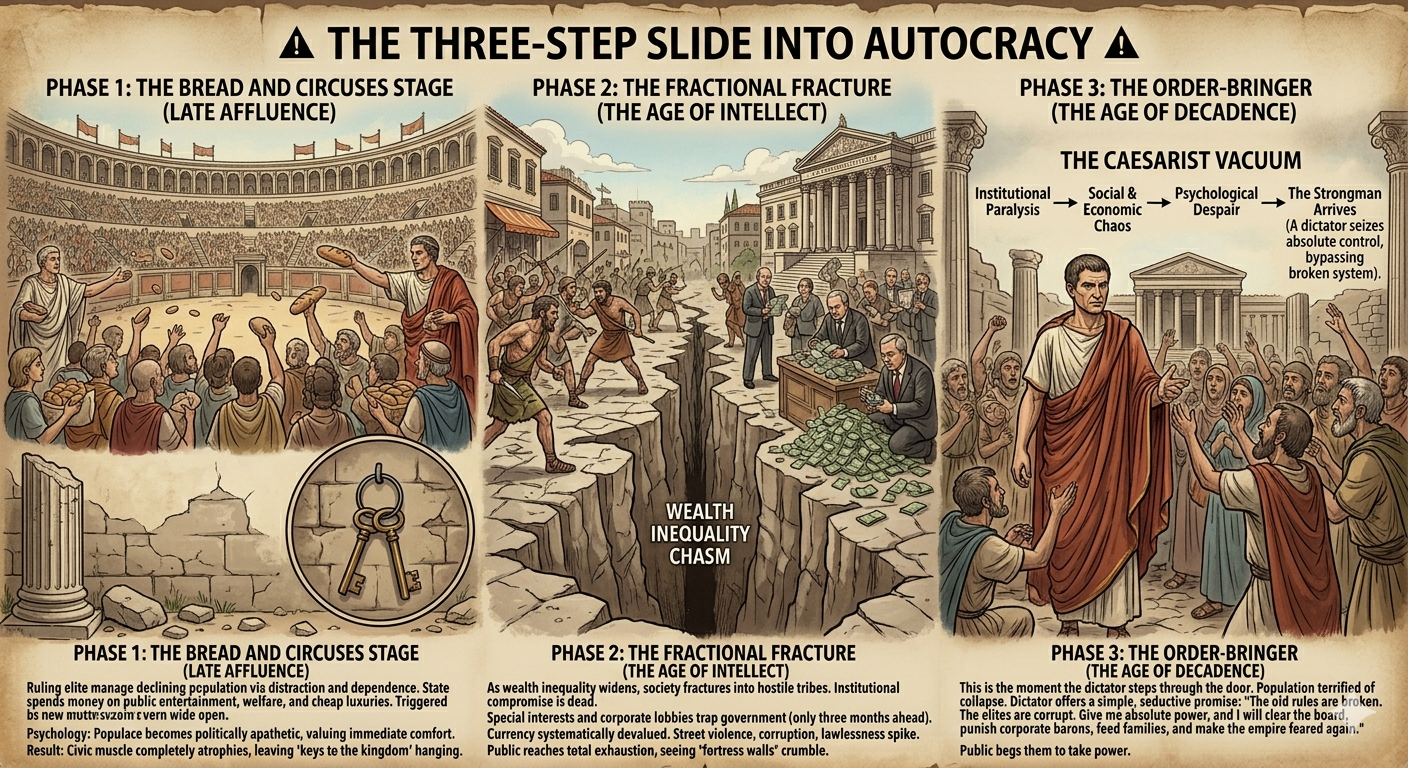
This image has been generated by Gemini AI to give a visual view of the process, there may be spelling errors, so please read the text below for full details.
Phase 1: The Bread and Circuses Stage (Late Affluence Stage)
Before the dictator arrives, the ruling elite try to manage the declining population by keeping them distracted and dependent. Sir John Glubb noted that as real economic production fades, the state spends massive amounts of money it doesn't have on public entertainment, welfare handouts, and cheap luxuries.
The Psychology: The populace becomes politically apathetic. They don't want to solve complex, long-term problems; they just want their immediate comfort protected.
The Result: The civic muscle of the society completely atrophies. The population forgets how to govern themselves, leaving the keys to the kingdom hanging wide open.
Phase 2: The Fractional Fracture (The Age of Intellect Stage)
As wealth inequality widens into a chasm, society fractures into bitter, hostile tribes. The internal political system becomes completely incapable of compromising or planning ahead—much like a government trapped by special interests or corporate lobbies that can only think about the next three months.
The currency is systematically devalued to pay for the bloated system, triggering severe inflation and economic panic.
Street violence, institutional corruption, and general lawlessness begin to spike.
The general public reaches a state of total exhaustion. They look at their gridlocked leaders and realize that the "fortress walls" are crumbling from the inside.
Phase 3: The Order-Bringer (The Age of Decadence Stage)
This is the moment the dictator steps through the door. When a society is terrified of collapse, a specific type of leader emerges—what historians call the Caesarist figure.
THE CAESARIST VACUUM
Institutional Paralysis ──► Government & Corporations focus only on short-term survival.
Social & Economic Chaos ──► Inflation spikes, food/energy unstable, public trust hits zero.
Psychological Despair ──► The population values "Safety & Order" over "Liberty & Law".
The Strongman Arrives ──► A dictator seizes absolute control, bypassing the broken system.
This strongman doesn't always seize power by force; often, the public begs them to take it. They offer a simple, seductive promise: "The old rules are broken. The elites are corrupt. Give me absolute power, and I will clear the board, punish the corporate barons, feed your families, and make the empire feared again."
The Historic Blueprints
This pattern has played out with terrifying accuracy across the macro-timeline:
Ancient Rome (The Ultimate Example): For 500 years, the Roman Republic was fiercely democratic. But as wealth from conquests flooded the capital, the senatorial elite grew hyper-rich, corrupt, and obsessed with short-term financial engineering. The rural farming economy collapsed, inflation soared, and politics became entirely gridlocked by violence. The people grew so desperate for stability that they cheered when Julius Caesar marched his army into Rome, effectively ending the democracy and birthing the age of absolute Emperors.
The Weimar Republic to Nazi Germany: Following WWI, Germany attempted a highly progressive democracy. However, catastrophic hyperinflation, political gridlock, and the Great Depression completely broke the social fabric. The population was so economically starved and exhausted by chaos that they willingly handed absolute power to a fascist dictatorship that promised immediate jobs, bread, and national pride.
The Warning for the Modern Stage
The majority of modern corporations operate 3 months to 1 year ahead —ignoring the 10-to-15-year horizon because they are blinded by immediate shareholder profits—is the exact economic engine that drives this slide.
When the major tech and corporate monopolies focus entirely on wealth extraction rather than maintaining a stable, prosperous society, they unintentionally hollow out the middle class. They create the exact economic pain, inflation, and desperation that forces a society into the arms of a strongman.
Dictators are never the cause of an empire's decline; they are the final, closing symptom of it. They arrive when a civilization has become too tired, too poor, and too divided to govern itself any longer, choosing the cold stability of tyranny over the chaotic freedom of a collapsing system.
|
| |
|---|
The Rise of Populism ▲ |
|---|
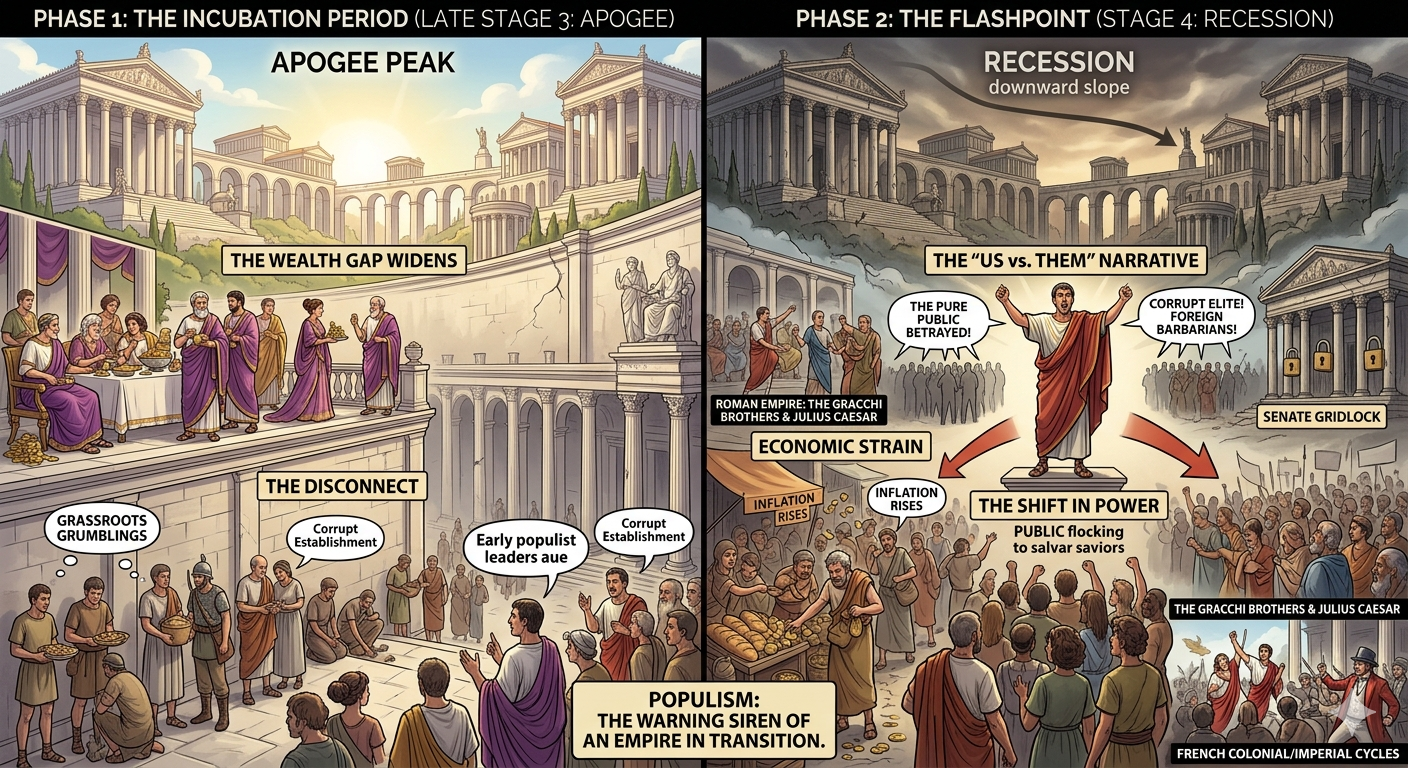
Phase 1: The Incubation Period (Late Stage 3: Apogee)
At the peak of the empire, things look perfect on the surface, but structural rot is starting underneath.
The Wealth Gap Widens: While the "Peak Stewards" are building monuments and consolidating their wealth, the middle and lower classes begin to feel left behind.
The Disconnect: The ruling elite becomes insular, hyper-bureaucratic, and increasingly disconnected from the day-to-day realities of ordinary citizens.
The Result: Early populist sentiments start as grassroots grumblings. People begin looking for an outsider who "speaks for the common man" against a corrupt establishment.
Phase 2: The Flashpoint (Stage 4: Recession)
This is the true golden age of populism. As the empire enters a recessionary downward slope, the social fabric begins to fray.
Economic Strain: Inflation rises, wages stagnate, and resources become scarce. The public's standard of living drops, creating intense anxiety and anger.
The "Us vs. Them" Narrative: Populist figures capitalize heavily on this fear. They weaponize the decline by dividing society into two moral groups: the pure, betrayed public versus the corrupt, self-serving elite (or external scapegoats, like foreign rivals and "barbarians").
The Shift in Power: Because the traditional political institutions are gridlocked or corrupt, the public loses faith in the system entirely. They turn away from institutional norms and flock to charismatic demagogues who promise swift, radical restructuring and a "return to greatness."
Historical Examples of this Intersection:
The Roman Empire: During Rome’s transition from a late Republic to an Empire (the beginning of its true imperial curve), massive wealth inequality led to the rise of the Gracchi brothers and later Julius Caesar—classic populist figures who bypassed the corrupt Senate by appealing directly to the plebeians and the military.
The French Colonial/Imperial Cycles: Economic crises and a completely unyielding aristocracy consistently birthed revolutionary populism that upended the established regime.
In short: Populism is the warning siren of an empire in transition. It breeds in the hidden inequalities of the Apogee and explodes into a dominant political force during the Recession, as the public looks for a savior to stop the slide into Devolution.
|
| |
|---|
Historic Examples ▲ |
|---|
The Five Titans of Macro-History
1. The Roman Empire (27 BC – AD 476)
The ultimate blueprint for Western imperialism. Born out of the collapse of the Roman Republic, it spanned from the sands of North Africa all the way up to the fort of Inchitutil in Scotland.
The Peak: AD 117 under Emperor Trajan, encompassing roughly 50 million people.
The Legacy: Roman law, concrete architecture, engineering, and the Latin roots of modern European languages.
The Age of Decadence: Hyper-inflation, a bloated bureaucracy, political fragmentation (splitting into East and West), and an over-reliance on foreign mercenary armies. The Western empire finally collapsed in AD 476 when the Germanic chieftain Odoacer deposed the last emperor.
2. The Han Dynasty & Tang Dynasty (China)
Han: 202 BC – AD 220 | Tang: AD 618 – 907
While Rome ruled the West, the Han Dynasty established the foundational identity of imperial China. Centuries later, the Tang Dynasty perfected it, creating the wealthiest, most advanced global superpower of the medieval world.
The Peak: The Tang Dynasty controlled the entirety of mainland China and stretched deep into Central Asia along the Silk Road.
The Legacy: The invention of paper, gunpowder, a merit-based civil service exam system, and the creation of global trade networks.
The Collapse: Both followed the classic dynamic: local military governors (warlords) grew too powerful, short-term court greed isolated the emperors, and peasant rebellions starved the central treasury.
3. The Mongol Empire (1206 – 1368)
The largest contiguous land empire in human history. Formed by Genghis Khan, it was a terrifyingly efficient military machine that united the nomadic tribes of the steppes and overran every settled civilization in its path.
The Peak: Around 1300, stretching from the Sea of Japan all the way into Eastern Europe, covering over 9 million square miles.
The Legacy: The Pax Mongolica—a period of secure trade routes that allowed tech, ideas, and goods to travel safely between Europe and Asia for the first time.
The Collapse: It was simply too large to govern with horse-back logistics. Once Genghis Khan’s descendants began fighting internal civil wars over succession, the empire split into four distinct fragments (Khanates) that were slowly absorbed by local populations.
4. The Ottoman Empire (1299 – 1922)
The longest-lasting Islamic superpower. By conquering Constantinople in 1453, they bridged the gap between East and West, controlling the Mediterranean and dominant overland trade routes for centuries.
The Peak: The 16th and 17th centuries under Suleiman the Magnificent, spanning Southeastern Europe, Western Asia, and North Africa.
The Legacy: Masterful architecture, religious administration systems, and the geopolitics of the modern Middle East and Balkans.
The Collapse: They entered a long "Age of Intellect and Bureaucracy." They ignored the European Industrial Revolution, choosing to protect legacy agricultural and tax systems. By the 19th century, they were known as the "Sick Man of Europe," eventually dissolving entirely after backing the losing side in WWI.
5. The British Empire (1601 – 1997)
The largest global empire in history—the true "empire on which the sun never sets." Driven by maritime dominance, financial capitalism, and industrial technology.
The Peak: 1920, controlling roughly 25% of the world's landmass and a quarter of the global population.
The Legacy: The English language, parliamentary democracy, global shipping lanes, and the modern financial grid.
The Collapse: The sheer financial exhaustion of fighting two World Wars broke the imperial treasury. Unable to afford the massive military costs required to police global territories, Britain was forced to systematically decolonize throughout the mid-20th century, handing over global dominance to the United States.
The Unbroken Timeline
If you step back and look at the lifespan of these empires, they show a see-saw timeline:
Empire Approximate Lifespan Primary Currency of Power
Roman ~500 Years (Western) Infantry, Roads, Central Law
Han/Tang ~400 Years / ~300 Years Civil Bureaucracy, Silk Road Trade
Mongol ~160 Years Cavalry Mobility, Terror, Open Trade
Ottoman ~600 Years Gunpowder, Geopolitical Chokepoints
British ~350 Years Naval Power, Industrial Machinery
Every single one of them started with hungry pioneers taking the early conquests, built magnificent structures, grew comfortable, shifted into short-term financial mismanagement, and was ultimately replaced by a younger, more focused adversary.
The stage changes—from horses to iron ships, and now to computer code—but the script stays exactly the same.
|
| |
|---|
Other Rise and Decline documents ▲ |
|---|
|
The pages below show links to documents that reference pages concerning Rise and Decline.
For the individual pages please click on the links, new documents will be auto populated as and when these
are written.
| |
|
|
;)
)
)
)