| The Origin of the Days of the Week and their Mythology |
|---|
| 
|
The Origin of the Days of the Week ▲ |
|---|
|
The seven-day week is not Roman in origin. The planetary names come from Hellenistic astrology, which probably drew on Babylonian ideas. The "Chaldean order" ranks the seven planets by apparent speed: Saturn, Jupiter, Mars, Sun, Venus, Mercury, Moon. Each hour of the day was assigned to a planet in that order, and the planet ruling the first hour gave its name to the day. That is why the sequence of days (Sun, Moon, Mars, Mercury, Jupiter, Venus, Saturn) looks scrambled against the planetary order.
Evidence: A Pompeii wall inscription from before AD 79 lists the planetary days. Tibullus (c. 20 BC) alludes to Saturn's day, and Cassius Dio (early 3rd century) describes the planetary week as a recent, originally Egyptian custom among the Romans. Constantine made dies Solis an official day of rest in AD 321. Inference: Germanic speakers probably adopted and translated the scheme through contact with Rome, perhaps in the 2nd to 4th centuries. The translated pattern recurs across West Germanic, so it probably predates the Anglo-Saxon migrations. Gap: The earliest firm attestations of the Old English day names still need checking against the Dictionary of Old English corpus before dates are given.
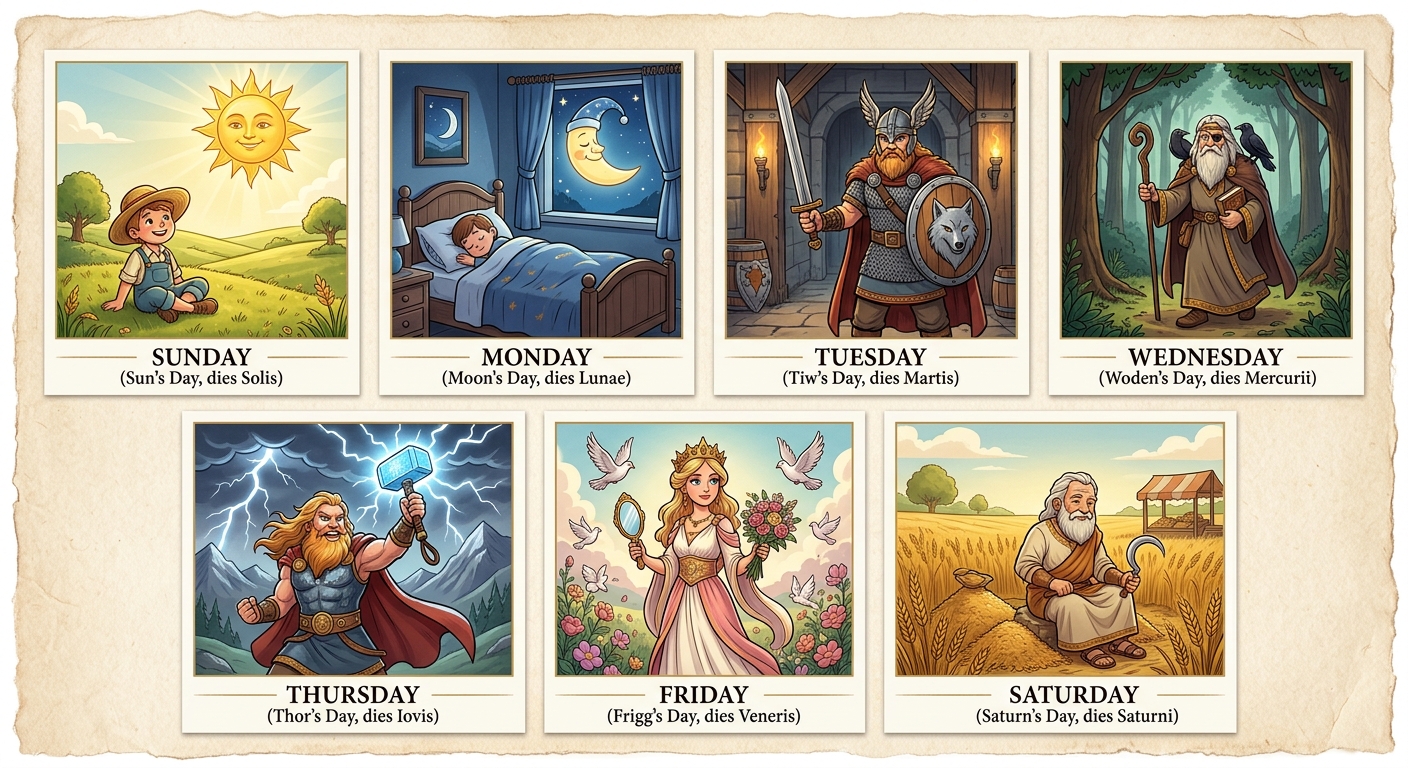
The process by which the Germanic peoples swapped their own gods in for the Roman ones is often called interpretatio germanica. Most of the myths below survive in Old Norse sources, chiefly the Poetic Edda and Snorri Sturluson's Prose Edda, both written down in Iceland in the 13th century by Christian authors. The Anglo-Saxons left far less, so the Saxon entries flag where the English evidence is direct and where we are extrapolating from the Norse.
|
| |
|---|
Sunday ▲ |
|---|
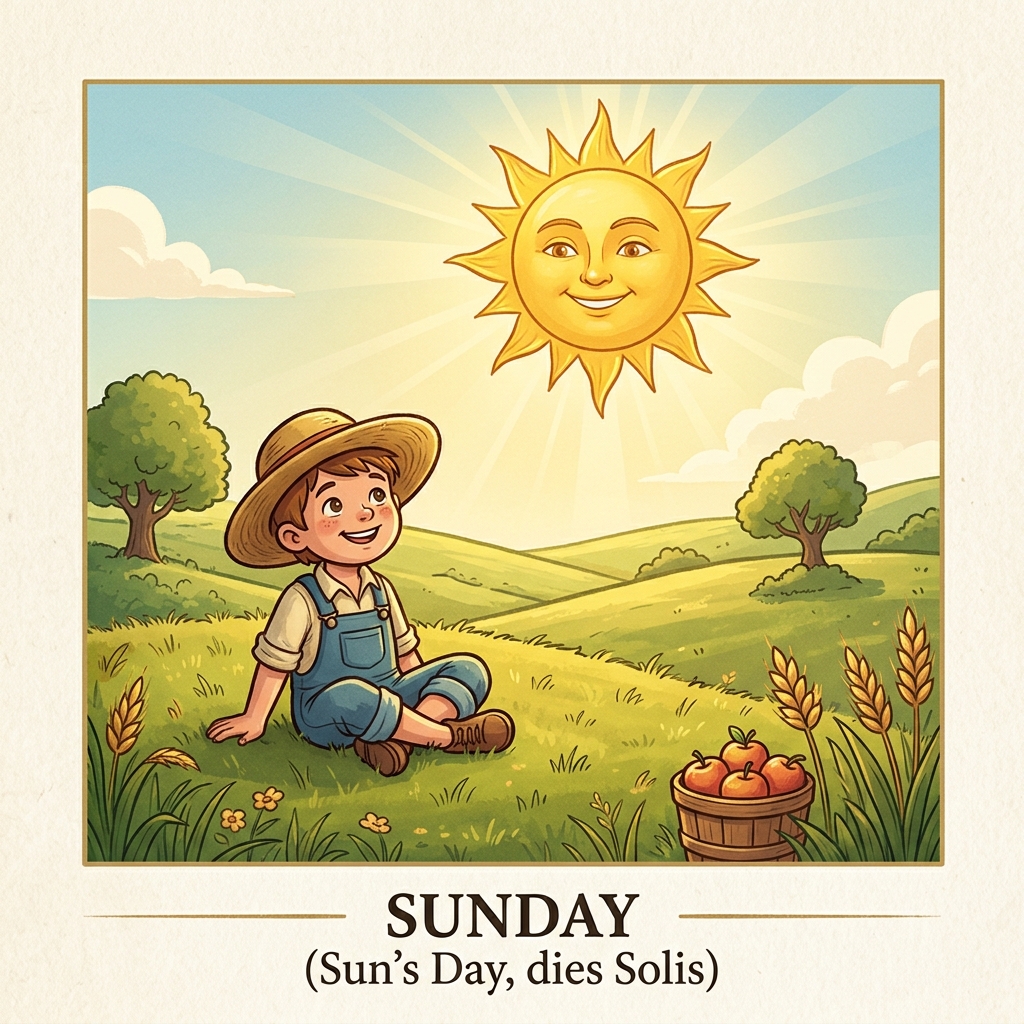 Old English Sunnandæg ("day of the Sun") is a direct translation of Latin dies Solis. The Germanic sun was grammatically feminine (Old English sunne), and a goddess figure is sometimes inferred from this, although the evidence for a cult of such a deity is thin. In Christian use the day also became the Lord's Day, which is why the Romance languages (French dimanche, Italian domenica) use a name derived from dies Dominica.
When the name arose: dies Solis is attested in the Roman period, from the 1st to 3rd centuries AD. The Germanic translation is probably contemporary with the other days.
Derivation: Sunnandæg comes from sunne (feminine), from Proto-Germanic *sunnǭ.
Greek: Helios, a Titan, drove the sun's chariot across the sky each day. In the Odyssey his sacred cattle are slaughtered by Odysseus's crew, and he demands vengeance.
Roman: Sol was an old Roman sun-god. Aurelian established Sol Invictus as an official state cult in AD 274, a likely backdrop to the day's later prominence.
Norse: Sól drives the sun's chariot while the wolf Sköll pursues her, and according to Snorri the wolf catches her at Ragnarök. Her brother is Máni, the moon.
Saxon: No myth survives. The feminine gender of sunne is suggestive but is not proof of a sun-goddess.
Open question: How far the Christian dies Dominica was shaped by, or in competition with, the Sol Invictus cult is debated.
|
| |
|---|
Monday ▲ |
|---|
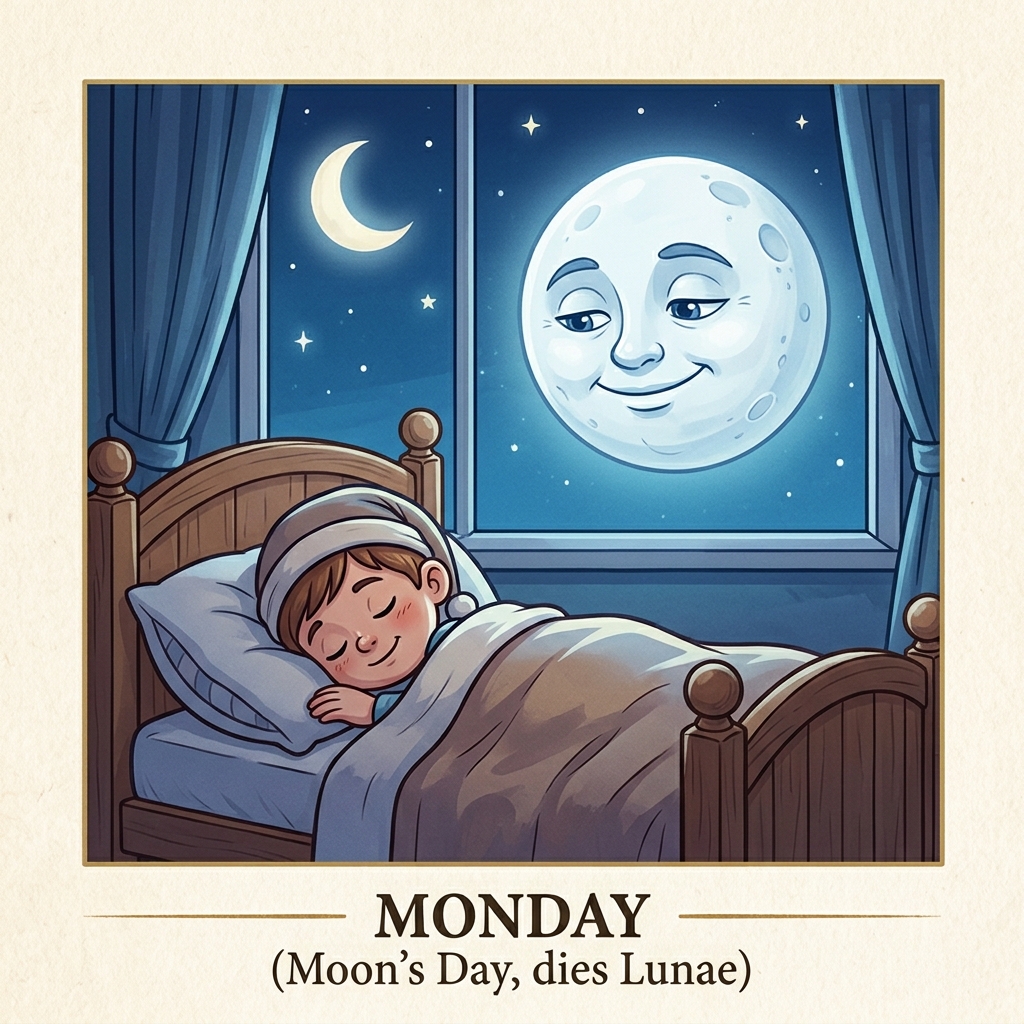 Old English Mōnandæg ("day of the Moon") translates Latin dies Lunae. The word mōna is masculine in Old English, in contrast to the feminine sun, a pairing that matches other Germanic languages and has been much discussed. The Romance forms (French lundi, Spanish lunes) preserve the Latin Luna directly.
When the name arose: dies Lunae belongs to the same Roman-period origin as Sunday.
Derivation: Mōnandæg comes from mōna (masculine), from Proto-Germanic *mēnōn.
Greek: Selene, the moon-goddess, loved the shepherd Endymion. Zeus granted him eternal sleep, and she bore him fifty daughters.
Roman: Luna, often identified with Diana in later tradition.
Norse: Máni steers the moon and is chased by the wolf Hati. According to Snorri he took two children, Bil and Hjúki, from the earth to follow him, and some have linked this to the "man in the moon".
Saxon: Only the day name and the gendered noun survive.
Open question: The masculine moon and feminine sun reverse the Latin pattern. That is a real feature of Germanic, but its mythological significance is inferred.
|
| |
|---|
Wednesday ▲ |
|---|
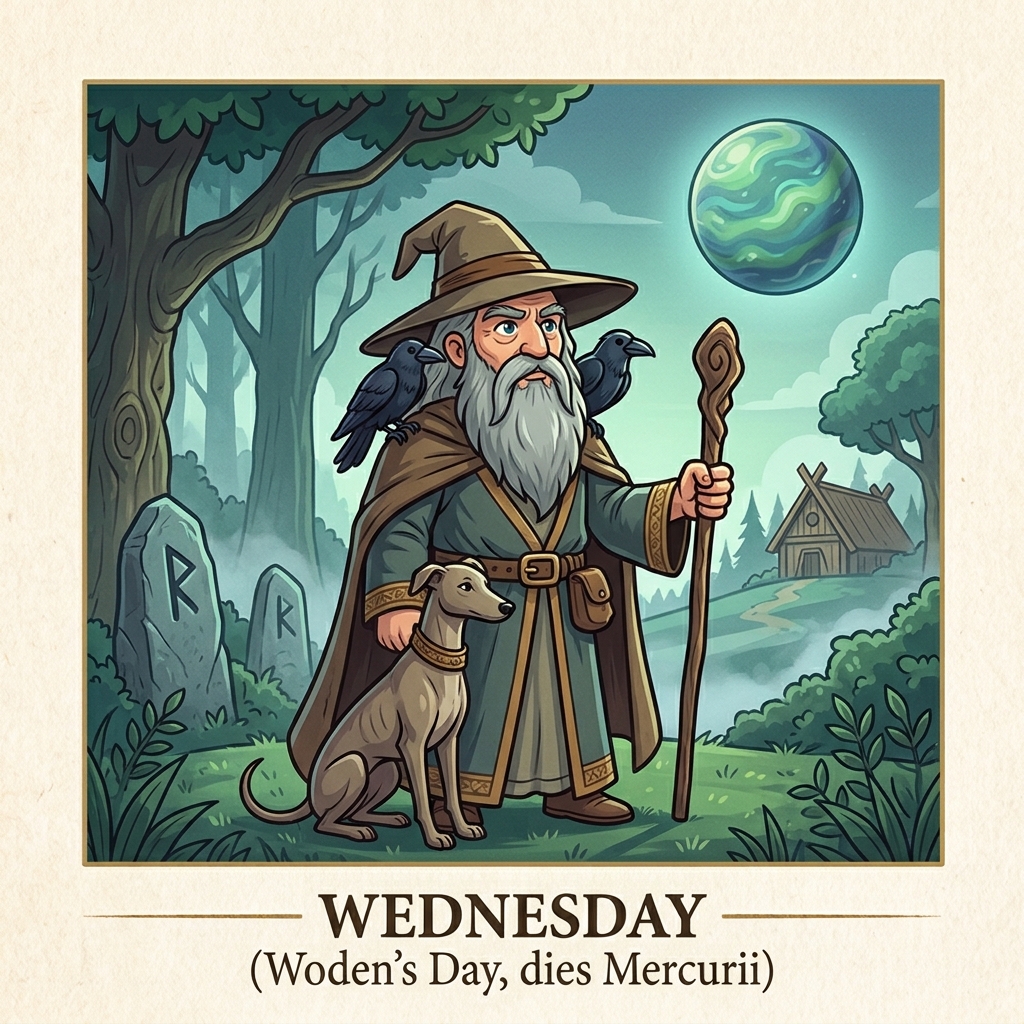 Old English Wōdnesdæg ("Woden's day") renders Latin dies Mercurii (French mercredi). Woden (Norse Odin) was equated with Mercury, probably because both guided souls and were associated with speed, eloquence and travel, rather than because of any similarity in rank. The name is a good example of how the translation was an interpretation and not a straight identification, since Woden was far more central to Germanic religion and royal genealogy than Mercury was to Rome.
When the name arose: dies Mercurii is Roman-period. Tacitus (Germania, c. AD 98) says the Germans worshipped Mercury above the other gods. This is the earliest evidence for the equation, although he does not name Woden.
Derivation: Wōdnesdæg comes from Woden, Proto-Germanic *Wōdanaz ("frenzy, inspiration"), cf. Old English wōd, "mad".
Greek: Hermes was born on Mount Cyllene and stole Apollo's cattle on his first day. He invented the lyre from a tortoise shell, served as herald of the gods, and guided the dead as psychopompos.
Roman: Mercurius was a god of trade (merx), with a temple near the Circus Maximus dated to 495 BC.
Norse: Odin is a god of war, poetry, wisdom, magic and death, and the chief of the Æsir. He sacrificed an eye at Mímir's well for wisdom, and hung himself for nine nights on the world-tree Yggdrasil, wounded by his own spear, to win the runes. He owns the spear Gungnir and the eight-legged horse Sleipnir, and is attended by the ravens Huginn and Muninn ("thought" and "memory") and two wolves. He gathers slain warriors to Valhalla and is killed by Fenrir at Ragnarök.
Saxon: The evidence is unusually good. The Old English Nine Herbs Charm has Woden striking down a serpent with nine "glory-twigs". The royal houses of Wessex, Kent, East Anglia, Mercia and Northumbria all traced their descent from him, as did Hengist and Horsa in Bede and the Chronicle. The Old Saxon baptismal formula names him among the gods to be renounced, and place names such as Woodnesborough in Kent preserve the cult.
Open question: Whether the royal genealogies are genuine tradition or later political construction is unresolved. German Mittwoch ("mid-week") replaced the old name, probably under church influence, so the Germanic day names were not preserved evenly.
|
| |
|---|
Thursday ▲ |
|---|
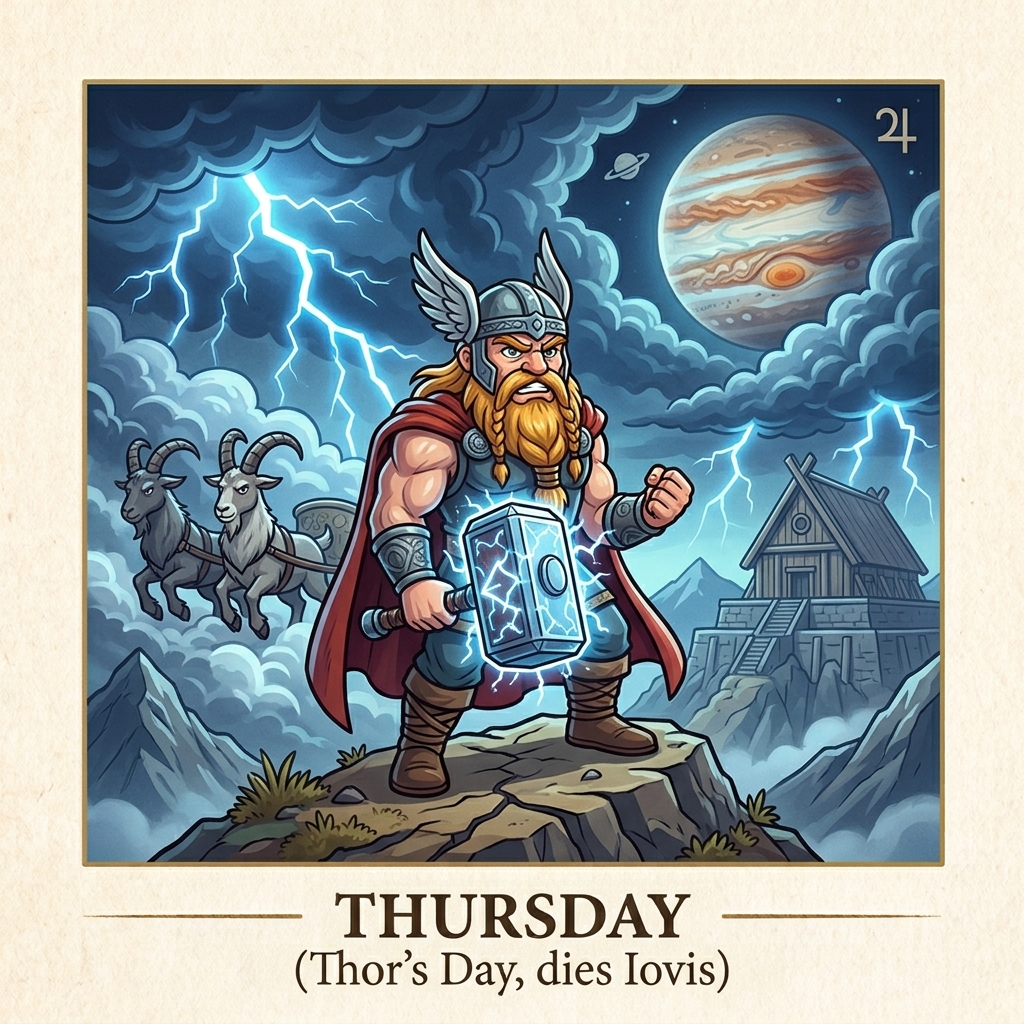 Old English Þunresdæg ("Thunor's day") corresponds to Latin dies Iovis (French jeudi). Thunor ("thunder", Norse Þórr) was matched with Jupiter as the thunder-wielding god. The modern spelling reflects Norse influence, since Thor's day is the Scandinavian equivalent, and the two traditions converged in the English word.
When the name arose: dies Iovis has the same Roman-period origin as the others.
Derivation: Þunresdæg comes from Thunor, Proto-Germanic *Þunraz ("thunder"). The modern Thurs- shows Norse influence.
Greek: Zeus, son of Cronus and Rhea, was hidden in Crete, overthrew his father, led the gods against the Titans, and wielded the thunderbolt.
Roman: Jupiter Optimus Maximus, chief god of the state, presided over the Capitoline cult.
Norse: Þórr(Thor) is the thunder-god, son of Odin and the earth (Jörð), and the defender of gods and men against the giants. He wields the hammer Mjölnir and rides a chariot drawn by two goats. In Þrymskviða the hammer is stolen and Thor disguises himself as a bride to retrieve it. In Hymiskviða he fishes for the Midgard Serpent with an ox's head as bait, and at Ragnarök he kills the serpent but dies of its venom after nine steps.
Saxon: The evidence is toponymic and liturgical. The Old Saxon baptismal formula names Thunær, and place names include Thundersley, Thursley and Thunderfield. No English myths survive, so the English Thunor presumably had a similar profile to Þórr, but that is an assumption.
Open question: Tacitus's "Hercules" among the Germans is sometimes read as Thor or Donar. This is an inference and not a certainty.
|
| |
|---|
Friday ▲ |
|---|
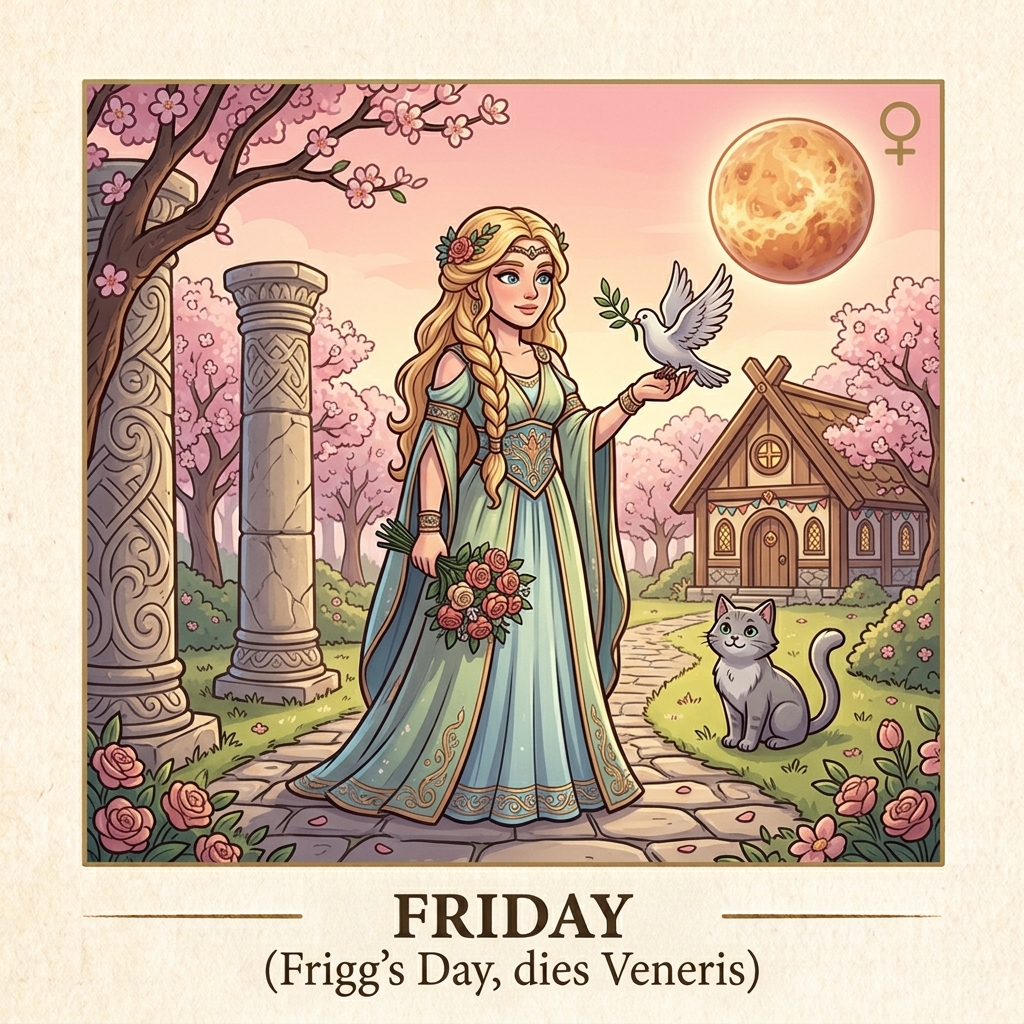 Old English Frīgedæg means "Frig's day", matching Latin dies Veneris (French vendredi). The goddess is usually taken to be Frig (Norse Frigg), wife of Woden, but some scholars argue the Germanic day was originally named for Freyja, or that Frigg and Freyja were once a single figure, since the evidence from other Germanic languages is mixed. The Venus equation probably rests on love, fertility and the feminine divine. Which Norse goddess the English name preserves is genuinely unsettled.
When the name arose: dies Veneris has the same Roman-period origin as the others.
Derivation: Old English Frīgedæg is "Frig's day", with Frīge the genitive of the goddess's name. It descends from Proto-Germanic *Frijjō, usually glossed "beloved" or "loved one", from the Proto-Indo-European root *preyh₁- ("to love, to be dear"). The same root gives Sanskrit priyā́ ("beloved, wife"), and within Germanic it gives the verb behind Old English frēond, "friend" (literally "loving one"), and probably frēo, "free", by way of the sense "dear, belonging to the loved ones of the household". Old Norse Frigg is the cognate form, and the Old High German name in the Merseburg Charms, Frija, is another.
Freyja is a different word. Her name comes from Proto-Germanic *Frawjōn ("lady, mistress"), the feminine counterpart of *frawjaz ("lord"), which also gives the god Freyr's name. On the philology alone, then, the English day belongs to Frig and not to Freyja, and the argument that Freyja was meant rests on how the two figures overlapped in the Norse sources, not on the etymology. Whether Frigg and Freyja began as one goddess and were later split by a title (Frija and "the Lady") is an inference that cannot presently be tested.
Greek: Aphrodite was born from the sea-foam after Cronus castrated Uranus (Hesiod), or in Homer is the daughter of Zeus and Dione.
Roman: Venus, mother of Aeneas and, by the Julian family's claim, ancestor of Caesar (Venus Genetrix).
Norse: Frigg is Odin's wife, associated with marriage, motherhood and foresight, and said to know all fates but never to speak them. Her best-known myth is the death of her son Baldr. After he dreamed of his own death she took oaths from every object and creature not to harm him, but overlooked the mistletoe, and Loki tricked the blind Höðr into hurling it at Baldr. Freyja, of the Vanir, is a goddess of love, fertility, war and magic. She owns the necklace Brísingamen, rides a chariot drawn by cats, and receives half of the battle-slain in her hall Fólkvangr.
Saxon and continental: No English myth survives. Paul the Deacon's 8th-century account of the Lombards has a goddess Frea persuading Godan (Woden) to give them victory, and the Old High German Merseburg Charms name Frija. Together these suggest a divine couple recognised across the Germanic peoples.
Open question: The English name is philologically Frig, but how distinct Frigg and Freyja were originally is disputed.
|
| |
|---|
Saturday ▲ |
|---|
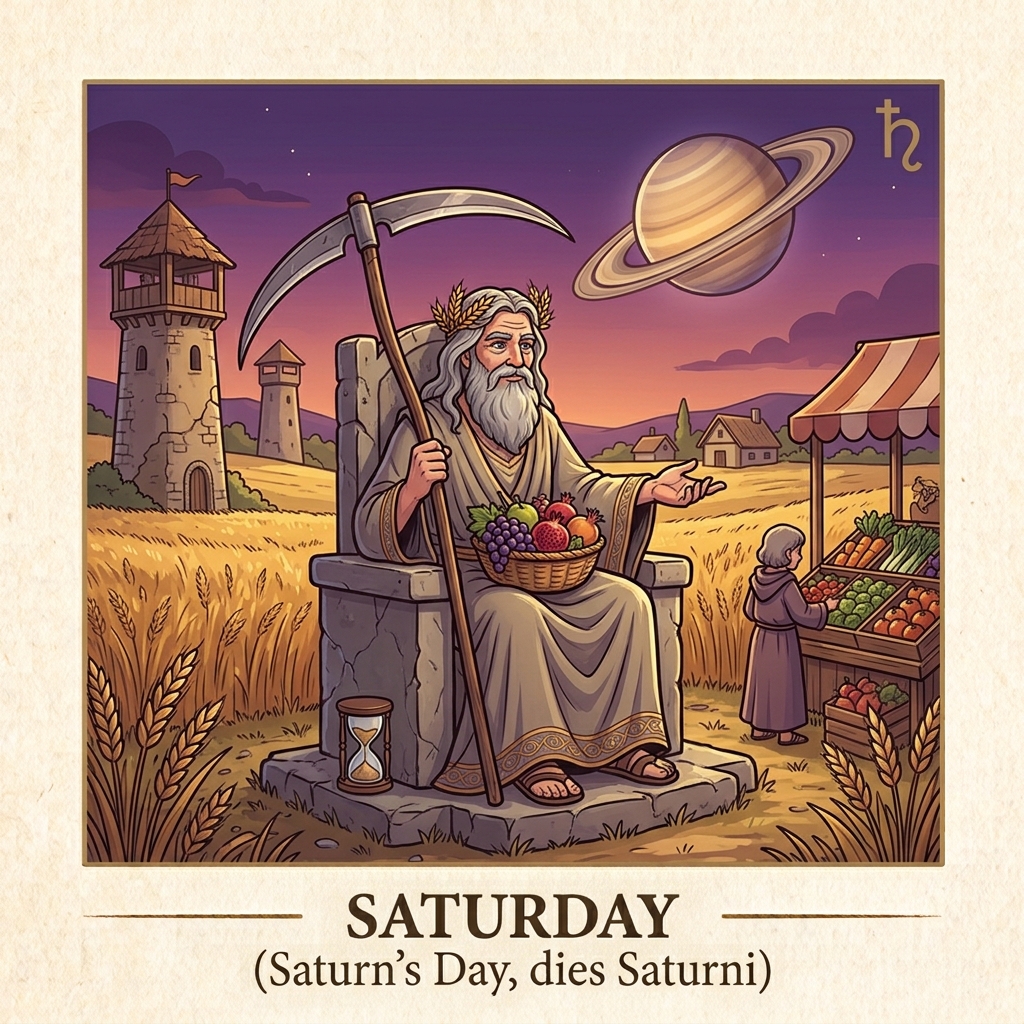 Old English Sæternesdæg is the odd one out, because it preserves the Roman god Saturn (dies Saturni) instead of substituting a Germanic equivalent. No obvious Germanic counterpart to Saturn presented itself, so the Latin name was simply borrowed. The Scandinavian languages took a different path, with Old Norse laugardagr ("washing day", now Swedish lördag), while German Samstag derives through a Greek-Latin route from sabbatum, the Sabbath.
When the name arose: dies Saturni is the earliest of the planetary days to be attested, as Tibullus's remark suggests. The Germanic world borrowed the name and did not translate it.
Derivation: Sæternesdæg comes from Latin Saturnus. The origin of the Latin name is uncertain, and an Etruscan source is sometimes proposed.
Greek: Cronus castrated his father Uranus and swallowed his own children to avoid being overthrown. Rhea tricked him by giving him a stone in place of Zeus, and Zeus later forced him to disgorge his siblings and led the Titanomachy.
Roman: Saturnus was an ancient agricultural god and the legendary king of Latium during a golden age, remembered in the midwinter festival of Saturnalia, originally held on 17 December. His temple in the Forum also housed the state treasury.
Norse: There is no equivalent. Scandinavian laugardagr is a separate coinage.
Saxon: None. The English day simply borrows the Roman god.
Open question: Roman writers linked the Jewish Sabbath with Saturn's day, and this association may have shaped how the week was perceived. It is worth treating as its own thread.
|
|
;)
)
)
)
)
)
)
)