| Roman Glass Making — A Division of Labour |
|---|
| |
The production of glass from raw materials demands an exceptional concentration of resources: reliable access to coastal shipping, large quantities of specialist sand, and enormous volumes of timber to sustain a furnace at 1,100 degrees Celsius for days at a time. The Romans understood this and responded with characteristic pragmatism, concentrating primary glass production at a small number of large industrial facilities in the Eastern Mediterranean, principally in Egypt and the Levant, rather than attempting to replicate the process across the empire.
|
| |
|---|
The Industrial Flow ▲ |
|---|
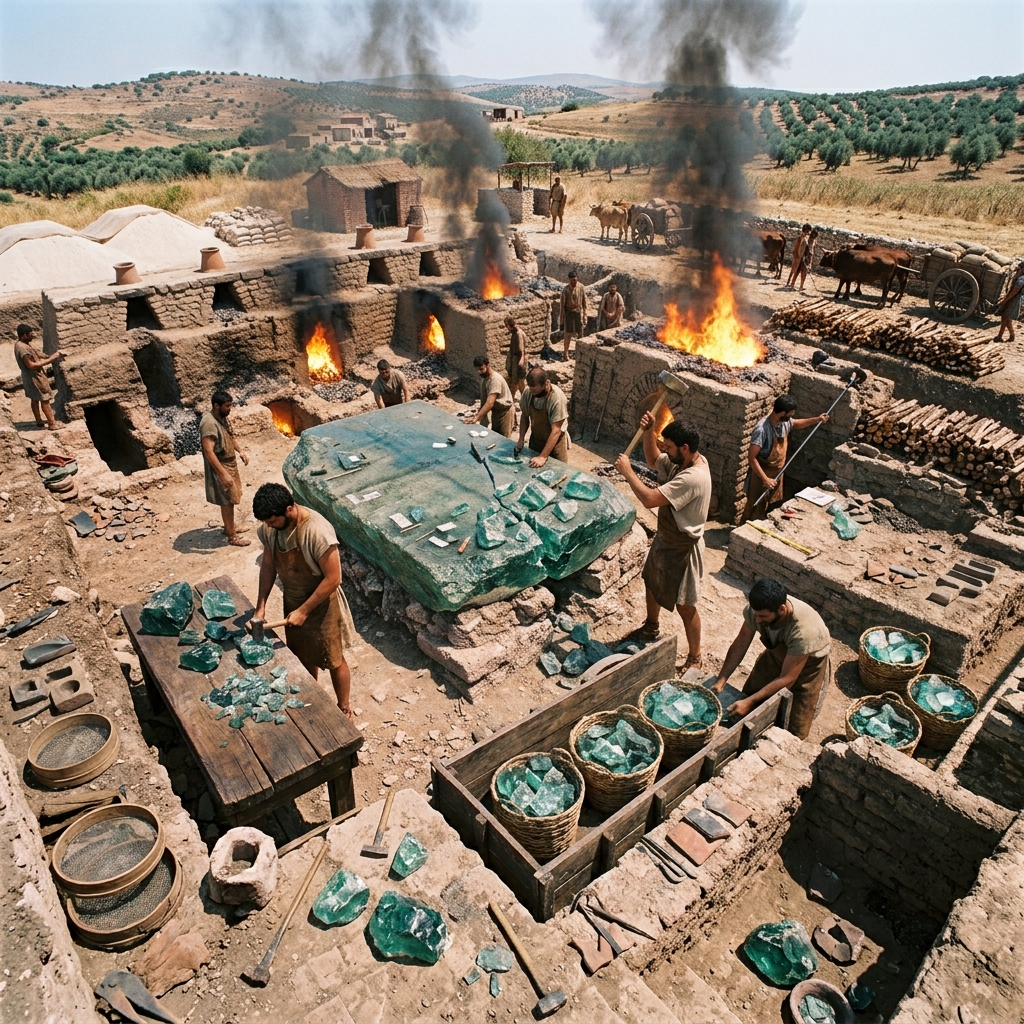 The logic was straightforward. Instead of every provincial town smelting its own raw glass and exhausting local timber and sand in the process, the Romans separated production into two stages.
What the primary facilities made
Roman glass is a soda-lime-silica glass, roughly two-thirds silica, with soda and lime making up most of the remainder. The silica came from coastal sand. The lime is generally thought to have come from shell fragments naturally present in that sand rather than from a separate addition. The soda came from natron, which also released carbon dioxide and water as it melted. Natron glass is distinguished chemically by very low potash and magnesia. Plant-ash glass, including Waldglas, is much richer in both. That difference in composition is what lets analysts tell the two traditions apart, and it underpins the contrast drawn later in this page.
How the melt worked
The batch of sand and natron was charged into a large rectangular tank furnace, heated from a separate firebox, and held at around 1,100 °C for days. Gases escaped and bubbles rose out of the melt until the glass stabilised. The tank was then left to cool, and the solid slab was broken up with sledgehammers into rough chunks resembling jagged blue-green stone. The chunks had no finished form, but they were chemically pure and ready to work. It is a reasonable inference that the cleaner glass was selected from the contaminated margins of the slab, but I know of no direct evidence for how chunks were graded.
The excavated evidence
The scale of these installations is vividly illustrated by a slab of raw glass at Bet She'arim in modern Israel. It dates to the early Islamic period but reflects the same tank-furnace technology used earlier. The tank was charged with some eleven tons of raw material and fired at 1,100 °C for up to ten days, consuming as much as twenty tons of fuel. The resulting slab weighs almost nine tons, enough, had the melt succeeded, for fifty to sixty thousand small vessels. This melt failed and was never broken up for distribution, which is why it survives intact on the cave floor where it was found.
A plausible inference from these figures is that the loss of about a fifth of the charge reflects the volatiles driven off from the natron and the moisture in the batch. A chemist could test this against the analysed composition.
At nearby Bet Eli'ezer, seventeen furnace floors have been excavated, which suggests that production on this scale was standard practice in the region. The Bet Eli'ezer furnaces appear to be Byzantine to early Islamic in date rather than Roman, as is the Bet She'arim slab.
|
| |
|---|
Local production of Glass Objects ▲ |
|---|
 From chunk to vessel
Those chunks were then loaded onto merchant vessels and distributed to secondary workshops across the empire, including more than twenty sites identified in Roman Britain alone.
Moving the glass
Raw glass is dense, chemically stable and, unlike finished vessels, hard to break in transit. This makes it a plausible bulk cargo for sea transport, and shipwrecks carrying raw glass chunks are the direct evidence that it moved this way. Ouest Embiez 1 off the Var coast and the Iulia Felix wreck in the Adriatic are the ones to check. The chunks were then traded on, and the evidence for what happened next is largely archaeological.
What the secondary workshops did
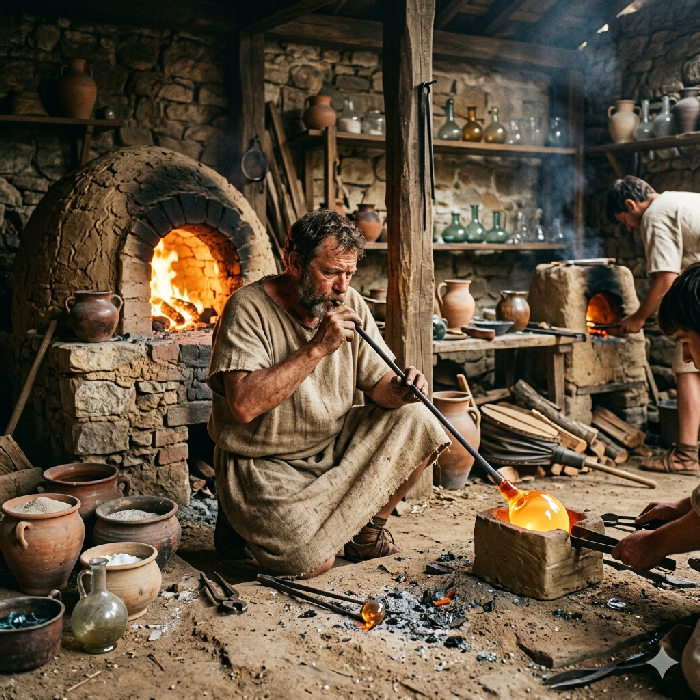
Secondary workshops are identified by their waste rather than their buildings. Typical finds are crucible fragments with glass adhering, droplets and trails of glass, raw chunks, broken vessels kept for remelting and moils, the waste glass left on a blowpipe when a vessel is detached. Many of these workshops were small. The core equipment was a modest furnace, ceramic pots to hold the melt and an annealing oven in which vessels were cooled slowly to avoid cracking.
The raw chunks were remelted in the pots at roughly 1,000 °C, and the artisan gathered the molten glass on a blowpipe. Blowing itself was a Roman-period invention of the Syro-Palestinian region, in the first century BC, and spread westward with the empire. The skill and the raw material therefore travelled separately, which is the central point of the page.
Recycling and colour
Secondary workshops did not rely on raw chunks alone. Broken glass (cullet) was widely collected and remelted, and compositional studies suggest recycled glass was a significant part of the supply. That bears directly on the claim of standardised raw material. Recycling mixes glasses of different origin and gradually accumulates decolourisers such as manganese and antimony, so the glass in a given vessel is not necessarily the same as the glass leaving the primary tank.
It is also a plausible inference that colourants such as copper or cobalt compounds were added at the secondary stage, since the clear base glass came from the primary furnaces. This is not firmly established for every workshop, so treat it as an inference.
|
| |
|---|
Why Roman Glass Was Clear ▲ |
|---|
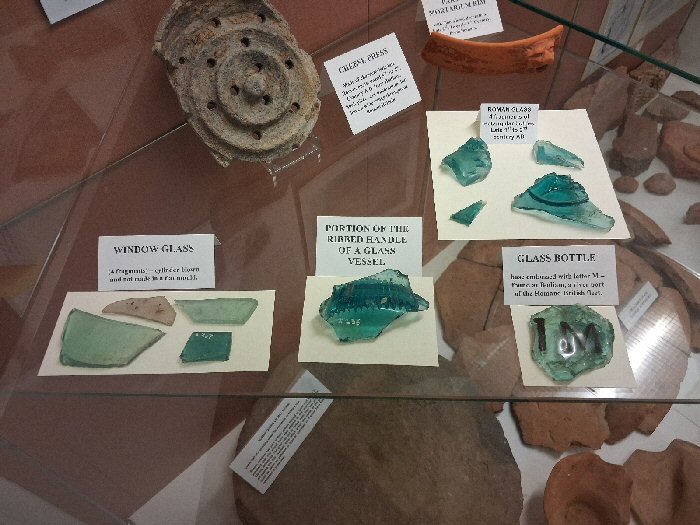 The clarity of Roman glass was not accidental and was not primarily a matter of skill. It was a direct consequence of the raw materials available at the primary production sites.
The sand used at the Eastern Mediterranean facilities, particularly from the Belus river mouth near Ptolemais on the Levantine coast, was exceptionally pure. Ancient writers including Pliny the Elder noted this specific location as the source of the finest glass sand in the known world. The grains were fine, consistent, and low in iron contamination. Iron is the principal enemy of glass clarity — even small concentrations produce the green or brown tint visible in most medieval and post-Roman glass.
Egyptian natron, used as the flux to lower the melting point of the sand, was similarly pure and chemically consistent in a way that locally gathered wood ash — the medieval substitute — could never match. Natron is a naturally occurring sodium carbonate salt harvested from dry lake beds in the Egyptian desert. It melts cleanly and introduces minimal contamination. Wood ash flux, by contrast, varies enormously in composition depending on the species burned and introduces potassium, calcium, and other minerals that cloud the finished glass and shift its colour unpredictably.
The combination of iron-poor Levantine sand and chemically stable Egyptian natron, processed at industrial scale in carefully managed tank furnaces, produced a raw glass of a purity that secondary workshops across the empire simply inherited. A glassblower in Roman Britain was working with material whose chemistry had already been optimised thousands of miles away. His medieval successor, forced to use whatever sand and ash he could find locally, was fighting the chemistry from the start.
We suggest you visit Battle Museum to see these examples of Roman and Medieval glass for yourself, please click the following link for the Museum Website Battle Museum of Local History.
|
| |
|---|
What the Medieval Period Lost ▲ |
|---|
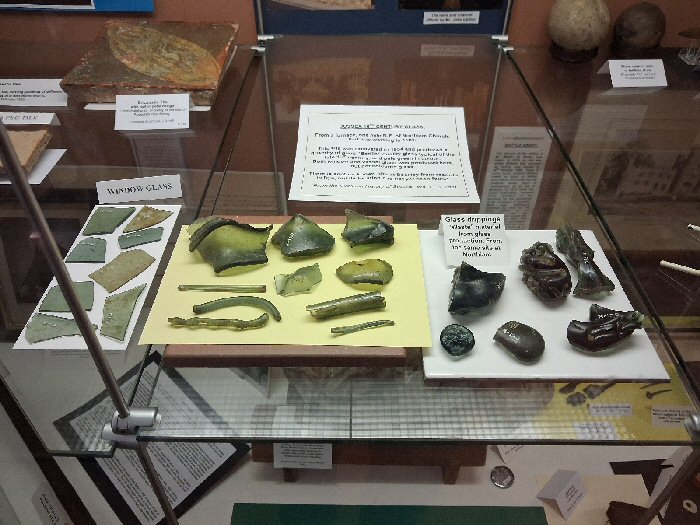 Waldglas, meaning literally "forest glass", was the dominant glassmaking tradition of medieval Northern Europe, so named because its makers were entirely dependent on woodland — both for the potash flux derived from burning beech and fern ash, and for the vast quantities of fuel needed to run their furnaces.
When the western empire collapsed, this supply chain collapsed with it. Medieval glassmakers in Northern Europe, working in the Waldglas tradition, had no access to centralised primary production and were forced to manage the entire process themselves — foraging local sand, burning their own woodland for potash flux, and blowing finished vessels all within the same small workshop. The raw materials were impure, the chemistry was compromised, and the results reflected it. The relative clarity of Roman glass in museum collections is a direct consequence of the empire's decision to treat primary glass production as a centralised industrial utility rather than a local craft.
|
| |
|---|
Conclusion ▲ |
|---|
|
The Roman glass industry is a precise small-scale model of how the empire functioned at every level. The concentration of specialist resource extraction at a few optimised locations, the separation of raw production from finished manufacture, the distribution network that carried standardised intermediate goods to local artisans across thousands of miles — these are not accidental features of the glass trade. They are the same organisational principles that built the road network, supplied the legions, and managed the iron production of the Wealden forests.
What the Waldglas tradition reveals is not a failure of medieval craft or ingenuity. Those glassmakers were often highly skilled. What they lacked was the imperial infrastructure that had quietly been doing half the work for them. When the supply chain dissolved, the true cost of Roman clarity became visible for the first time — not in the finished vessels, but in the centuries it took to rediscover what the empire had made invisible by making it routine.
|
|
;)

)
)
)
)