| The Battle of Winchelsea, 1350AD |
|---|
| Source of the Name ▲ |
|---|
|
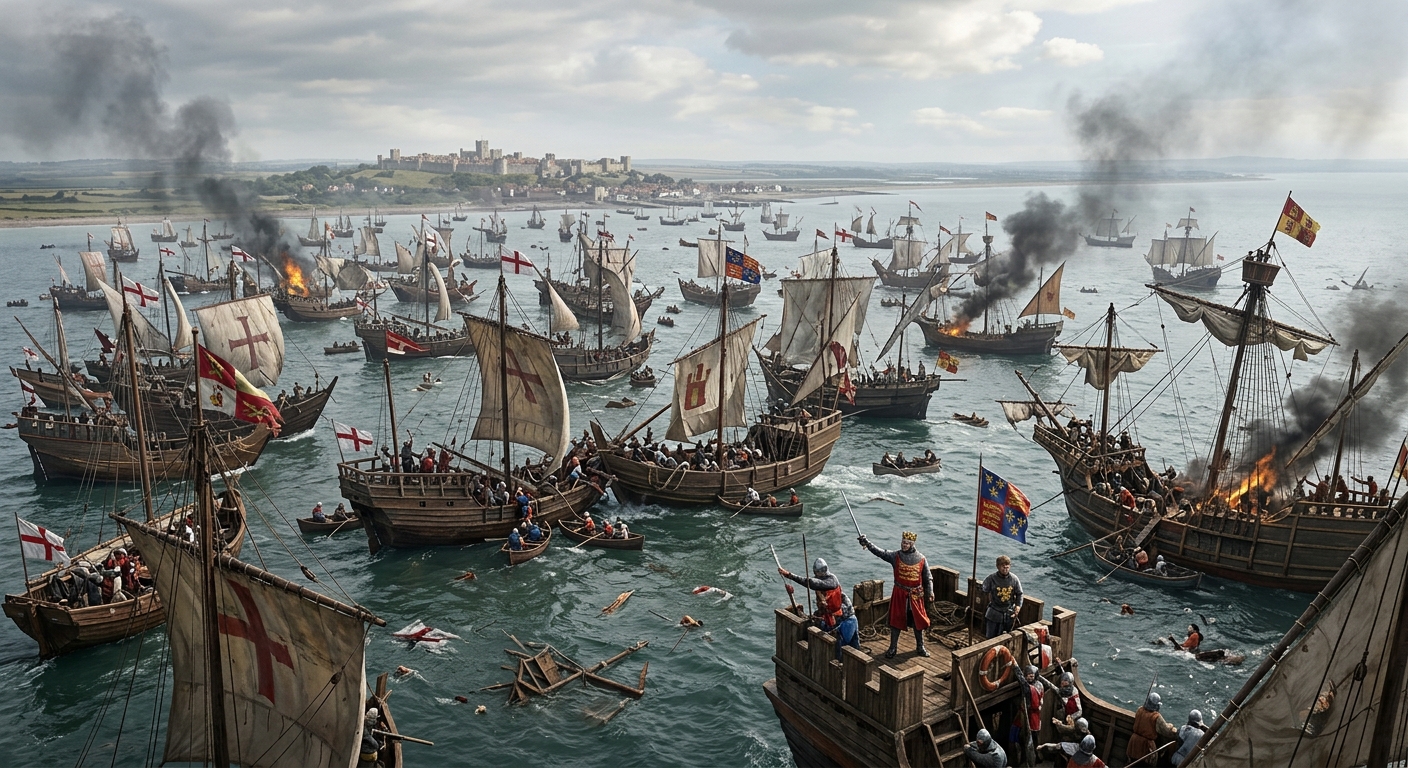
The Battle of Winchelsea — known to contemporaries as Les Espagnols sur Mer, "the Spaniards on the Sea" — was fought in the Channel off the East Sussex coast on 29 August 1350AD, during the early phase of the Hundred Years' War. An English fleet under the personal command of King Edward III, with his son Edward the Black Prince and Henry of Grosmont, Earl of Lancaster, intercepted a Castilian fleet returning from Flanders. The fighting was visible from the shore, and crowds are said to have watched from the cliffs near Winchelsea — probably the source of the battle's English name.
| | |
|---|
Background ▲ |
|---|
|
English trade and war finance depended heavily on open sea lanes to Gascony, the source of the crown's wine imports and a route for supplying troops on the continent. Castilian ships, nominally merchantmen but heavily armed, had been hired or encouraged by the French crown to harass this traffic; several English vessels were taken and their crews thrown overboard in the process, a detail repeated across the near-contemporary chronicle accounts. The Castilian fleet was commanded by Don Carlos (Charles) de la Cerda, a soldier of fortune with Castilian royal connections, who had earlier in 1350AD led a wool fleet of 47 ships from Corunna to Sluys, seizing more English shipping along the way. There the fleet wintered and unloaded its wool, taking on Flemish cloth, treasure, and other valuable cargo for the return voyage — and taking on several hundred Flemish mercenaries as well, mostly crossbowmen, drawn by the prospect of plunder. This meant the Castilian force, though fewer in ships than the English, was not necessarily fewer in fighting men. By early August 1350AD word reached Edward that the Castilian fleet had gathered at Sluys. Edward announced his intention to intercept them on their return voyage and assembled an English fleet, estimated at around fifty vessels, at Winchelsea. He travelled down accompanied by Queen Philippa and her household, and by the Black Prince; several of the kingdom's senior earls joined with their own retinues.
| | |
|---|
The English Fleet ▲ |
|---|
|
The English side is often summarised as fifty cogs, but the reality recorded in the surviving naval administration was more varied. Mobilisation began in earnest at the start of May 1350AD, when Cog Thomas was ordered to sail from Sandwich with a doubled crew of around a hundred mariners, joined there by several of the crown's other ships. Over the following months the remainder of the royal fleet gathered in from ports around the kingdom — vessels such as the Jerusalem, already at home in Winchelsea, and others arriving from London, Dartmouth, Southampton, and further afield. Of the roughly twenty-five ships in royal ownership at the time, some twenty were judged fit to take on the far larger Castilian vessels; a handful of the smallest royal ships were deliberately held back in the Thames as unsuited to the task. The fleet Edward led into battle was therefore a mixture of substantial royal cogs, impressed merchant shipping, and contributions from the Cinque Ports and other coastal towns, rather than a single uniform class of vessel — which sharpens rather than undermines the "castles to cottages" contrast with the Castilian ships, since even the largest English cogs present were still markedly outmatched in height.
| | |
|---|
The Action ▲ |
|---|
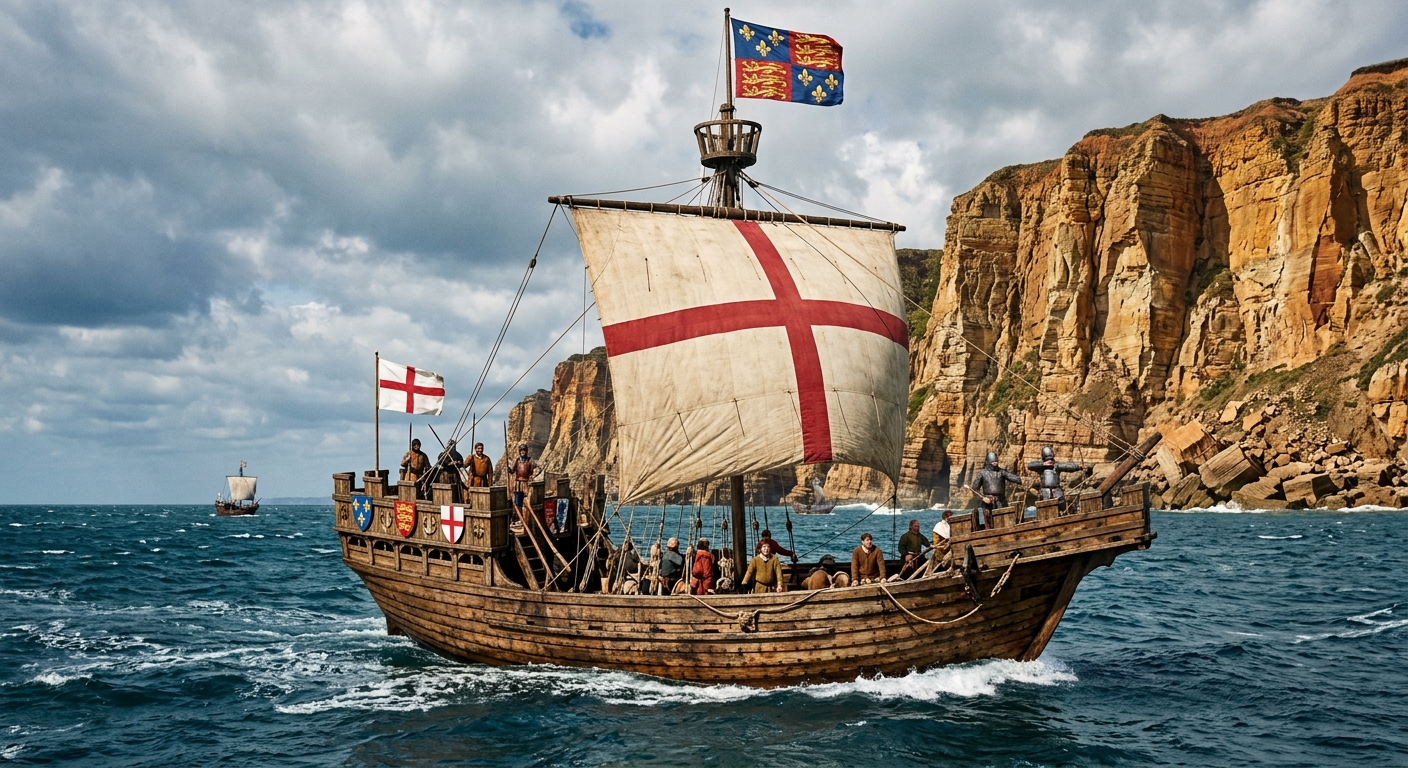
Froissart's account, drawing on men who had been present, gives a picture of the wait before battle. Edward stood on the deck of the Cog Thomas dressed in a black velvet jacket and a black beaver hat, and had his minstrels strike up a German dance that Sir John Chandos had recently brought back from abroad, keeping half an eye on the lookout posted at the masthead. Late in the afternoon of 29 August the lookout sighted the Castilian fleet and called down a count that kept climbing — the wording varies between tellings of Froissart's account, but the gist is consistent: too many ships to number confidently.
The two fleets met off Winchelsea on the afternoon of 29 August. Medieval naval combat of this kind was effectively land warfare conducted on water: ships closed, grappled together, and the fighting was decided by boarding and hand-to-hand combat rather than by manoeuvre or gunnery in the modern sense. The Castilian ships had a marked height advantage over the English cogs — "like castles to cottages," in one chronicler's phrase — which let their crossbowmen fire down onto the English decks and allowed heavy iron bars and stones to be dropped from the higher freeboard onto the ships below.
Edward's own flagship, the Cog Thomas, was disabled early in the fighting in a collision with a Castilian vessel — the chronicle tradition is not fully consistent on which ship struck which, only that the impact left Thomas taking on water. Edward and his men grappled and boarded the Castilian ship in front of them, cleared it by fighting, and transferred across just as their own ship was going down. The Black Prince's vessel suffered a near-identical fate: grappled and badly damaged under sustained fire, it was on the point of sinking when Henry of Grosmont brought his own ship alongside the Castilian and boarded from the opposite side, drawing pressure off the Prince's crew long enough for them to take the enemy vessel and escape their own sinking ship. A separate episode is recorded involving the English ship La Salle du Roi, under Sir Robert de Namur, which was being towed off by the Castilian ship grappling her until a sailor named Hannekin cut the halyards of the enemy's mainsail, bringing it down and fouling her deck long enough for the English to break free. Fighting continued until dusk.
| | |
|---|
Outcome ▲ |
|---|
|
The English took the field, in the naval sense: between fourteen and twenty-six Castilian ships were captured, with more reported sunk, against at least two English ships lost — including the king's own — and heavy casualties on both sides. Few prisoners were taken; the wounded and dead on both sides were largely thrown overboard rather than recovered, in keeping with the brutal conduct already established before the battle. The victory cleared the immediate threat to the Sussex coast and briefly gave Edward effective control of the Channel — commemorated shortly afterwards on a gold noble coin showing the king enthroned aboard ship. The relief was temporary: French and allied privateering resumed within a few years, and the Channel remained unsafe for unescorted English shipping through the following spring.
| | |
|---|
Winchelsea's Geography and the Cinque Ports ▲ |
|---|
|
The Winchelsea that Edward III sailed from in 1350AD was not the town whose ruins and grid-plan streets survive today, but a relatively young one. Old Winchelsea, which had stood on Romney Marsh closer to the sea, was destroyed in the Great Storm of February 1287AD, one of two severe storms that year to redraw this stretch of coastline. Edward I had the town rebuilt on the higher ground of the Iham ridge, on a deliberate grid plan, with a new tidal harbour served by the River Brede. This gave the rebuilt Winchelsea a working, if hedged, claim to be a functioning Channel port by the time of the 1350AD battle — a very different relationship to the sea than the town has now, sitting as it does some two miles inland behind silted marshland.
Winchelsea never became a full member of the Cinque Ports confederation, but held the status of "Antient Town" alongside Rye, a rank that carried the same core obligation as full membership: ship service to the crown in exchange for trading privileges and a measure of self-government. It is this arrangement, rather than any special naval reputation, that explains why Edward mustered his fleet at Winchelsea in particular in 1350AD — it was one of the working harbours obliged to answer the summons, and conveniently placed to intercept a fleet returning from Flanders along the Channel approaches.
The same stretch of water had served this purpose before. On 9 August 1297AD, Edward I had inspected the assembled Channel fleet in the Winchelsea anchorage close to Brede Bridge, a mile or so east of the modern village — now reclaimed farmland, but then part of the same tidal system that gave Winchelsea its harbour. By 1297AD this was already the rebuilt town on the Iham ridge, Old Winchelsea on the Marsh having been destroyed a decade earlier in the storm of 1287AD; the fifty-three years separating the 1297AD inspection from the 1350AD muster were years in which this same harbour, not two different ones, served the crown's Channel fleet. The earlier inspection is a useful marker that this reach of the Brede estuary was capable of holding a mustered Channel fleet well before Edward III's fleet gathered there.
|
|
|
;)

)
)