| Battle of Hastings 1066AD Reference - Master Wace(the Roman de Rou) |
|---|
| | |
|---|
Master Wace |
|---|
Master Wace's text
for the Battle of Hastings 1066 - le Roman de Rou (The Romance of Rollo)
Click the following link for a copy of EDGAR TAYLOR translation from 1836.
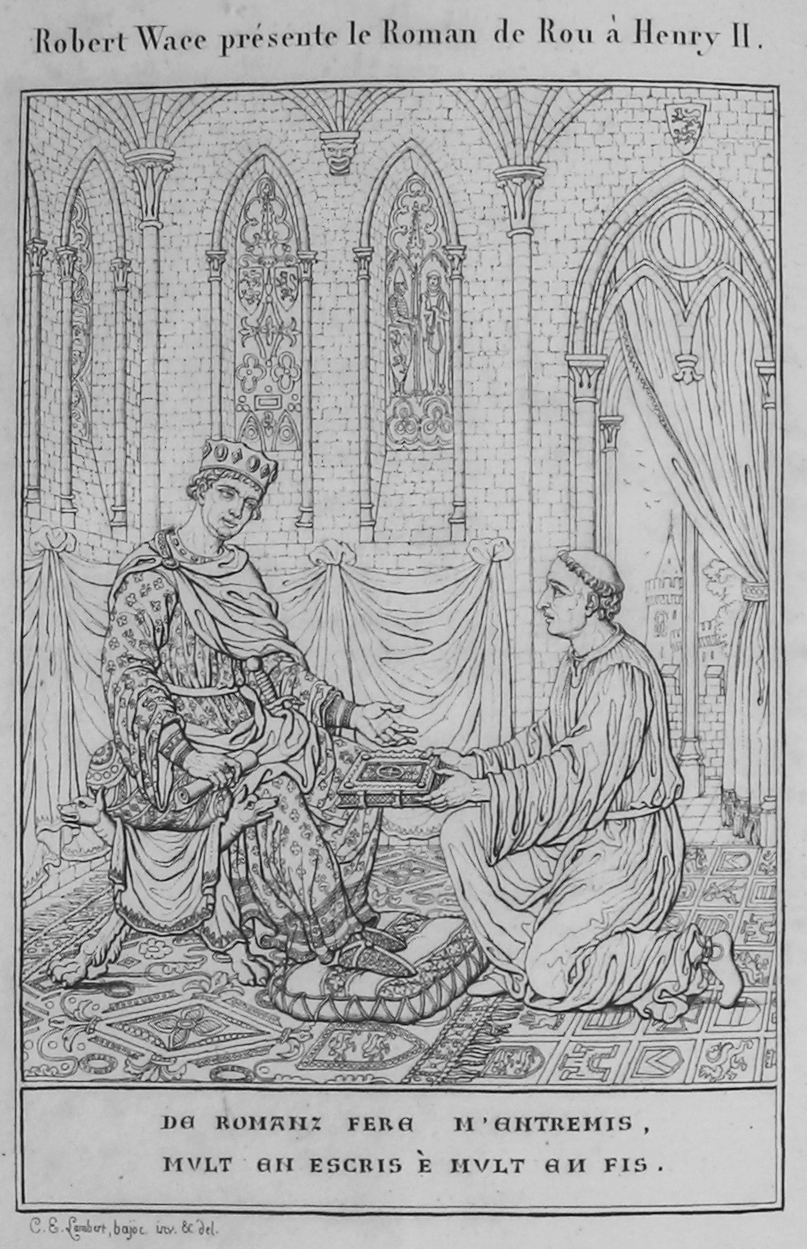
Master Wace (c. AD1099 to after AD1174), sometimes referred to as Robert Wace, was a Norman poet, who was born in Jersey and brought up in mainland Normandy, ending his career as Canon of Bayeux. All that is known of Wace's life comes from autobiographical references in his poems. He neglected to mention his birthdate; some time between 1099 and 1111 is the most commonly accepted year of his birth. (see Wikipedia).
The image to the left is from the Wikipedia article of the Roman de Rou.
|
Extract of the Roman de Rou |
|---|
I shall never put in writing, and would not undertake to set down, what barons, and how many
knights, how many vavassors, and how many soldiers the duke had in his company, when he had
collected all his navy ; but I heard my father say I remember it well, although I was but a lad that
there were seven hundred ships, less four, when they sailed from St. Valeri ; and that there were besides
these ships, boats and skiffs for the purpose of carrying the arms and harness. I have found it written
(but I know not whether it be true) that there were in all three thousand vessels bearing sails and
masts. Any one will know that there must have been a great many men to have furnished out so
many vessels.
They waited long at St. Valeri for a fair wind, and the barons were greatly wearied. Then they
prayed the convent to bring out the shrine of St. Valeri, and set it on a carpet in the plain ; and all
came praying the holy reliques, that they might be allowed to pass over sea. They offered so much money,
that the reliques were buried beneath it ; and from that day forth, they had good weather and a
fair wind. The duke placed a lantern on the mast of his ship, that the other ships might see it, and
hold their course after it. At the summit was a vane of brass, gilt. On the head of the ship, in the front,
which mariners call the prow, there was the figure of a child in brass, bearing an arrow with a bended
bow. His face was turned towards England, and thither he looked, as though he was about to shoot;
so that whichever way the ship went, he seemed to aim onwards.
Of so large a fleet with so many people, only two ships were in any peril, and those perhaps from being
overloaded. The duke had a great chivalry in his ships ; and besides these, he had many archers
and Serjeants, many brave men and warriors, carpenters and engineers, good smiths and other handicraftsmen.
The ships steered to one port; all arrived and reached the shore together ; together cast anchor,
and ran on dry land ; and together they discharged themselves. They arrived near Hastings, and there
each ship ranged by the other's side. There you might see the good sailors, the Serjeants and squires
sally forth and unload the ships ; cast the anchors, haul the ropes, bear out shields and saddles, and
land the warhorses and palfreys. The archers came forth, and touched land the foremost; each with his
bow bent, and his quiver full of arrows slung at his side. All were shaven and shorn, and all clad in
short garments, ready to attack, to shoot, to wheel about and skirmish. All stood well equipped, and
of good courage for the fight ; and they scoured the whole shore, but found not an armed man there.
After the archers had thus gone forth, the knights landed next, all armed; with their hauberks on, their
shields slung at their necks, and their helmets laced. They formed together on the shore, each armed up
on his warhorse. All had their swords girded on, and passed into the plain with their lances raised.
The barons had gonfanons, and the knights pennons. They occupied the advanced ground, next
to where the archers had fixed themselves. The carpenters, who came after, had great axes in their
hands, and planes and adzes hung at their sides. When they had reached the spot where the archers
stood, and the knights were assembled, they consulted together, and sought for a good spot to place
a strong fort upon. Then they cast out of the ships the materials, and drew them to land, all shaped
framed and pierced to receive the pins which they had brought, cut and ready in large barrels ; so that
before evening had well set in, they had finished a fort. Then you might see them make their kitchens,
light their fires, and cook their meat. The duke sat down to eat, and the barons and knights had
food in plenty; for he had brought ample store. All ate and drank enough, and were right glad that they
were ashore.
Before the duke left the Somme,a clerk had come to him, who knew, he said, astronomy and necromancy, and
held himself a good diviner, and predicted many things. So he divined for the duke,
and predicted that he should pass the sea safely, and succeed in his expedition, without fighting at
all; for that Harold would make such promises, and come to such terms, that he would hold the land of
the duke, and become his liegeman, and so William would return in safety. As to the good passage, he
predicted right enough ; but as to not fighting, he lied. When the duke had crossed, and arrived safely,
he remembered the prediction, and inquired for the diviner. But one of the sailors said he had miscarried
and was drowned at sea, being in one of the lost ships. ' Little matters it,' said the duke; ' no
great deal could he have known. A poor diviner indeed must he be about me, who could predict
nought about himself. If the things to come were known to him, he might well have foreseen his own
death ; foolish is he who trusts in a diviner, who takes heed for others but forgets himself; who knows
the end of other men's work, and can not discern the term of his own life.' Such was the end of the diviner.
The fame of the Norman duke soon went forth through many lands; how he meant to cross the sea
against Harold, who had taken England from him. Then soldiers came flocking to him, one by one, two
by two, and four by four ; by fives and sixes, sevens and eights, nines and tens ; and he retained them
all, giving them much and promising more. Many came by agreement made with them beforehand ;
many bargained for lands, if they should win England ; some required pay, allowances and gifts ; and
the duke was often obliged to give at once to those who could not wait the result.
The first day they held their course along the seashore ; and on the morrow came to a castle called
Penevesel. The squires and foragers, and those who looked out for booty, seized all the clothing
and provisions they could find, lest what had been brought by the ships should fail them ; and the
English were to be seen fleeing before them, driving off their cattle, and quitting their houses. All
took shelter in the cemeteries, and even there they were in grievous alarm.
A KNIGHT of that country heard the noise and cry made by the peasants and villeins when they saw
the great fleet arrive. He well knew that the Normans were come, and that their object was to seize
the land. He posted himself behind a hill, so that they should not see him, and tarried there, watching
the arrival of the great fleet. He saw the archers come forth from the ships, and the knights follow.
He saw the carpenters with their axes, and the host of people and troops. He saw the men throw the
materials for the fort out of the ships. He saw them build up and enclose the fort, and dig the fosse
around it. He saw them land the shields and armour. And as he beheld all this, his spirit was
troubled ; and he girt his sword and took his lance, saying he would go straightway to king Harold, and
tell the news. Forthwith he set out on his way, resting late and rising early; and thus he journeyed on
by night and by day to seek Harold his lord.
He found him beyond the Humber, in a town where he had just dined. Harold carried himself
very loftily, for he had been beyond Humber, and had had great success in overcoming Tosti. Tosti
was Harold's brother ; but unfortunately they had become enemies, and Tosti had sent his friends to
Harold, calling upon him to give him his father's fief, now that it had fallen out, that, right or wrong,
he had become king; and requiring him to let him have the lands their father held by inheritance; and
he promised on this being done to ask no more; but to become his man, and acknowledge him for lord,
and serve him as well as he did King Edward.
But Harold would not agree to this ; he would neither give nor exchange ought with him ; so Tosti
became very wroth, and crossed over to Denmark, and brought with him Danes and Norwegians, and
landed over against Eurowick. When Harold learnt the news, he made himself ready, and set out against
Tosti, and fought with and conquered him and his troops. Tosti was killed near Pontfrait, and his
army besides suffered great loss. Then Harold set out on his return from Pontfrait, and glorified him
self exceedingly. But foolish is he who glorifies himself, for good fortune soon passeth away ; bad
news swiftly comes ; soon may he die himself who has slain others; and the heart of man often rejoiceth
when his ruin is nigh.
Harold returned rejoicing and triumphing, bearing himself right proudly, when news met him that
put other thoughts in his mind ; for lo ! the knight is come who set out from Hastings. ' The Normans,'
he cried, ' are come ! they have landed at Hastings ! thy land will they wrest from thee, if
thou canst not defend thyself well ; they have enclosed a fort, and strengthened it round about with
palisades and a fosse.'
'Sorry am I,' said Harold, 'that I was not there at their arrival. It is a sad mischance; I had better
have given what Tosti asked, so that I had been at the port when William reached the coast, and had
disputed his landing ; we might then have driven so many into the sea that they would never have
made good their landing, nor have touched ought of ours : neither would they have missed death on
land, if they had escaped the dangers of the sea. But thus it hath pleased the heavenly king; and
I could not be every where at once.'
There was a baron of the land I do not know his name who had loved the duke well, and was in
secret council with him, and desired, so far as he was able, that no harm should befall him. This
baron sent word to him privily, that he was too weak ; that he had come with too little force, as it seemed
to him, to do what he had undertaken ; for that there were so many men in England, that it would be very
hard to conquer. So he counselled him in good faith, and in true love, to leave the country and go home
to his own land before Harold should arrive ; for he feared lest he should miscarry, and he should grieve
much, he said, if any misfortune should befall him. The duke answered briefly, that he saw no reason
for doubt ; that he might rely upon it, if he had but ten thousand of as noble knights as those of whom
he had sixty thousand or more, he would still fight it out. Yea, he said, he would never go back till
he had taken vengeance on Harold.
Harold came full speed to London, ordering that from every part of England all should come forthwith,
fully equipped, by a time appointed them, without allowing any excuse except sickness. He
would have challenged the duke, and at once fixed a day for the battle, but he waited till his great baronage
should come together : and they came in haste on receiving the summons.
The duke soon heard that Harold was assembling a great host, and that he was come to London from
the north, where he had killed his brother Tosti.
Then he sent for Huon Margot , a tonsured monk
of Fescamp ; and as he was a learned man,well known, and much valued, the duke despatched him to Harold.
And Margot set out on his way, and finding Harold at London, spoke to him thus :
'Harold ! hearken to me! I am a messenger, hear ye from whom ! The duke tells thee, by my mouth,
that thou hast too soon forgotten the oath, which thou didst but lately take to him in Normandy, and
that thou hast forsworn thyself. Repair the wrong, and restore him the crown and lordship, which are not
thine by ancestry ; for thou art neither king by heritage, nor through any man of thy lineage. King
Edward of his free will and power, gave his land and realm to his best kinsman William. He gave
this gift as he had a right to do, to the best man he had. He gave it in full health before his death, and
if he did wrong, thou didst not forbid it; nay, thou didst assent, and warrant and swear to maintain it.
Deliver him his land ; do justice, lest greater damage befall thee. No such hosts can assemble as thou
and he must combat with, without great cost and heavy loss ; and thus there will be mischief to both
sides. Restore the kingdom that thou hast seized ! woe betide thee if thou shalt endeavour to hold it!'
Harold was exceedingly proud, and it is said that he had sometimes fits of madness. He was enraged
at the words with which Margot had menaced him; and it is thought he would have ill used him, had
not Gurth his brother sprung forth and stood between them, and sent Huon Margot away ; and he
went forth without taking leave, not choosing to stay longer, and neither said nor did any thing more
concerning the matter he came about, but returned to duke William, and told him how Harold had insulted him.
Then Harold chose a messenger who knew the language of France, and sent him to duke William,
charging him with these words ; ' Say to the duke that I desire he will not remind me of my covenant
nor of my oath ; if I ever foolishly made it and promised him any thing, I did it for my liberty. I swore
in order to get my freedom ; whatever he asked I agreed to ; and I ought not to be reproached, for I
did nothing of my own free will. The strength was all on his side, and I feared that unless I did his
pleasure, I should never return, but should have remained there for ever. If I have done him any
wrong, I will make him recompense. If he want any of my wealth, I will give it according to my ability.
I will refit all his ships, and give them safe conduct; but if he refuse this offer, tell him for a truth, that
if he wait for me so long, I will on Saturday seek him out, and on that day will do battle with him.'
The messenger hastened to the duke, and on the part of king Harold, told him that if he would re
turn to his own land, and free England of his presence, he should have safe conduct for the purpose ;
and if money was his object, he should have as much gold and silver as should supply the wants of
all his host.
Duke William replied, 'Thanks for his fair words! I am not come into this country with so many escus,
to change them for his esterlins ; but I am come that I may have all his land, according to his oath, and
the gift of king Edward, who delivered me two youths of gentle lineage as hostages ; the one the
son, the other the nephew of Godwin. I have them still in my keeping, and keep them I will, if I can,
till I have right done unto me.'
Then the messenger replied, ' Sire, you ask too much of us, far too much of my lord ; you would
rob him of his honour and fair name, requiring him to deliver up his kingdom, as if he dared not defend
it. All is still safe, and in good order with us; there is no weakness or decay in his force. He is not so
pressed by the war, as that he should give up his land to you ; neither is it very agreeable that, because you
wish for his kingdom, he should at once abandon it to you. Harold will not give you what you cannot
take from him; but in good will, and as a matter of favour, and without fear of your threats, he will give
you as much as you desire of gold and silver, money and fine garments : and thus you may return
to your country before any affray happen between you. If you will not accept this offer, know this,
that if you abide his coming, he will be ready in the field on Saturday next, and on that day he will
fight with you.'
The duke accepted this appointment, and the messenger took his leave; but when he proposed to go,
the duke gave him a horse and garments : and when he came back to Harold thus arrayed, he shewed all
that the duke had given him, and told how he had been honoured, and all that had passed ; and Harold
repented much that he had done otherwise by Huon Margot.
WHILST Harold and William communicated in this way by messengers, clerks and knights, the English
assembled at London. When they were about to set out thence, I have heard tell that Gurth, one of
Harold's brothers, reasoned thus with him. ' Fair brother, remain here, but give me your
troops ; I will take the adventure upon me, and will fight William l . I have no covenant with him, by
oath or pledge ; I am in no fealty to him, nor do I owe him my faith. It may chance that there will
be no need to come to blows ; but I fear that if you fight, you will pay the penalty of perjury, seeing you
must forswear yourself; and he who has the right will win. But if I am conquered and taken prisoner,
you, if God please, being alive, may still assemble your troops, and fight or come to such an arrange
ment with the duke, that you may hold your kingdom in peace. Whilst I go and fight the Normans,
do you scour the country, burn the houses, destroy the villages, and carry off all stores and provisions,
swine and goats and cattle ; that they may find no food, nor any thing whatever to subsist upon. Thus
you may alarm and drive them back, for the duke must return to his own country if provisions for his
army shall fail him.'
But Harold refused, and said that Gurth should not go against the duke and fight without him; and
that he would not burn houses and villages, neither would he plunder his people. ' How,' said he, ' can
I injure the people I should govern ? I cannot destroy or harass those who ought to prosper under me.
However all agreed that Gurth's advice was good, and wished him to follow it ; but Harold, to shew
his great courage, swore that they should not go to the field or fight without him. Men, he said, would
hold him a coward, and many would blame him for sending his best friends where he dared not go him
self. So he would not be detained, but set out from London, leading his men forward armed for the fight,
till he erected his standard and fixed his gonfanon right where THE ABBEY OF THE BATTLE is now
built. There he said he would defend himself against whoever should seek him ; and he had the
place well examined, and surrounded it by a good fosse, leaving an entrance on each of three sides,
which were ordered to be all well guarded.
The Normans kept watch and remained through out the night in arms, and on their guard ; for they
were told that the English meant to advance and attack them that night. The English also feared
that the Normans might attack them in the dark ; so each kept guard the whole night, the one watching
the other.
At break of day in the morning, Harold rose and Gurth with him. Noble chiefs were they both. Two
warhorses were brought for them, and they issued forth from their entrenchment. They took with them
no knight, varlet on foot, nor squire ; and neither of them bore other arms than shield, lance and
sword; their object being to reconnoitre the Normans, and to know where and how they were posted.
They rode on, viewing and examining the ground, till from a hill where they stood they could see
those of the Norman host, who were near. They saw a great many huts made of branches of trees, tents
well equipped, pavilions and gonfanons ; and they heard horses neighing, and beheld the glittering of
armour. They stood a long while without speaking; nor do I know what they did, or what they said, or
what counsel they held together there ; but on their return to their tent Harold spoke first.
' Brother/' said he, ' yonder are many people, and the Normans are very good knights, and well
used to bear arms. What say you ? what do you advise ? With so great a host against us, I dare
not do otherwise than fall back upon London : I will return thither and assemble a larger army.'
' Harold !' said Gurth, ' thou base coward ! This counsel has come too late ; it is of no use now to
flinch, we must move onward. Base coward! when I advised you, and got the barons also to beseech
you, to remain at London and let me fight, you would not listen to us, and now you must take the
consequence. You would take no heed of any thing we could say ; you believed not me or any one else;
now you are willing, but I will not. You have lost your pride too soon ; quickly indeed has what you
have seen abated your courage. If you should turn back now, every one would say that you ran away.
If men see you flee, who is to keep your people to gether ? and if they once disperse, they will never
be brought to assemble together again.'
Thus Harold and Gurth disputed, till their words grew angry, and Gurth would have struck his bro
ther, had he not spurred his horse on, so that the blow missed, and struck the horse behind the sad
dle, glancing along Harold's shield. Had it gone aright, it would have felled him to the ground.
Gurth thus vented his humour, charging his brother with cowardice ; but they galloped on to the
tents, and shewed no sign of their dispute, neither let any ill will appear between them, when they saw
their people coming. Lewine, Harold's next brother after Gurth, had also arisen early, and gone to
Harold's tent ; and when he found not his two brothers where he left them over night, he thought he
should see them no more. ' By Heaven,' cried he, 'they have been taken and delivered to their ene
mies ;' for he thought they must either have been killed, or betrayed to the Normans; and he ran forth
like a madman, shouting and crying out as if he had lost his senses. But when he learned where they
were, and that they had gone out to reconnoitre the Normans, he and his companions, and the earls and
barons, mounted quickly upon their horses, and set out from the tents; when behold ! they met the bro
thers. The barons took it ill that they went so imprudently, and without any guard; but all turned
back to the tents, and prepared for battle.
When they came in front of the enemy, the sight alarmed them grievously; and Harold sent forth two
spies to reconnoitre the opposite troops, and see what barons and armed men the duke had brought with
him. As they drew near to his army, they were observed, and being taken before William, were sore
afraid. But when he learnt what was their errand, and that they wanted to estimate his strength, he
had them taken through all the tents, and shewed the whole host to them. Then he used them exceeding well, gave
them abundantly to eat and drink, and let them go without injury or molestation.
When they returned to their lord, they spoke very honourably of the duke; and one of them, who had
seen that the Normans were so close shaven and cropt, that they had not even moustaches, supposed
he had seen priests and mass-sayers; and he told Harold that the duke had more priests with him
than knights or other people. But Harold replied, 'Those are valiant knights, bold and brave warriors,
though they bear not beards or moustaches as we do.'
THEN the duke chose a messenger, a monk learned and wise, well instructed and experienced, and sent
him to king Harold. He gave him his choice, to take which he would of three things. He should
either resign England and take his daughter to wife; or submit to the good judgment of the apostle and
his people ; or meet him singly and fight body to body on the terms that he who killed the other,
or could conquer and take him prisoner, should have England in peace, nobody else suffering. Harold
said he would do neither; he would neither perform his covenant, nor put the matter in judgment, nor
would he meet him and fight body to body.
Before the day of the battle, which was now become certain, the duke of his great courage told his ba
rons, that he would himself speak with Harold; and summon him with his own mouth to render up what
he had defrauded him of, and see what he would answer ; that he would appeal him of perjury, and
summon him on his pledged faith ; and if he would not submit, and make reparation forthwith, he would
straightway defy, and fight him on the morrow ; but that if he yielded, he would, with the consent of his
council, give up to him all beyond the Humber towards Scotland.
The barons approved this, and some said to him, ' Fair sir, one thing we wish to say to you ; if we
must fight, let us fight promptly, and let there be no delay. Delay may be to our injury, for we have
nothing to wait for, but Harold's people increase daily; they come strengthening his army con
stantly with fresh forces.' The duke said this was true, and he promised them that there should be no
more delay.
Then he made a score of knights mount upon their war-horses. All had their swords girt, and their
other arms were borne by the squires who went with them. A hundred other knights mounted next, and
went riding after them, but at a little distance; and then a thousand knights also mounted and followed
the hundred, but only so near as to see what the hundred and the twenty did.
The duke then sent to Harold, whether by monk or abbot I know not, and desired him to come into
the field, and speak with him, and to fear nothing, but bring with him whom he would, that they might
talk of an arrangement. But Gurth did not wait for Harold's answer, and neither let him speak, nor
go to talk with the duke ; for he instantly sprang up on his feet, and said to the messenger, ' Harold
will not go ! tell your lord to send his message to us hither, and let us know what he will take, and
what he will leave, or what other arrangement he is willing: to make.
Whilst the messenger returned to carry this answer, Harold called together his friends and his earls,
all by their names, to hear what message the duke would send back. And he sent word to Harold, that
if he would abide by his covenant, he would give him all Northumberland, and whatever belonged to
the kingdom beyond Humber ; and would also give to his brother Gurth the lands of Godwin their fa
ther. And if he refused this, he challenged him for perjury in not delivering up the kingdom, and not
taking his daughter to wife, as he ought : in all this he had lied and broken faith ; and unless he made
reparation he defied him. And he desired the English should know and take notice, that all who came
with Harold, or supported him in this affair, were excommunicated by the apostle and the clergy. At
this excommunication the English were much troubled; they feared it greatly, and the battle still
more. And much murmuring was to be heard on all hands, and consulting one with the other ; none
was so brave, but that he wished the battle might be prevented.
' Seignors,' said Gurth, ' I know and see that you are in great alarm ; that you fear the event of
the battle, and desire an arrangement : and so do I as much, and in truth more, I believe ; but I have
also great fear of duke William, who is very full of treachery. You have heard what he says, and how
low he rates us, and how he will only give us what he likes of a land which is not his yet. If we take
what he offers, and go beyond the H umber, he will not long leave us even that, but will push us yet
further. He will always keep his eye upon us, and bring us to ruin in the end. When he has got the
uppermost, and has the best of the land, he will leave little for us, and will soon try to take it all. He
wants to cheat us into taking instead of a rich country, a poor portion of one, and presently he will have
even that. I have another fear, which is more on your than on my own account, for I think I could
easily secure myself. He has given away all your lands to knights of other countries. There is neither
earl nor baron to whom he has not made some rich present : there is no earldom, barony, nor chatelainie,
which he has not given away : and I tell you for a truth, that he has already taken homage
from many, for your inheritances which he has given them. They will chase you from your lands, and
still worse, will kill you. They will pillage your vassals, and ruin your sons and daughters: they do not
come merely for your goods, but utterly to ruin you and your heirs. Defend yourselves then and your
children, and all that belong to you, while you may. My brother hath never given away, nor agreed to
give away the great fiefs, the honors, or lands of your ancestors ; but earls have remained earls, and
barons enjoyed their rights ; the sons have had their lands and fiefs after their fathers' deaths : and you
know this to be true which I tell you, that peace was never disturbed. We may let things remain
thus if we will, and it is best for us so to determine. But if you lose your houses, your manors, demesnes,
arid other possessions, where you have been nourished all your lives, what will you become, and
what will you do? Into what country will you flee, and what will become of your kindred, your wives
and children ? In what land will they go begging, and where shall they seek an abode ? When they
thus lose their own honour, how shall they seek it of others?'
By these words of Gurth, and by others which were said at his instance, and by pledges from Ha
rold to add to the fiefs of the barons, and by his promises of things which were then out of his power
to give, the English were aroused, and swore by God, and cried out, that the Normans had come on
an evil day, and had embarked on a foolish matter. Those who had lately desired peace, and feared the
battle, now carried themselves boldly, and were eager to fight ; and Gurth had so excited the council,
that no man who had talked of peace would have been listened to, but would have been reproved by
the most powerful there.
THE duke and his men tried no further negotiation, but returned to their tents, sure of fighting on the
morrow. Then men were to be seen on every side straightening lances, fitting hauberks and helmets ;
making ready the saddles and stirrups; filling the quivers, stringing the bows, and making all ready
for the battle.
I have heard tell that the night before the day of battle, the English were very merry, laughing
much and enjoying themselves. All night they ate and drank, and never lay down on their beds. They
might be seen carousing, gambolling and dancing, and singing; BUBLIE() they cried, and WEISSEL(wæs hæle - to be healthy), and
LATICOME(læt æc macung - all to action) and DRINCHEHEIL(drinc hal - good health), DRINC-HINDRE-WART(drinc) and DRINTOME(drinc to me), DRINC-HELF(drinc hal - good health), and DRINC-TOME(drinc to me).
Thus they bemeaned themselves; but the Normans and French betook themselves all night
to their orisons, and were in very serious mood. They made confession of their sins, and accused
themselves to the priests; and whoso had no priest near him, confessed himself to his neighbour.
The day on which the battle was to take place being Saturday, the Normans, by the advice of the
priests, vowed that they would nevermore while they lived eat flesh on that day. Giffrei, bishop of Cou
tanes, received confessions, and gave benedictions, and imposed penances on many ; and so did the
bishop of Bayeux, who carried himself very nobly.He was bishop of the Bessin, Odes by name, the son
of Herluin, and brother of the duke on the mother's side. He brought to his brother a great body of
knights and other men, being very rich in gold and silver.
On the fourteenth day of October was fought the battle whereof I am about to tell you.
The priests had watched all night, and besought and called on God, and prayed to him in their cha
pels which were fitted up throughout the host. They offered and vowed fasts, penances, and orisons; they
said psalms and misereres, litanies andkyriels ; they cried on God, and for his mercy, and said pater
nosters and masses; some the SPIRITUS DOMINI, others SALUS POPULI, and many SALVE SANCTE
PARENS, being suited to the season, as belonging to that day, which was Saturday. And when the
masses were sung, which were finished betimes in the morning, all the barons assembled and came to
the duke, and it was arranged they should form three divisions, so as to make the attack in three places.
The duke stood on a hill, where he could best see his men ; the barons surrounded him, and he
spoke to them proudly :' Much ought I,' said he, ' to love you all, and much should I confide in you;
I thank you who have crossed the sea for me, and have come with me into this land. It grieves me
that I cannot now render such thanks as are due to you, but when I can I will, and what I have shall
be yours. If I conquer, you will conquer. If I win lands, you shall have lands ; for I say most truly
that I am not come merely to take for myself what I claim, but to punish the felonies, treasons, and
falsehoods which the men of this country have always done and said to our people. They have done much
ill to our kindred, as well as to other people, for they do all the treason and mischief they can. On
the night of the feast of St. Brigun, they committed horrible treachery ; they slew all the Danes in one
day ; they had eaten with them, and then slew them in their sleep ; no fouler crime was ever heard
of than in this manner to kill the people who trusted in them.
' You have all heard of Alfred, and how Godwin betrayed him ; he saluted and kissed him, ate
and drank with him; then betrayed, seized and bound him, and delivered him to the felon king, who
confined him in the Isle of Eli, tore out his eyes, and afterwards killed him. He had the men of Normandy
also brought to Gedefort, and decimated them ; and when the tenth was set apart, hear what
felony they committed! they decimated that tenth once more, because it appeared too many to save.
These felonies, and many other which they have done to our ancestors, and to our friends who demeaned
themselves honourably, we will revenge on them, if God so please. When we have conquered
them, we will take their gold and silver, and the wealth of which they have plenty, and their manors,
which are rich. We shall certainly easily conquer them, for in all the world there is not so brave an
army, neither such proved men and vassals, as are here assembled.'
Then they began to cry out, ' You will not see one coward ; none here will fear to die for love of
you, if need be.'
And he answered them, ' I thank you well. For God's sake spare not; strike hard at the beginning;
stay not to take spoil; all the booty shall be in common, and there will be plenty for every one. There
will be no safety in peace or flight ; the English will never love or spare Normans. Felons they were and
are ; false they were and false they will be. Shew no weakness towards them, for they will have no
pity on you ; neither the coward for his flight, nor the bold man for his strokes, will be the better liked
by the English, nor will any be the more spared on that account. You may fly to the sea, but you can
fly no further ; you will find neither ship nor bridge there ; there will be no sailors to receive you ; and
the English will overtake you and kill you in your shame. More of you will die in flight than in battle;
flight, therefore, will not secure you; but fight, and you will conquer. I have no doubt of the victory ;
we are come for glory, the victory is in our hands, and we may make sure of obtaining it if we
so please.'
As the duke said this, and would have said yet more, William Fitz Osber rode up, his horse being
all coated with iron; ' Sire/' said he to his lord, ' we tarry here too long, let us all arm ourselves.
'Allons! allons!'
Then all went to their tents and armed themselves as they best might ; and the duke was very busy,
giving every one his orders ; and he was courteous to all the vassals, giving away many arms and horses
to them.
When he prepared to arm himself, he called first for his good hauberk, and a man brought it on his
arm, and placed before him; but in putting his head in, to get it on, he inadvertently turned it the wrong
way, with the back part in front. He quickly changed it, but, when he saw that those who stood by
were sorely alarmed, he said, ' I have seen many a man who, if such a thing had happened to him,
would not have borne arms, or entered the field the same day ; but I never believed in omens, and I
never will. I trust in God ; for he does in all things his pleasure, and ordains what is to come to pass,
according to his will. I have never liked fortune tellers, nor believed in diviners; but I commend my
self to our Lady. Let not this mischance give you trouble. The hauberk which was turned wrong, and
then set right by me, signifies that a change will arise out of the matter we are now moving. You
shall see the name of duke changed into king. Yea, a king shall I be, who hitherto have been but duke.'
Then he crossed himself, and straightway took his hauberk, stooped his head, and put it on aright;
and laced his helmet and girt his sword, which a varlet brought him.
THEN the duke called for his good horse; a better could not be found. It had been sent him by a king
of Spain as a token of friendship l . Neither arms nor throng did it fear, when its lord spurred on.
Galtier Giffart, who had been to St. Jago, brought it. The duke stretched out his hand, took the reins,
put foot in stirrup and mounted; and the good horse pawed, pranced, reared himself up, and curvetted.
The viscount of Toarz saw how the duke bore himself in arms, and said to his people that were around
him, ' Never have I seen a man so fairly armed, nor one who rode so gallantly, or bore his arms, or
became his hauberk so well ; neither any one who bore his lance so gracefully, or sat his horse and
manoeuvred him so nobly. There is no other such knight under heaven ! a fair count he is, and fair king
he will be. Let him fight and he shall overcome ; shame be to him who shall fail him '
The duke called for horses, and had several led out to him; each had a good sword hanging at the
saddlebow, and those who led the horses bore lances. Then the barons armed themselves, the knights and
the lancemen; and the whole were divided into three companies ; each company having many lords
and captains appointed to them, that there might be no cowardice, or fear of loss of member or life.
The duke called a serving man, and ordered him to bring forth the gonfanon which the pope had sent
him ; and he who bore it having unfolded it, the duke took it, reared it, and called to Raol de Conches;
' Bear my gonfanon,' said he, ' for I would not but do you right ; by right and by ancestry your line
are standard bearers of Normandy, and very good knights have they all been.' 'Many thanks to
you,' said Raol, 'for acknowledging our right; but by my faith, the gonfanon shall not this day be borne
by me. To-day I claim quittance of the service, for I would serve you in other guise. I will go with
you into the battle, and will fight the English as long as life shall last, and know that my hand will
be worth any twenty of such men.'
Then the duke turned another way, and called to him Galtier Giffart. ' Do thou take this gonfa
non,' said he, 'and bear it in the battle.' But Galtier Giffart answered, ' Sire, for God's mercy look
at my white and bald head ; my strength has fallen away, and my breath become shorter. The standard
should be borne by one who can endure long labour ; I shall be in the battle, and you have not
any man who will serve you more truly ; I will strike with my sword till it shall be died in your enemies
blood
Then the duke said fiercely, ' By the splendour of God, my lords, I think you mean to betray and
fail me in this great need.' ' Sire,' said Giffart, ' not so ! we have done no treason, nor do I refuse
from any felony towards you ; but I have to lead a great chivalry, both soldiers and the men of my fief.
Never had I such good means of serving you as I now have ; and if God please, I will serve you : if
need be, I will die for you, and will give my own heart for yours.'
'By my faith,' quoth the duke, 'I always loved thee, and now I love thee more ; if I survive this
day, thou shalt be the better for it all thy days.' Then he called out a knight, whom he had heard
much praised, Tosteins Fitz Rou le blanc, by name, whose abode was at Bec-en-Caux T . To him
he delivered the gonfanon; and Tosteins took it right cheerfully, and bowed low to him in thanks, and
bore it gallantly, and with good heart. His kindred still have quittance of all service for their inheritance
on that account, and their heirs are entitled so to hold their inheritance for ever.
William sat on his warhorse, and called out Rogier, whom they call de Montgomeri. ' I rely
much on you,' said he ; 'lead your men thitherward, and attack them from that side. William, the son
of Osber, the seneschal, a right good vassal, shall go with you and help in the attack, and you shall
have the men of Boilogne and Poix, and all my soldiers. Alain Fergant and Aimeri shall attack
on the other side; they shall lead the Poitevins and the Bretons, and all the barons of Maine ; and I
with my own great men, my friends and kindred, will fight in the middle throng, where the battle
shall be the hottest.'
The barons and knights and lancemen were all now armed ; the men on foot were well equipped,
each bearing bow and sword : on their heads were caps, and to their feet were bound buskins.
Some had good hides which they had bound round their bodies ; and many were clad in frocks, and
had quivers and bows hung to their girdles. The knights had hauberks and swords, boots of steel and
shining helmets ; shields at their necks, and in their hands lances. And all had their cognizances, so
that each might know his fellow, and Norman might not strike Norman, nor Frenchman kill his country
man by mistake. Those on foot led the way, with serried ranks, bearing their bows. The knights rode
next, supporting the archers from behind. Thus both horse and foot kept their course and order of
march as they began ; in close ranks at a gentle pace, that the one might not pass or separate from the
other. All went firmly and compactly, bearing themselves gallantly; and in each host stood archers
ready to exchange shots.
HAROLD had summoned his men, earls, barons, and vavassors, from the castles and the cities ; from the
ports, the villages, and boroughs. The villeins were also called together from the villages, bearing such
arms as they found ; clubs and great picks, iron forks and stakes. The English had enclosed the
field where Harold was with his friends, and the barons of the country whom he had summoned and
called together. Those of London had come at once, and those of Kent, of Herfort, and of Essesse ; those
of Suree and Sussesse, of St. Edmund and Sufoc; of Norwis and Norfoc ; of Cantorbierre and Stanfort ;
Bedefort and Hundetone *. The men of Northanton also came ; and those of Eurowic and Bokin
keham, of Bed and Notinkeham, Lindesie and Nichole. There came also from the west all who
heard the summons ; and very many were to be seen coming from Salebiere and Dorset, from Bat and
from Sumerset. Many came too from about Glocestre, and many from Wirecestre, from Wincestre,
Hontesire, and Brichesire ; and many more from other counties that we have not named, and cannot
indeed recount. All who could bear arms, and had learnt the news of the duke's arrival, came to de
fend the land. But none came from beyond Humbre, for they had other business upon their hands;
the Danes and Tosti having much damaged and weakened them.
Harold knew that the Normans would come and attack him hand to hand : so he had early enclosed
the field in which he placed his men. He made them arm early, and range themselves for the battle ; he
himself having put on arms and equipments that became such a lord. The duke, he said, ought to seek
him, as he wanted to conquer England ; and it became him to abide the attack, who had to defend
the land. He commanded his people, and counselled his barons to keep themselves all together, and
defend themselves in a body ; for if they once separated, they would with difficulty recover themselves.
'The Normans,' said he, 'are good vassals, valiant on foot and on horseback ; good knights are they on
horseback, and well used to battle ; all is lost if they once penetrate our ranks. They have brought long
lances and swords, but you have pointed lances and keen edged bills; and I do not expect that their
arms can stand against yours. Cleave whenever you can ; it will be ill done if you spare aught.'
Harold had many and brave men that came from all quarters in great numbers ; but a multitude of
men is of little worth, if the favour of Heaven is wanting. Many and many have since said, that Ha
rold had but a small force, and that he fell on that account. But many others say, and so do I, that
he and the duke had man for man. The men of the duke were not more numerous ; but he had cer
tainly more barons, and the men were better. He had plenty of good knights, and great plenty of good
archers.
The English peasants carried hatchets, and keen edged bills. They had built up a fence before
them with their shields, and with ash and other wood ; and had well joined and wattled in the whole work,
so as not to leave even a crevice; and thus they had a barricade in their front, through which any Nor
man who would attack them must first pass. Being covered in this way by their shields and barricades,
their aim was to defend themselves ; and if they had remained steady for that purpose, they would not
have been conquered that day ; for every Norman who made his way in, lost his life in dishonour,
either by hatchet or bill, by club or other weapon. They wore short and close hauberks, and helmets
that over hung their garments.
King Harold issued orders and made proclamation round, that all should be ranged with their faces
toward the enemy ; and that no one should move from where he was ; so that whoever came might
find them ready; and that whatever any one, be he Norman or other, should do, each should do his best
to defend his own place. Then he ordered the men of Kent to go where the Normans were likely to
make the attack; for they say that the men of Kent are entitled to strike first ; and that whenever the
king goes to battle, the first blow belongs to them. The right of the men of London is to guard the
king's body, to place themselves around him, and to guard his standard ; and they were accordingly
placed by the standard, to watch and defend it.
When Harold had made all ready, and given his orders, he came into the midst of the English, and
dismounted by the side of the standard. Leofwin and Gurth, his brothers, were with him ; and around him
he had barons enough, as he stood by his gonfanon, which was in truth a noble one, sparkling with gold
and precious stones. After the victory William sent it to the apostle, to prove and commemorate his great
conquest and glory. The English stood in close ranks, ready and eager for the fight; and they had
moreover made a fosse, which went across the field, guarding one side of their army.
MEANWHILE the Normans appeared, advancing over the ridge of a rising ground ; and the first di
vision of their troops moved onwards along the hill and across a valley. As they advanced king Ha
rold saw them afar off, and calling to Gurth, said, ' Brother, which way are you looking ? See you
the duke coming yonder ? Our people will have no mischief from the force I see yonder. There are not
men enough there to conquer the great force we have in this land. I have four times a hundred thousand
armed men, knights and peasants.'
'By my faith,' answered Gurth, ' you have many men ; but a great gathering of vilanaille is worth
little in battle. You have plenty of men in every day clothes, but I fear the Normans much ; for all
who have come from over sea are men to be feared. They are all well armed, and come on horseback,
and will trample our people under foot ; they have many lances and shields, hauberks and helmets ;
glaives and swords, bows and barbed arrows that are swift, and fly fleeter than the swallow.'
' Gurth,' said Harold, ' be not dismayed, God can give us sufficient aid, if he so pleases ; and there
certainly is no need to be alarmed at yonder army.'
But while they yet spoke of the Normans they were looking at, another division, still larger, came
in sight, close following upon the first; and they wheeled towards another side of the field, forming
together as the first body had done. Harold saw and examined them, and pointing them out to Gurth,
said to him, ' Gurth, our enemies grow ; knights come up thickening their ranks ; they gather toge
ther from all around ; I am dismayed, and was never before so troubled : I much fear the result of the
battle, and my heart is in great tribulation.'
' Harold,' said Gurth, ' you did ill when you fixed a day for the battle. I lament that you came,
and that you did not remain at London, or at Winchester : but it is now too late ; it must be as it is.'
' Sire brother,' replied Harold, 'bygone counsel is little worth ; let us defend ourselves as we can ;
I know no other remedy.'
' If,' said Gurth, ' you had stayed in London, you might have gone thence from town to town, and
the duke would never have followed you. He would have feared you and the English, and would have
returned or made peace ; and thus you would have saved your kingdom. You would not believe me,
nor value the advice I gave ; you fixed the day of battle, and sought it of your own free will.'
' Gurth,' said Harold, ' I did it for good ; I named Saturday because I was born on a Saturday;
and my mother used to tell me that good luck would attend me on that day.'
'He is a fool,' said Gurth, ' who believes in luck, which no brave man ought to do. No brave man
should trust to luck. Every one has his day of death ; you say you were born on a Saturday, and
on that day also you may be killed.'
Meanwhile, a fresh company came in sight, covering all the plain ; and in the midst of them was
raised the gonfanon that came from Rome. Near it was the duke, and the best men and greatest
strength of the army were there. The good knights, the good vassals and brave warriors were there ; and
there were gathered together the gentle barons, the good archers, and the lancemen, whose duty it was
to guard the duke, and range themselves around him. The youths and common herd of the camp,
whose business was not to join in the battle, but to take care of the harness and stores, moved off to
wards a rising ground. The priests and the clerks also ascended a hill, there to offer up prayers to God,
and watch the event of the battle.
Harold saw William come, and beheld the field covered with arms, and how the Normans divided
into three companies, in order to attack at three places. I know not of which he was most afraid ;
but his trouble was so great that he could scarcely say, ' We are fallen on an evil lot, and I fear much
lest we come to shame. The count of Flanders hath betrayed me : I trusted to him, and was a fool for
so doing; when he sent me word by letter, and assured me by messages that William could never col
lect so great a chivalry. On the faith of his report I delayed my preparations, and now I rue the delay.'
Then his brother Gurth drew near, and they placed themselves by the standard ; each praying
God to protect them. Around them were their kinsmen, and those barons who were their nearest
friends; and they besought all to do their best, seeing that none could now avoid the conflict. Each
man had his hauberk on, with his sword girt and his shield at his neck. Great hatchets were also
slung at their necks, with which they expected to strike heavy blows. They were on foot in close
ranks, and carried themselves right boldly ; yet if they had foretold the issue, well might they have
bewailed the evil fate cruel and hard of a truth that was approaching. OLiCRossE they often
cried, and many times repeated GoDEMiTE. ' Olicrosse* is in English what ' Sainte Croix' is in French,
and 'Godemite* the same as ' Dex tot poissant in
French.
The Normans brought on the three divisions of their army to attack at different places. They set
out in three companies, and in three companies did they fight. The first and second had come up, and
then advanced the third, which was the greatest ; with that came the duke with his own men, and all
moved boldly forward.
As soon as the two armies were in full view of each other, great noise and tumult arose. You
might hear the sound of many trumpets, of bugles and of horns ; and then you might see men rang
ing themselves in line, lifting their shields, raising their lances, bending their bows, handling their ar
rows, ready for assault and for defence. The English stood steady to their post, the Normans still
moving on ; and when they drew near, the English were to be seen stirring to and fro ; men going and
coming; troops ranging themselves in order; some with their colour rising, others turning pale ; some
making ready their arms, others raising their shields; the brave man rousing himself to the fight, the cow
ard trembling at the approaching danger.
THEN Taillefer who sang right well, rode mounted on a swift horse before the duke, singing of Karle
maine, and of Rollant, of Oliver and the vassals who died in Renchevals. And when they drew nigh to
the English, 'A boon, sire !' cried Taillefer; ' I have long served you, and you owe me for all such
service. To-day, so please you, you shall repay it. I ask as my guerdon, and beseech you for it earnestly,
that you will allow me to strike the first blow in the battle!'
And the duke answered, ' I grant it.' Then Taillefer put his horse to a gallop, charging before
all the rest, and struck an Englishman dead, driving his lance below the breast into his body, and
stretching him upon the ground . Then he drew his sword, and struck another, crying out ' Come on !
come on! What do ye, sirs? lay on ! lay on !' At the second blow he struck, the English pushed for
ward and surrounded him . Forthwith arose the noise and cry of war, and on either side the people put
themselves in motion. The Normans moved on to the assault, and the English defended themselves
well. Some were striking, others urging onwards ; all were bold, and cast aside fear.
AND NOW, BEHOLD ! THAT BATTLE WAS GATHERED WHEREOF THE FAME IS YET MIGHTY.
Loud and far resounded the bray of the horns ; and the shocks of the lances ; the mighty strokes
of clubs, and the quick clashing of swords. One while the Englishmen rushed on, another while
they fell back ; one while the men from over sea charged onwards, and again at other times retreat
ed. The Normans shouted DEX A IE, the English people UT. Then came the cunning manoeuvres,
the rude shocks and strokes of the lance and blows of the sword, among the Serjeants and soldiers, both
English and Norman. When the English fall, the Normans shout. Each side taunts and defies the
other, yet neither knoweth what the other saith ; and the Normans say the English bark, because they
understand not their speech.
Some wax strong, others weak; the brave exult, but the cowards tremble, as men who are sore dis
mayed. The Normans press on the assault, and the English defend their post well; they pierce the hau
berks, and cleave the shields ; receive and return mighty blows. Again some press forwards ; others
yield, and thus in various ways the struggle proceeds.
In the plain was a fosse, which the Normans had now behind them, having passed it in the fight with
out regarding it. But the English charged and drove the Normans before them, till they made them fall
back upon this fosse, overthrowing into it horses and men. Many were to be seen falling therein,
rolling one over the other, with their faces to the earth, and unable to rise. Many of the English also,
whom the Normans drew down along with them, died there. At no time during the day's battle did
so many Normans die, as perished in that fosse. So those said who saw the dead.
The varlets who were set to guard the harness began to abandon it, as they saw the loss of the Frenchmen,
when thrown back upon the fosse without power to recover themselves. Being greatly alarmed at seeing the
difficulty in restoring order, they began to quit the harness, and sought around, not
knowing where to find shelter. Then Odo, the good priest, the bishop of Bayeux, galloped up, and said
to them, ' Stand fast ! stand fast ! be quiet and move not ! fear nothing, for if God please, we shall
conquer yet.' So they took courage, and rested where they were ; and Odo returned galloping back
to where the battle was most fierce, and was of great service on that day. He had put a hauberk on, over
a white aube ; wide in the body, with the sleeve tight; and sat on a white horse, so that all might
recognise him. In his hand he held a mace, and wherever he saw most need, he led up and stationed
the knights, and often urged them on to assault and strike the enemy
FROM nine o'clock in the morning, when the combat began, till three o'clock came, the battle was up
and down, this way and that, and no one knew who
would conquer and win the land. Both sides stood
so firm and fought so well, that no one could guess
which would prevail. The Norman archers with
their bows shot thickly upon the English ; but they
covered themselves with their shields, so that the
arrows could not reach their bodies, nor do any mischief, how true soever was their aim, or however
well they shot. Then the Normans determined to
shoot their arrows upwards into the air, so that they
might fall on their enemies' heads, and strike their
faces. The archers adopted this scheme, and shot
up into the air towards the English ; and the ar
rows in falling struck their heads and faces, and put
out the eyes of many ; and all feared to open their
eyes, or leave their faces unguarded.
The arrows now flew thicker than rain before the
wind ; fast sped the shafts that the English call
' wibetes V Then it was that an arrow, that had
been thus shot upwards, struck Harold above his
right eye, and put it out. In his agony he drew the
arrow and threw it away, breaking it with his hands :
and the pain to his head was so great, that he lean
ed upon his shield. So the English were wont to
say, and still say to the French, that the arrow was
well shot which was so sent up against their king;
and that the archer won them great glory, who thus
put out Harold's eye.
The Normans saw that the English defended
themselves well, and were so strong in their position that they could do little against them. So they
consulted together privily, and arranged to draw off,
and pretend to flee, till the English should pursue
and scatter themselves over the field ; for they saw
that if they could once get their enemies to break
their ranks, they might be attacked and discomfited
much more easily. As they had said, so they did.
The Normans by little and little fled, the English
following them. As the one fell back, the other
pressed after ; and when the Frenchmen retreated,
the English thought and cried out, that the men of
France fled, and would never return.
Thus they were deceived by the pretended flight,
and great mischief thereby befell them ; for if they
had not moved from their position, it is not likely
that they would have been conquered at all ; but
like fools they broke their lines and pursued.
The Normans were to be seen following up their
stratagem, retreating slowly so as to draw the English further on. As they still flee, the English pursue ; they push out their lances and stretch forth
their hatchets: following the 'Normans, as they go
rejoicing in the success of their scheme, and scattering themselves over the plain. And the English
meantime jeered and insulted their foes with words.
' Cowards,' they cried, ' you came hither in an
evil hour, wanting our lands, and seeking to seize
our property, fools that ye were to come! Normandy
is too far off, and you will not easily reach it. It is
of little use to run back ; unless you can cross the
sea at a leap, or can drink it dry, your sons and
daughters are lost to you.'
The Normans bore it all, but in fact they knew
not what the English said ; their language seemed
like the baying of dogs, which they could not understand. At length they stopped and turned round,
determined to recover their ranks ; and the barons
might be heard crying DEX AIE ! for a halt. Then
the Normans resumed their former position, turning their faces towards the enemy ; and their men
were to be seen facing round and rushing onwards
to a fresh melee; the one party assaulting the other;
this man striking, another pressing onwards. One
hits, another misses; one flies, another pursues: one
is aiming a stroke, while another discharges his
blow. Norman strives with Englishman again, and
aims his blows afresh. One flies, another pursues
swiftly : the combatants are many, the plain wide,
the battle and the melee fierce. On every hand they
fight hard, the blows are heavy, and the struggle
becomes fierce.
The Normans were playing their part well, when
an English knight came rushing up, having in his
company a hundred men, furnished with various
arms. He wielded a northern hatchet 3, with the
blade a full foot long ; and was well armed after his
manner, being tall, bold, and of noble carriage. In
the front of the battle where the Normans thronged
most, he came bounding on 4swifter than the stag,
many Normans falling before him and his company.
He rushed straight upon a Norman who was armed
and riding on a warhorse, and tried with his hatchet of steel to cleave his helmet ; but the blow mis
carried, and the sharp blade glanced down before
the saddle bow, driving through the horse's neck
down to the ground, so that both horse and master
fell together to the earth. I know not whether the
Englishman struck another blow; but the Normans
who saw the stroke were astonish
|
|
;)

)