| The Psychology of Empire - A Framework for Decline |
|---|
|
I built this model as a way to understand history, but 'history is a continuum' - Simon Mansfield
| The Psychology of Empire: A Framework for Decline ▲ |
|---|
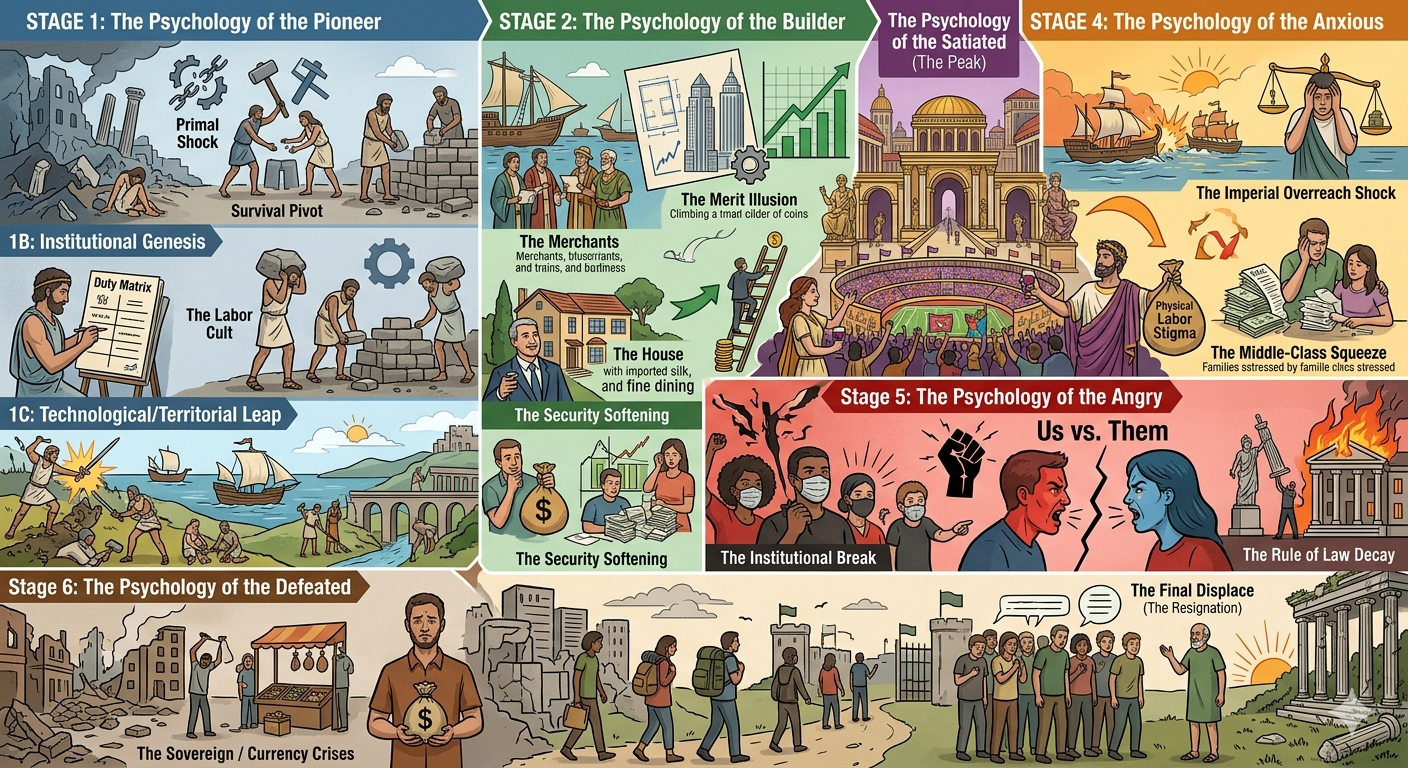
This image has been generated by Gemini AI to give a visual view of the process, there may be spelling errors, so please read the text below for full details.
History rarely records the moment an empire decides to fail. What it does record — in tax records, court proceedings, military dispatches, and the desperate legislation of late administrations — is the psychological residue of that failure: the denial, the scapegoating, the retreat into spectacle, and the final exhausted acceptance of a diminished world.
This page sets out a generalised model of the collective psychological arc that appears to repeat across empires and dominant civilisations. It is not a deterministic law, but a pattern of recognisable human responses to the same sequence of pressures: abundance following struggle, complacency following abundance, and crisis following complacency. The stages described here find their clearest ancient illustration in the Roman empire — a civilisation that moved from the austere civic virtue of the early Republic through the confidence of the Augustan age, the anxious overreach of the 3rd century crisis, and the exhausted fragmentation of the 5th — but the same arc is visible, with uncomfortable clarity, in the political and economic landscape of the early 21st century. Whether that parallel is instructive or merely cautionary is left to the reader.
| | |
|---|
Stage 0: The Genesis Dynamics (The Architectural Baseline) ▲ |
|---|
|
While the traditional lifecycles of empires focus heavily on the predictable progression from youthful expansion to eventual stagnation, an empire’s trajectory is heavily dictated before its clock even begins to tick. Level 0: The Genesis Dynamics introduces the baseline civilizational code of a nation—acting as either an accelerator or a brake pedal for every subsequent stage of development. Civilizations do not emerge onto the geopolitical stage with identical blank slates; instead, their structural endurance, velocity through the phases, and ultimate vulnerability to flashpoints are hardcoded by the precise conditions of their birth and how they interface with the historical remnants that preceded them.
This baseline is defined by a critical variable: the balance between a nation's Baseline Inheritance (I) and its Memory Depth (M).
Some empires are born from clean sheets of paper, unburdened by tradition but highly volatile; others are structural chimeras, building new engines over old, decaying administrative foundations; and a rare few are continuous civilizational ghosts, capable of absorbing massive structural trauma because their collective identity stretches back millennia. By categorizing a nation's foundational setting within the 0xx matrix, we can calculate its systemic momentum and unlock the predictive accuracy required to map its future path through the lifecycle.
The Three Foundational Settings:
Setting 001 — The Rupture Genesis (I=0,Mzero): A civilization built from an ideological or geographic clean slate, severed from old imperial structures. They feature hyper-accelerated early stages and explosive innovation, but lack a historical survival baseline, making their eventual Stage 5 decadence highly volatile and prone to inward structural fracturing.
Setting 002 — The Synthesized Genesis (I=0.5,Mmed): A hybrid system born directly out of the ashes of a predecessor, intentionally cloning old administrative frameworks while infusing them with new youthful energy. This setting follows the classic, predictable linear timeline but inherently hides old systemic bugs within its structural design.
Setting 003 — The Continuous Genesis (I=1.0, Mhigh): A deep-rooted, continuous civilizational identity that survives the physical collapse of its political iterations. This setting acts as a massive flywheel, severely decelerating the stages of decay and providing an ancient, shared psychological fallback that allows the nation to endure extreme external pressure without its core shattering.
The Memory Depth Variants:
The Memory Depth variable (M) introduced in the Genesis Settings requires more precise treatment than the initial framework suggests, because the case studies reveal that Memory Depth is not a single uniform quantity but a composite of qualitatively different types of civilisational inheritance, each generating a different flywheel effect and each carrying different vulnerabilities. Four distinct variants have been identified across the historical record, and correctly classifying a civilisation's Memory Depth type — not just its depth — significantly improves the model's predictive accuracy.
-
Native Memory Depth is the foundational variant and the one the Genesis Settings originally describe. It is the accumulated civilisational inheritance carried by a population across generations through continuous cultural transmission — the shared historical experience of survival, failure, and reconstitution that gives a Setting 003 civilisation its characteristic resilience. Native Memory Depth is the most robust variant: it is embedded in language, in oral and written tradition, in religious practice, and in the collective psychological experience of the population at a level that political disruption cannot easily reach. The Chinese and Byzantine cases are the clearest illustrations. The flywheel effect of Native Memory Depth operates at full force because it does not depend on conscious institutional maintenance — it persists through the population's lived cultural experience even when the institutional structures that formally express it have been disrupted or destroyed.
-
Borrowed Memory Depth is the variant introduced by the American case but visible in earlier form in the Norman case. It is the Memory Depth acquired at the Genesis moment through the deliberate absorption of an existing intellectual and institutional tradition rather than through the civilisation's own historical experience. The American founders borrowed the Whig constitutional tradition, the common law inheritance, and the Enlightenment political philosophy of the preceding century and encoded it into the constitutional framework with a rigour and systematisation that exceeded anything the originating British tradition had achieved. The Norman ruling class borrowed Frankish administrative discipline and ecclesiastical institutional frameworks within a single generation of their Scandinavian ancestors' settlement in the Seine valley. Borrowed Memory Depth generates a partially attenuated flywheel effect: stronger than a pure minimal Memory Depth Setting 001 baseline, but more dependent on conscious institutional maintenance and more vulnerable to erosion when the intellectual tradition that transmitted it ceases to be actively understood and defended. The critical vulnerability of Borrowed Memory Depth is that it can be forgotten in a way that Native Memory Depth cannot — a population can lose conscious access to an intellectual inheritance through educational neglect or cultural disruption in a way that it cannot lose access to its own lived historical experience.
-
Acquired Memory Depth is the variant introduced by the Saxon case. It is Memory Depth built up mid-arc through deliberate institutional absorption — the progressive incorporation of an external civilisational inheritance into a developing framework rather than its adoption at the Genesis moment. The Saxon acquisition of the Latin ecclesiastical tradition through the Conversion of 597 to 664 is the clearest illustration: a minimal Memory Depth Setting 001 civilisation gaining access to centuries of Roman administrative, legal, and intellectual inheritance through a specific institutional event, and deploying that inheritance to achieve administrative sophistication that its original baseline could not have generated. Acquired Memory Depth occupies an intermediate position between Borrowed and Native variants: more deeply embedded than Borrowed Memory Depth because it is acquired through lived institutional experience rather than intellectual inheritance, but less robust than Native Memory Depth because the acquisition is recent enough to be disrupted by sufficiently severe external shock. The Alfredian period's educational programme — explicitly designed to restore the Latin literacy that the Viking raids had degraded — is evidence of Acquired Memory Depth requiring active maintenance in a way that Native Memory Depth does not.
-
Environmental Memory Depth is the most recently identified variant and the most analytically subtle. It is the transmission of prior civilisational logic through landscape, infrastructure, and ecological organisation rather than through cultural or institutional channels — the path dependency of a physically organised environment shaping the choices of successor populations who may have no conscious awareness of the prior civilisation that created it. The Romano-British landscape inheritance operating on Saxon settlement patterns is the clearest illustration: villa estate boundaries surviving as parish boundaries, Roman road alignments determining Saxon and medieval route networks, and Roman urban sites attracting Saxon settlement not because the settlers understood or valued their Roman origins but because the physical organisation of the landscape made those locations objectively advantageous. Environmental Memory Depth is the weakest flywheel variant — it generates structural continuity rather than psychological resilience, and it erodes as the physical infrastructure that transmits it degrades or is superseded — but it is significant precisely because it operates independently of cultural transmission, persisting into successor periods even when all other forms of Memory Depth have been disrupted. It is most relevant to conquest settlements occurring within landscapes of high prior civilisational investment, and its effects are most visible in the work of landscape archaeology, place name analysis, and the study of estate and parish boundary persistence.
The Ideological Carrier.
Across the historical record, the primary institutional mechanism through which Memory Depth is generated, transmitted, and sustained across political disruptions is the organised belief system — religious, nationalist, or political — that gives a civilisation its shared moral vocabulary and its sense of collective purpose. This is not because ideology creates Memory Depth directly, but because the institutions that carry ideology across generations — churches, legal traditions, scholarly communities, constitutional frameworks — are the same institutions that preserve the administrative, intellectual, and cultural inheritance that Memory Depth represents. When the Byzantine Orthodox church maintained its institutional continuity through the political disruptions of the 7th century Arab conquests, it was simultaneously maintaining the Greek scholarly tradition, the Roman legal inheritance, and the administrative vocabulary of the Eastern empire — the ideological carrier and the civilisational Memory Depth were the same institutional entity. When the Saxon church preserved Latin literacy through the Viking disruptions of the 9th century, it was preserving the Acquired Memory Depth that the Conversion had introduced — without the ecclesiastical institutional infrastructure, the literacy would have been lost and with it the administrative capability that the Alfredian reactivation required. The practical implication for the model is that a civilisation whose Memory Depth is carried primarily by a single ideological institution is more vulnerable to Memory Depth loss than one whose inheritance is distributed across multiple independent carriers — the concentration of Memory Depth in a single institution creates a single point of failure whose disruption can collapse the civilisational flywheel effect far more rapidly than the aggregate Memory Depth depth would suggest.
The Composite Memory Depth Profile. Most civilisations in the historical record carry a composite Memory Depth profile — multiple variants operating simultaneously, each contributing differently to the flywheel effect and each carrying different vulnerabilities. The late Saxon state carried all four variants simultaneously: Native Memory Depth from the Germanic secular tradition, Borrowed Memory Depth from the Carolingian administrative models the Mercian hegemony had absorbed, Acquired Memory Depth from the Latin ecclesiastical tradition gained through the Conversion, and Environmental Memory Depth from the Romano-British landscape inheritance. The Byzantine state carried Native Memory Depth from the Greek civilisational tradition, Acquired Memory Depth from the Roman imperial inheritance absorbed through the eastern provinces, and Borrowed Memory Depth from the Christian theological tradition whose intellectual architecture was largely Greek but whose institutional framework was Roman. Correctly identifying each component of a civilisation's composite Memory Depth profile — its type, its depth, and its specific vulnerabilities — produces a significantly more accurate prediction of how that civilisation will respond to the Stage 4 to 5 transition than a single aggregate Memory Depth score can generate.
Genesis Reset — The Mid-Arc Restart
The Genesis Settings framework treats the foundational classification of a civilisation as a fixed starting condition — the baseline from which all subsequent stage analysis proceeds. The case studies reveal, however, that the Genesis Setting can be reset mid-arc by specific categories of event that produce a qualitative transformation of the civilisational profile rather than merely a Stage 1 reactivation within the existing arc. Correctly identifying a Genesis Reset event — and applying the stage analysis from the reset point rather than from the original founding — is essential for accurate lifecycle modelling of civilisations that have undergone major mid-arc transformations.
The Conquest-Driven Genesis Reset is the most common variant. It occurs when the collision of two civilisations at different psychological stages and different Memory Depth profiles produces a third entity that is qualitatively different from either component — not a continuation of the conquering civilisation with a subject population attached, and not a continuation of the subject civilisation under new political management, but a genuine synthesis whose constitutional DNA is determined by the specific combination of institutional features contributed by each party at the moment of collision. The 1066 Norman conquest of Anglo-Saxon England is the clearest illustration: what emerged was neither a Norman state ruling an English population nor an English state under Norman management, but a new English Setting 002 civilisation whose common law framework, feudal land tenure system, and Latin ecclesiastical administration represented a compound that none of its components could have produced independently. The key diagnostic indicator of a Conquest-Driven Genesis Reset, as opposed to a simple political conquest, is the emergence of institutional features in the successor state that cannot be derived from either the conquering or the conquered civilisation alone — features that are genuinely new, produced by the specific interaction rather than inherited from either party.
The Institutional Genesis Reset is the variant introduced by the Saxon Conversion case. It occurs when a civilisation acquires, through a specific institutional event rather than through conquest, an external inheritance of sufficient depth and breadth to transform its civilisational profile qualitatively — shifting its effective Genesis Setting rather than merely adding to its existing Memory Depth. The distinction between an Institutional Genesis Reset and Acquired Memory Depth acquisition is one of degree: Acquired Memory Depth modifies the existing profile, while an Institutional Genesis Reset transforms it. The diagnostic indicator is whether the acquisition changes the civilisation's stage trajectory — its speed of transition, its characteristic vulnerabilities, and its response to external pressure — or merely deepens it. The Saxon Conversion qualifies as an Institutional Genesis Reset because it introduced a qualitatively new administrative and intellectual framework, the Latin ecclesiastical tradition, that changed the Saxon arc's trajectory in ways that cannot be explained by a simple Memory Depth modifier on the pre-existing minimal baseline. The post-Conversion Saxon state was a different kind of entity from the pre-Conversion Saxon kingdoms, not merely a more sophisticated version of the same entity.
The Political Reset without Genesis Change is the outcome category introduced by the Cnut conquest case — the political disruption that preserves the existing Genesis Setting and Memory Depth profile intact, because the conquering power either lacks the cultural depth to displace the subject civilisation's institutional inheritance or actively chooses to govern through it rather than replace it. The Cnut conquest left the common law, the shire system, and the ecclesiastical framework of the late Saxon state substantially intact because Cnut arrived as a king seeking to govern a sophisticated administrative state rather than as a raiding force seeking to extract and destroy. The diagnostic indicator is the speed of institutional continuity reassertion: where a genuine Genesis Reset produces a new synthesis, a Political Reset produces a rapid return to the prior institutional logic under new political management, usually within a single generation. The Political Reset is most likely when the Memory Depth differential between conqueror and conquered is large and the conqueror's objective is governance rather than extraction.
Applying the Reset to the Stage Duration Table. When a Genesis Reset occurs, the Stage Duration Modifier table should be applied from the reset point using the new Genesis Setting, not from the original founding. The pre-Reset arc is treated as a predecessor civilisation whose institutional inheritance feeds into the Reset Genesis moment as a Memory Depth input. The total arc prediction therefore runs from the Reset point, and the Memory Depth inherited from the predecessor is classified according to the four variants described above — Native if the predecessor and successor share cultural continuity, Borrowed if the institutional inheritance is adopted rather than lived, Acquired if it is absorbed through institutional experience, Environmental if it operates through landscape and infrastructure rather than cultural transmission.
System Integration Note: When utilizing the predictive dashboard, the Level 0xx setting modifies the standard duration of all future stages (T). It dictates whether a nation approaching a Stage 5 convergence vector will lash outward through territorial revanchism, project power via asymmetric proxy networks, or paralyze itself through internal tribalization.
Constitutional DNA — The Genesis Moment as Predictive Key
The most powerful predictive application of the Genesis Settings framework is not the estimation of stage durations — though the modifier table provides useful indicative ranges — but the identification of the Constitutional DNA encoded at the Genesis moment: the specific combination of institutional features, inherited tensions, and structural compromises that determine the character of the latent bugs that will express themselves across the entire subsequent arc.
Every civilisation carries forward from its Genesis moment a set of unresolved structural tensions — compromises made at founding between competing interests, inherited contradictions from absorbed predecessor civilisations, or deliberate ambiguities encoded because the founding generation could not or would not resolve them. These tensions do not express themselves immediately: in Stage 1 and Stage 2 the Pioneer and Builder energy is sufficient to override or defer them, and the institutional trust generated by the early arc's achievements provides a cushion of goodwill that makes the tensions manageable. It is in Stage 3 and Stage 4, when that energy dissipates and that cushion erodes, that the Genesis tensions begin to express themselves as structural pathologies — not as new problems but as the original unresolved contradictions finally reaching the surface under the pressure of declining institutional performance.
The practical implication is that the specific character of a civilisation's Stage 4 to 5 crisis is not random or contingent — it is the direct expression of its Genesis DNA. The British arc's Stage 4 to 5 dynamics are dominated by the tension between common law constraint and feudal elite protection encoded in the 1066 Norman-Saxon synthesis, expressed through three centuries of constitutional argument about the relationship between parliamentary sovereignty and individual rights. The Ottoman arc's Stage 5 crisis is dominated by the tension between the Islamic legal tradition and the secular administrative necessity encoded in the original Ottoman synthesis of sharia and kanun, expressed through the Tanzimat's impossible attempt to reconcile them within a single modernising framework. The Saxon arc's Stage 4 vulnerability was shaped by the tension between the Pioneer civic military obligation of the Alfredian settlement and the estate-based aristocratic insularity that the subsequent Builder phase had encoded into the land tenure system — a tension that the Æthelredian period could not resolve and that the Norman conquest displaced rather than settled.
Identifying a civilisation's Constitutional DNA therefore requires asking, at the Genesis moment: what tensions were left unresolved, what compromises were made between incompatible interests, and what inherited contradictions from absorbed predecessors were carried forward rather than addressed? The answers to these questions predict, with significant accuracy, not whether the civilisation will face a Stage 4 to 5 crisis — the lifecycle model predicts that for all civilisations — but what specific form that crisis will take, which institutional mechanisms will fail first, and which stabilisation interventions have any realistic prospect of success given the structural features already present.
The Constitutional DNA concept also illuminates why stabilisation interventions frequently fail even when correctly diagnosed and competently deployed. The Ottoman Tanzimat reformers correctly identified the Stage 4 to 5 dynamics they were attempting to address, correctly selected Interventions I, II, and III as the appropriate response, and deployed them with considerable administrative sophistication — and failed, because the interventions required resolving tensions encoded at the Genesis moment of the Ottoman synthesis that the Tanzimat framework was structurally incapable of resolving. The Islamic legal tradition's claim to universal authority and the secular administrative necessity of governing a multi-religious empire were not a Stage 5 problem produced by poor governance: they were a Stage 0 Genesis tension that had been deferred through the millet system for four centuries and that the Stage 5 nationalist fracturing finally forced into the open in a form that no institutional intervention could address without dismantling the Ottoman identity itself. Understanding Constitutional DNA does not guarantee successful intervention, but it prevents the systematic misdiagnosis of Genesis-level structural tensions as Stage 4 to 5 management failures — a misdiagnosis that produces interventions targeted at symptoms rather than causes, and that therefore fails regardless of their technical sophistication.
Real World Examples of Empires
To make these settings concrete, consider three civilisations that illustrate each archetype clearly.
Rome is the clearest example of Setting 002 (Synthesized Genesis). The Republic did not emerge from a blank slate: it inherited Etruscan administrative structures, Greek cultural frameworks absorbed through southern Italy, and a pre-existing Latin tribal confederacy. The new Roman identity was consciously constructed over these older foundations, borrowing their organisational logic while replacing their governing class. The consequence, visible in hindsight, was that Roman institutions carried latent structural bugs from the start — the unresolved tension between patrician and plebeian authority, for instance, was not a Roman invention but an inherited Etruscan social fault line that the Republic patched rather than resolved. When those patches began to fail in the late Republic, the decay was rapid and surprisingly total.
The United States is a near-perfect Setting 001 (Rupture Genesis). Founded on an explicit ideological break from inherited monarchy and aristocracy, it carried no medieval administrative legacy, no guild system, no established church embedded in law. This produced the explosive early-stage acceleration the model predicts: extraordinary innovation velocity, rapid territorial expansion, and a democratic experiment conducted without the dead weight of feudal habit. The corresponding vulnerability — also predicted — is fragility under internal tribal stress. A Setting 001 civilisation has no ancient shared survival memory to draw on when the civic contract fractures; the only founding myth is the ideology itself, and when that ideology becomes contested, the psychological centre hollows out quickly.
China is the clearest living example of Setting 003 (Continuous Genesis). Successive dynasties collapsed, were conquered, and were replaced, yet the underlying civilisational identity — the written language, the Confucian administrative tradition, the concept of the Mandate of Heaven as a legitimising framework — survived each rupture intact. This gives the DFI curve its characteristic dampened shape: Chinese populations have absorbed catastrophes that would have permanently shattered Setting 001 states, because the collective memory includes successful recovery from comparable or worse events. The cost is the model's predicted one — a tendency to defer the flashpoint rather than resolve it, exporting internal pressure through peripheral proxy engagements rather than confronting structural rot directly.
| | |
|---|
Stage 1: The Psychology of the Pioneer ▲ |
|---|
1A: The Catalyst Event
1A1 (Primal Shock): A severe crisis, foreign invasion, or systemic collapse completely shatters the old way of life. The populace experiences shared trauma, wiping out preexisting political divisions overnight.
1A2 (The Survival Pivot): Society shifts from panic to hard-edged focus. Individuals realize that if they do not cooperate immediately, they face total destruction. Competence and raw utility become the only traits that matter.
1A3 (The Cleansing of Ego): Inherited privilege, titles, and wealth lose all meaning. A completely flat, egalitarian social order forms where respect is exclusively earned through contribution to group survival.
1B: Institutional Genesis
1B1 (The Duty Matrix): A fierce code of ethics is codified. Leaders emerge naturally from the trenches based on merit, and they view power not as a privilege, but as an exhausting, heavy burden of civic duty.
1B2 (The Labor Cult): Hard, grueling physical labor is elevated to a spiritual virtue. The collective psyche severely punishes laziness, luxury, or complaining, viewing them as existential threats to the community.
1B3 (The Trust Foundation): High social cohesion takes root. Because everyone relies on everyone else to survive, institutional structures are built with radical transparency, generating immense public trust.
1C: Technological/Territorial Leap
1C1 (The Conquest High): The new society experiences its first major breakthrough—a massive military victory, a brand-new territory opened, or a groundbreaking technological innovation. Confidence explodes.
1C2 (The Horizon Mindset): The collective imagination shifts toward the future. Families grow rapidly, and citizens view hardships as minor speed bumps on an inevitable path to glory.
1C3 (The Reinvestment Habit): Excess resources are immediately poured back into building roads, aqueducts, industry, or defense. The psychological reward is found in building the empire, not consuming it.
| The Dilution Dynamic - The Pioneer Inheritance Problem ▲ |
|---|
|
The six stages described on this page are sometimes read as a sequence of choices — as though the Builder civilisation could simply decide not to become Satiated, or the Satiated civilisation could choose to retain its Pioneer virtues if it recognised the danger in time. This misreads the model. The transitions are not failures of will. They are the predictable consequence of a demographic mechanism that success itself sets in motion.
The Pioneer psychology described in Stage 1 is not an attitude that can be taught. It is the product of specific conditions: shared trauma (1A1), the lived experience of survival dependency (1A2), and the social levelling that follows when inherited status becomes irrelevant to group survival (1A3). The people shaped by those conditions carry a psychological architecture — the duty ethic, the labour cult, the reinvestment habit — that is genuinely structural, not merely cultural. It determines how they run institutions, maintain standards, and respond to fiscal pressure. The Integrity Currency of Stage 2 is maintained not because the Builder phase has good monetary policy but because the people responsible for it still feel the 1B1 obligation to the standard as a personal duty rather than an administrative convention.
The problem is arithmetic. As the empire succeeds, the proportion of the population personally shaped by the founding conditions falls with each generation. No one living remembers 1A1. The 1A3 Cleansing of Ego is a story their grandparents tell. The 1B2 Labour Cult feels like ancestral mythology rather than survival necessity. The institutional forms the Pioneers built persist — the mint, the legion, the law — but they are progressively staffed by people whose psychological formation occurred under Builder or Satiated conditions. Those people are not worse; they are differently shaped. They optimise for the rewards their environment offers rather than the survival imperatives of a crisis they never experienced. The systems begin to drift, not through sabotage but through the gradual replacement of the people whose psychology held them true.
This is the Pioneer Inheritance Problem: the founding psychology cannot be transmitted by instruction, only by experience, and the founding experience cannot be reproduced without the founding crisis. The Stage 3 to 4 transition — the moment when quiet debasements begin, when reinvestment gives way to consumption, when duty yields to entitlement — is not the point at which the civilisation makes a wrong choice. It is the point at which Pioneer-psychology individuals have been sufficiently diluted within the institutional population that the structural load they were carrying can no longer be held.
The Genesis Settings modify the rate of dilution but not its direction. A Setting 003 civilisation resists Stage 3 onset longest precisely because its Memory Depth provides institutional and cultural transmission mechanisms — religious frameworks, legal traditions, codified historical memory — that can approximate Pioneer-psychology formation without requiring the founding crisis to recur. The Byzantine solidus held its integrity for seven centuries not because Byzantine moneyers were unusually virtuous but because the currency's trustworthiness was embedded in the civilisational identity at a depth that individual psychology could not easily override. Setting 001 civilisations dilute fastest, because their minimal Memory Depth provides no such transmission infrastructure: when the founders die, the psychology largely dies with them.
The stabilisation interventions described later on this page can be read in this light. Each of them — Economic Decompression, Institutional Venting, Constitutional Hardening — is an attempt to artificially recreate the conditions that generate Pioneer psychology without waiting for civilisational collapse to impose them from outside. They can slow the dilution rate. They cannot reverse it, because the founding shock cannot be manufactured. What they can do is buy enough time for the institutional architecture to adapt to a population that no longer carries the psychology that built it.
| | |
|---|
Stage 2: The Psychology of the Builder ▲ |
|---|
2A: Global Trade Dominance
2A1 (The Merchant Transition): The physical pioneer passes the torch to the intellectual strategist. The cultural hero shifts from the soldier to the trader, engineer, and wealth-creator.
2A2 (The Merit Illusion): The public becomes highly motivated by upward mobility. The prevailing psychological belief is that anyone can achieve wealth and status through pure wit, innovation, and long hours.
2A3 (The Optimization Obsession): Efficiency becomes the cultural obsession. The society builds sprawling trade networks, standardizes currency, and turns the entire nation into a finely tuned engine of commerce.
2B: The Rise of the Merchant Class
2B1 (The Security Softening): As raw wealth floods the empire, life becomes profoundly safe and comfortable. The public mind shifts from "how do we survive?" to "how do we optimize our personal comfort?"
2B2 (The Aspirational Standard): A robust middle class emerges, obsessed with luxury goods, real estate upgrades, fine dining, and elite education for their children to signal their status.
2B3 (The Risk Aversion Bug): The ruling class transitions from bold innovators to defensive asset managers. Their primary psychological goal changes from creating new industries to building legal moats to protect their existing wealth.
2C: The Debt-Asset Foundations
2C1 (The Abstraction of Value): Wealth is disconnected from physical production. The collective mind begins valuing financial engineering, stock speculation, and interest-bearing loans over physical manufacturing or agriculture.
2C2 (The Baseline Delusion): The public starts treating continuous economic growth as an unyielding law of nature. The historical memory of poverty fades, leading to severe complacency.
2C3 (The Future-Borrowing Trap): Thrift and saving are discarded as outdated concepts. The society collectively embraces credit, eagerly borrowing against tomorrow's presumed wealth to finance today's extreme luxury.
| Stage 3: The Psychology of the Satiated (The Peak) ▲ |
|---|
3A: The Golden Age Achievement
3A1 (The Unipolar Hubris): The empire achieves total geopolitical dominance. The elite and public develop an "Exceptionalism" complex, genuinely believing they are morally and intellectually superior to all other humans on earth.
3A2 (The Ancestral Coast): The population stops producing great feats and instead glides on historical momentum. They take deep personal pride in achievements they didn't build, treating past greatness as a permanent birthright.
3A3 (The Spectacular Distraction): Mass entertainment, colossal sports spectacles, and hyper-extravagant art installations become the primary cultural focus, masking the fact that the underlying infrastructure has stopped growing.
3B: Shift from Production to Consumption
3B1 (The Physical Labor Stigma): Manual work, manufacturing, and farming are reclassified as low-status, dirty jobs. The empire outsources its production to younger, hungrier foreign nations, viewing its own citizens as "above" physical labor.
3B2 (The Virtue Economy): Status is no longer earned by building things, but by consuming correctly and signaling moral purity. Public discourse shifts away from practical economics toward abstract, high-minded social debates.
3B3 (The Softening of the Will): Physical and mental resilience decline across the population. The society becomes highly hyper-sensitive, prioritising immediate comfort, emotional safety, and luxury over duty or sacrifice.
3C: The Incubation of Rot
3C1 (The Gated Enclave Mindset): The ruling class completely insulates themselves inside wealthy bubbles. They interact only with other elites, developing a psychological blind spot toward the rest of the country.
3C2 (The Alienation Filter): The working class experiences stagnating real wages and watches the elite’s opulence with a growing, unexpressed sense of exclusion. National pride begins to rot from the bottom up.
3C3 (The Anesthetic Culture): To cope with a creeping sense of purposelessness, the population turns en masse to escapism. Addictions, depression, and a total withdrawal from civic participation rise dramatically, though the economic surface still looks flawless.
| Stage 4: The Psychology of the Anxious ▲ |
|---|
4A: Geopolitical & Military Strain
4A1 (The Imperial Overreach Shock): A rising global rival or an overextended foreign commitment severely checks the empire’s power. The elite experiences a massive shock but responds with intense psychological denial.
4A2 (The Resource Drain Panic): The cost of maintaining global dominance begins to skyrocket, bleeding the treasury dry. The government hides the costs through creative accounting rather than enacting reforms.
4A3 (The Scapegoat Reflex): Unable to face their own structural decline, the public and leadership aggressively blame external enemies, foreign powers, or immigrants for their internal domestic problems.
4B: Financial Engineering & Currency Debasement
4B1 (The Short-Termism Virus): Facing massive deficits, the political class adopts a "kick the can down the road" philosophy. Long-term strategic planning is abandoned in favor of printing money to survive the next election cycle.
4B2 (The Contract Broken): As inflation steadily erodes purchasing power, the average citizen realizes that playing by the rules (working hard and saving) no longer guarantees economic security. The psychological incentive to be a "good citizen" shatters.
4B3 (The Speculative Mania): Realizing money is melting, the populace stops investing in productive enterprises and turns to high-risk gambling—speculating on real estate, alternative assets, and financial bubbles just to stay afloat.
4C: Economic Stagnation
4C1 (The Gaslighting Phase): The elite weaponizes manipulated data and media narratives to tell the public the economy is booming, fundamentally invalidating the lived, painful experience of ordinary people.
4C2 (The Middle-Class Squeeze): The core engine of the empire—the middle class—is crushed under a spiraling cost of living. Stress, sleep deprivation, and financial dread become the universal baseline psychological state.
4C3 (The Doom Descent): A deep, cultural doomerism takes root. The society collectively stops believing that the future will be better. Young people delay marriages and childbirth, viewing the world as inherently hostile.
| Stage 5: The Psychology of the Angry ▲ |
|---|
5A: The Institutional Break
5A1 (The Great Cynicism): Trust in foundational institutions drops to zero. The public views all foundational institutions as corrupt speed bumps designed purely to protect the wealthy elite.
5A2 (The Parallel Reality Split): The population completely abandons mainstream sources of information, fracturing into parallel, underground echo chambers where alternative realities and deep tribal narratives thrive.
5A3 (The Rules Devaluing): Institutional norms, checks and balances, and unwritten political rules are openly viewed as tools of oppression. The public actively wants these rules broken if it means achieving their political goals.
5B: The "Us vs. Them" Flashpoint
5B1 (The Tribal Binary): Complexity dies. Society splits into a rigid, unforgiving binary. Political opponents are no longer viewed as citizens with different ideas, but as subhuman, existential threats that must be destroyed.
5B2 (The Populist Savior Demand): Driven by severe financial pain and tribal fear, the public stops looking for competent administrators and begins desperately seeking a a charismatic strongman to confront their enemies.
5B3 (The Death of Nuance): Moderate voices are completely purged from public discourse. Anyone advocating for compromise, reason, or unity is branded a traitor by their own side.
5C: The Rule of Law Decay
5C1 (The Weaponization Blitz): The political faction in power drops all pretenses of neutrality. They hey openly direct state agencies, the judicial apparatus, and executive authority to actively target, suppress, or bankrupt their political opposition.
5C2 (The Tyranny Absolution): The public undergoes a terrifying moral shift. They willingly cheer on authoritarian overreach and the dismantling of civil liberties, provided their side holds the reins of power.
5C3 (The Escalation Loop): As both sides realize the winner of an election takes total control of the state's weapons, politics transforms into a desperate, zero-sum war for raw survival, setting the stage for total structural collapse.
| Stage 6: The Psychology of the Defeated ▲ |
|---|
6A: Sovereign / Currency Crises
6A1 (The Faith Vaporization): A sudden tipping point is reached where the public completely loses faith in the national currency. The shared psychological contract holding up the financial system instantly dissolves.
-
6A2 (The Liquidation Scramble): The elite and corporate class aggressively liquidate local assets, convert their wealth into hard goods or foreign currencies, and quietly abandon ship to secure their private enclaves.
-
6A3 (The Jungle Reversion): Civic solidarity completely vanishes. The average citizen enters a state of pure primal survival, viewing every neighbor as a direct competitor for food, fuel, and basic medical supplies.
6B: Internal Balkanization / Civil Strife
6B1 (The Identity Death): The grand overarching national identity dies completely. A citizen no longer feels any psychological loyalty to the empire or federal state, viewing it as a dead entity.
-
6B2 (The Tribal Retreat): People seek psychological shelter and physical safety exclusively within localized, regional, or ideological networks. The country splits into distinct, self-governing cultural fiefdoms.
-
6B3 (The Warlord Normalization): Central authority stops functioning. Local councils, gangs, or corporate forces take over security, and the public readily submits to these non-democratic rulers in exchange for basic protection from violence.
6C: The Final Displace (The Resignation)
6C1 (The Peace of Exhaustion): The intense, exhausting psychological trauma of Stages 4 and 5 burns out. The population stops fighting for the empire, overwhelmed by deep civilizational fatigue.
-
6C2 (The Pragmatic Reset): A new, highly disciplined domestic faction or an external foreign power steps into the vacant capital. The public does not fight them; they passively accept the new rule simply because it restores predictable daily order.
-
6C3 (The Mythologizing of the Past): Grand imperial history is relegated to fairy tales and legend. The population completely adapts to a localized, simpler, and heavily diminished existence, looking back at the "Golden Age" as if it happened to an entirely different species.
| | |
|---|
The Stabilization Mechanics: Short-Circuiting the Collapse Pipeline ▲ |
|---|
|
To prove that civilizational decline is a treatable disease rather than an unalterable law, we must examine the specific systemic interventions required to arrest the descent. The framework dictates that once a society enters Stage 4, it is racing against a psychological clock.
As there is a high possibility of an Authoritarian take over in Stage 5C2 this can be defused by deploying one of the three structural escape hatches.
Intervention I: The Economic Decompression (Halting Step 4C2)
The transition from Stage 4B to 4C represents the moment structural economic decay transforms into mass psychological trauma. When the middle class is crushed under the 4C2 Squeeze, the baseline survival instinct overrides civic virtue, making the public highly vulnerable to authoritarian rhetoric.
The Blueprint: To bypass the authoritarian trap, the state must enact radical economic decompression before the public mood sours into Stage 5 hostility.
The Policy Lever: This requires moving aggressively against 4B1 (Short-Termism) and 4B3 (Speculative Mania). To rescue the economy from abstract engineering, the financial system must be forcefully realigned to penalize zero-value extraction—including high-frequency trading, short-selling speculation, and hyper-leverage—in order to restore the primacy of physical labor and utility, (Stage 1C3/2A1 mechanics): domestic manufacturing, supply chain independence, and high-wage labor.
The Result: By restoring a predictable, fair relationship between hard work and standard of living, you eliminate the existential dread that serves as a dictator's primary fuel.
The closest ancient parallel is Augustus's settlement of 27 BC, which arrested Stage 4 decline not primarily through military victory but through a deliberate restoration of the dignity and economic viability of Italian agriculture and small-scale manufacture — consciously reversing the latifundia-driven dispossession that had fuelled a century of civil war.
Intervention II: Institutional Venting & Concession (Halting Step 5A1)
If the economic escape hatch is missed, the empire slides into 5A1 (The Great Cynicism). At this point, the danger is no longer just financial; it is existential. The public perceives the ruling elite as a corrupt cartel and begins actively looking for external forces to smash the system.
The Blueprint: Avoidance of a dictator requires immediate, voluntary Elite Concession. The established ruling class must realize that maintaining 100% of their power guarantees they will lose all of it to a populist uprising.
The Policy Lever: The institutional gates must be thrown open. This means dismantling the legal moats, legacy preferences, and regulatory capture that protect the top tier of society. It requires installing radical, un-erasable transparency tools into government contracts, campaign finance, and judicial appointments, alongside the aggressive integration of outside, non-elite voices into the decision-making apparatus.
The Result: This halts 5A2 (The Parallel Reality Split). When the public witnesses institutions actively disciplining their own corrupt members, the psychological motivation to abandon the rule of law disappears.
The Roman Senate's periodic willingness to absorb provincial elites — first Italian, then Iberian, then African — into the governing class functioned as a crude but effective version of this lever, repeatedly refreshing institutional legitimacy at moments when purely hereditary oligarchy would have produced a terminal cynicism crisis.
Intervention III: Constitutional Hardening (The 5B3 Shield)
If society bypasses the first two hatches and enters 5B1 (The Tribal Binary), it has reached the red line. The population is now divided into two hostile factions, both fully convinced that the other side presents an existential threat. At 5B2, this conflict creates an intense demand for an autocratic savior.
The Concept of "Militant Constitutionalism"
When a society reaches the late stages of polarization, the legal architecture can no longer afford to be passive. It must switch from a flexible framework into an unyielding, rigid fortress.
The Blueprint: To prevent a populist savior (5B2) from executing a Weaponization Blitz (5C1) and gaining Tyranny Absolution (5C2), the constitution must deploy automated structural circuit-breakers.
The Policy Lever: Key levers of state violence and systemic administration—the independent judiciary, election administration boards, central banking, and military operational command—must be legally insulated from executive orders or simple parliamentary majorities. The rules for altering these foundational institutions must require cross-tribal, near-unanimous consensus to pass.
The Result: This freezes the board at 5B3. Even if an aggressive, authoritarian-minded leader wins a democratic election by capitalizing on populist anger, they find that the actual administrative machinery required to become a literal dictator is completely locked away from them. The system forces them to behave as a mere administrator, buying the civilization time to cool down.
The closest modern structural analogue is the post-war West German Basic Law of 1949, explicitly designed by a society that had just lived through Stage 5C in its most complete form: its architects built in deliberate circuit-breakers — the constructive vote of no confidence, the constitutional court's independence from parliamentary majorities, the explicit ban on parties seeking to dismantle the constitutional order — precisely to freeze the board before a future 5B2 demand for a populist saviour could translate into a 5C1 weaponisation of the state.
The Factional Hardening Limitation
The historical record reveals a critical limitation of Intervention III Constitutional Hardening that the framework must acknowledge explicitly, because its failure to do so would lead to systematically optimistic assessments of constitutionally sophisticated states. The limitation is this: constitutional hardening freezes the board around whatever elite settlement exists at the moment of hardening, and if that settlement already contains legal mechanisms protecting a governing class's privileges, the hardening encodes those mechanisms as constitutional features rather than correcting them.
The Glorious Revolution of 1688 is the clearest illustration — the model's most successful historical Intervention III deployment and simultaneously its most instructive limitation case. The Bill of Rights and the subsequent constitutional settlement successfully prevented the Stage 5B2 Catholic absolutist takeover it was designed to block, buying the British arc approximately two centuries of additional institutional stability. But the hardening was performed around a specific Protestant parliamentary elite settlement, not around universal civic principles, with the consequence that the legal moats protecting the landowning and commercial governing class were constitutionally entrenched at precisely the moment the framework was hardened against executive overreach. The constitution was locked against one form of tyranny while remaining entirely flexible in the hands of the parliamentary majority that controlled it — which is not Intervention III as the model intends it, but a partial deployment that solved the immediate Stage 5B2 threat while encoding the Stage 3C2 elite capture mechanism as a permanent constitutional feature.
The diagnostic distinction between an effective Intervention III and a Factional Hardening is therefore: does the constitutional settlement constrain all concentrations of power, including those currently held by the faction deploying the hardening, or does it constrain only the specific threat that motivated the intervention? An effective Intervention III requires the deploying faction to accept constitutional constraints on its own power as the price of constraining its opponents — a requirement that is psychologically very difficult to meet at Stage 5B, when the tribal binary psychology makes any concession to the opposing faction feel like an existential surrender. This is why genuinely effective Intervention III deployments are rare in the historical record: they require a degree of constitutional self-abnegation that the Stage 5 psychology systematically works against. The post-war German Basic Law of 1949, designed by a generation that had lived through the complete failure of the Weimar constitution's partial hardening, comes closest to the model's ideal — its architects were sufficiently traumatised by the consequences of factional hardening to accept genuine constraints on their own future power as the price of preventing a recurrence.
| | |
|---|
Outcome Variants — Non-Standard Lifecycle Trajectories ▲ |
|---|
|
The standard lifecycle model describes a sequential arc from Stage 1 Pioneer through Stage 6 Defeated as the baseline trajectory — the path a civilisation follows in the absence of successful stabilisation interventions or significant external disruption. The case studies have revealed, however, that several non-standard outcome categories occur with sufficient frequency that the model must accommodate them as recognised variants rather than treating them as anomalies requiring ad hoc explanation. Four such variants have been identified.
The Split-Track Decline occurs when the imperial arc and the domestic state arc decouple and run on separate clocks, producing different psychological outcomes in the same population simultaneously. The British Empire case is the clearest illustration: the imperial Stage 6 collapse of 1945 to 1997 occurred while the domestic state continued as a functioning parliamentary democracy undergoing its own separate Stage 4 to 5 arc on a timetable roughly two generations behind the imperial sequence. The Split-Track Decline is most likely when the empire and the home civilisation are institutionally distinct entities — when the empire is governed through a separate administrative apparatus that can dissolve without taking the domestic institutions with it. The diagnostic indicator is the survival of domestic institutional continuity through the imperial collapse: where the standard model predicts unified Stage 6 dissolution, the Split-Track Decline produces imperial Stage 6 alongside domestic Stage 4 to 5, with the two tracks interacting but not identical. The critical analytical implication is that Split-Track civilisations carry an unprocessed psychological burden — the 6C3 Mythologizing of the collapsed imperial identity — into the domestic Stage 5 arc, where it interacts with the tribal binary dynamics to produce the Exceptionalism Relapse: the periodic reactivation of imperial-scale ambitions within a post-imperial resource base, generating Stage 4A overreach dynamics without the Stage 4 structural conditions that would make them comprehensible.
The Stage 1 Reactivation occurs when an acute external threat severe enough to override the accumulated complacency of the current stage temporarily restores Pioneer psychology within a later-stage arc, producing genuine institutional outputs — buildings, laws, infrastructure — that outlast the psychological conditions that generated them. The Alfredian response to the Viking crisis within the Saxon arc, the British wartime mobilisation of 1939 to 1945, and the Heraclian reconstitution of the Byzantine state in the early 7th century are all Stage 1 Reactivations. The diagnostic indicators are: a shared existential threat distributed across the entire population rather than concentrated in a military or political class; a leadership capable of converting the reactivation energy into durable institutional outputs before the acute pressure lifts; and a surviving institutional inheritance deep enough to provide the framework within which those outputs can be systematised and retained. The critical limitation of Stage 1 Reactivation is that it operates against the grain of the existing institutional structure, which reasserts its Stage 3 to 5 characteristics once the acute pressure lifts. Reactivation period institutional outputs therefore require deliberate constitutional protection to survive the reassertion — outputs that are not constitutionally embedded tend to be progressively eroded by the returning Stage 3 to 5 psychology within one to two generations of the threat's removal. The British welfare state's contested trajectory from 1951 onward is the clearest illustration of this erosion dynamic.
The Short-Circuit Outcome occurs when a Stage 4 to 5 external forcing event prevents the expected Stage 5 to 6 sequence by imposing a political reset that preserves the subject civilisation's institutional Memory Depth rather than dissolving it. The Cnut conquest of England in 1013 to 1016 is the clearest illustration: a Stage 4 Saxon state absorbed by a Pioneer-phase Danish conquest that arrived with governance rather than extraction as its primary objective, producing a Political Reset that left the Saxon institutional inheritance substantially intact and allowed it to reassert its structural logic within a single generation. The Short-Circuit Outcome is most likely when three conditions are simultaneously present: the conquering power has governance rather than extraction as its primary objective; the Memory Depth differential between conqueror and conquered is large enough that the subject civilisation's institutional inheritance is more administratively useful than the conqueror's own traditions; and the subject civilisation's Stage 4 to 5 decay has not yet progressed far enough to render its institutional framework non-functional. The Short-Circuit Outcome is analytically significant because it demonstrates that Stage 5 to 6 dissolution is not the only possible response to Stage 4 structural failure — external political reset can preserve the institutional inheritance through the political disruption and transmit it forward into a successor framework, as the Saxon case demonstrates.
The Franchise Conquest occurs when a Pioneer-phase civilisation with minimal Memory Depth replicates its psychological template across multiple independent conquest episodes in different cultural environments simultaneously, producing radically different outcomes in each because the Memory Depth differential between the conquering template and the subject populations varies dramatically across cases. The Norman conquests of the 11th and 12th centuries — England, Sicily, southern Italy, Antioch — are the clearest illustration. The franchise model is analytically distinct from standard imperial expansion because there is no unified home state directing the conquest programme: each episode is an independent application of the same Pioneer psychological template by members of the same ruling class, and the outcome of each episode is determined not by the strategic decisions of a central authority but by the specific Memory Depth differential between the Norman template and the local subject population. Where the differential is moderate — Norman versus Anglo-Saxon — the outcome is a Setting 002 synthesis in which both parties contribute approximately equally to the constitutional DNA of the resulting state. Where the differential is extreme — Norman versus the Arab-Byzantine-Latin palimpsest of Sicily — the outcome is near-total absorption of the conquering template into the subject civilisation's institutional framework, with the Norman contribution limited to Pioneer energy and conquest momentum rather than lasting institutional content.
| | |
|---|
The Flashpoint Mechanics: Domestic Frustration vs Military Capability ▲ |
|---|
|
To calculate a civilization’s exact proximity to a geopolitical flashpoint, the model tracks the interaction between two opposing force vectors: the Domestic Frustration Index (DFI) and the Military Capability Curve (MCC). As an empire transitions into Stage 5 (Decadence), these two lines begin traveling in violently opposite directions.
The DFI is an exponential curve measuring the velocity of internal instability, driven by systemic factors such as wealth inequality, trust decay in foundational institutions, and demographic pressures.
Conversely, the MCC is a parabolic arc representing the empire's peak physical power projection, which eventually begins to decay due to industrial atrophy, over-complicated defense architectures, or resource starvation.
The intersection of these two curves represents the Desperation Vector — the precise moment when a regime's domestic survival threshold is overtaken by its declining capacity to project force.
- In autocracies, this intersection triggers a "Peak Leverage Window," where the leadership will actively choose external, revanchist conflict (5c1) to artificially suppress domestic anger with nationalism before their military edge permanently evaporates.
- In highly financialized, zero-memory democracies, this same intersection manifests as systemic paralysis, where the state's military remains formidable on paper, but its political will is completely frozen by inward-facing polarization. Identifying where these lines cross allows us to predict the transition from stagnant decline to active crisis..
| The Flashpoint Mechanics: Level 0: Genesis Influences ▲ |
|---|
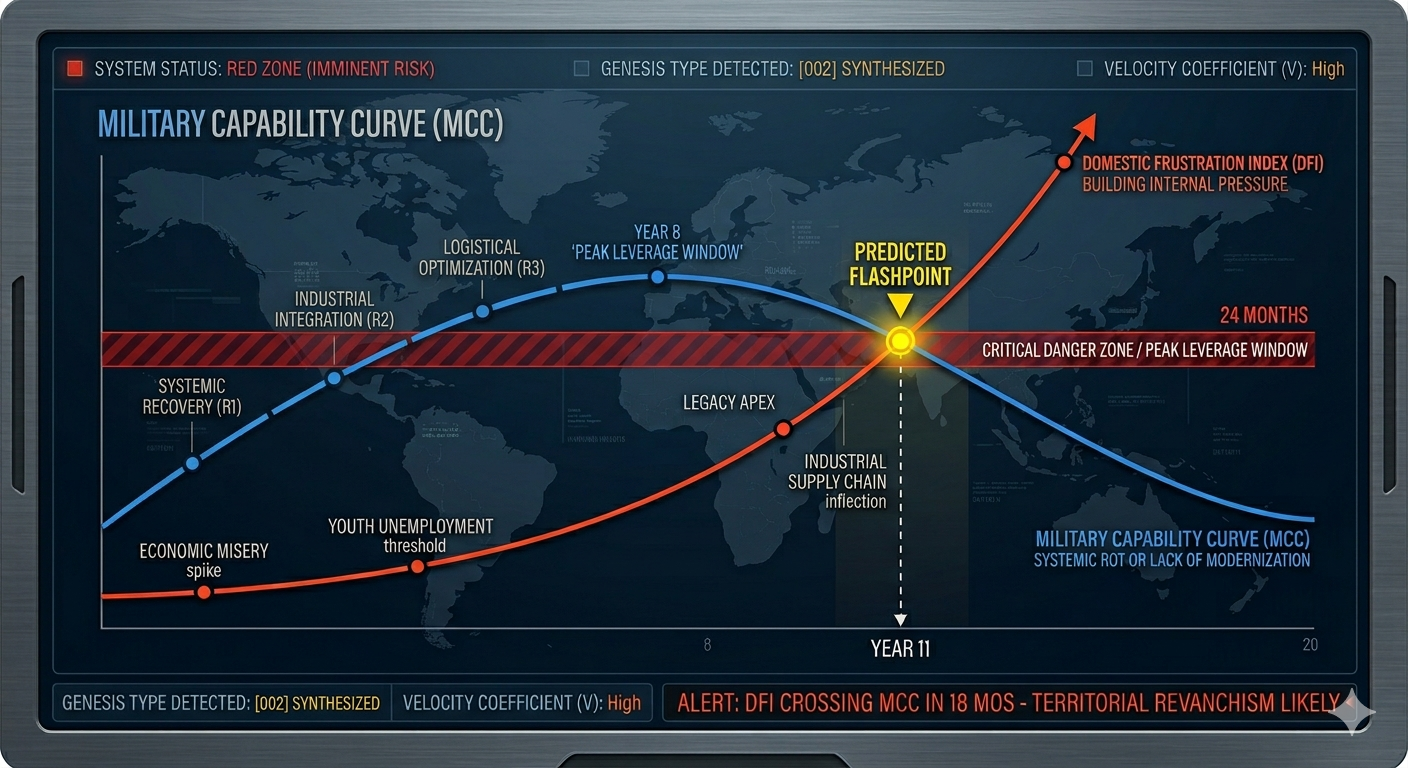
To understand the predictive power of the Domestic Frustration Index (DFI) and the Military Capability Curve (MCC), you must apply the Level 0 Genesis Setting as a "volatility modifier".
The Empires starting point fundamentally changes the shape of these curves and the nature of the inevitable intersection. When the DFI rises and the MCC falls, the "Flashpoint" isn't a single universal event; it is colored by the nation's ancestral code.
Here is how each Genesis Setting modifies the DFI/MCC trajectory:
1. Setting 001 — Rupture Genesis (I=0)
- The Curve Shape: Highly volatile. The MCC peaks rapidly but creates "financialized atrophy," where the military becomes too expensive to sustain in its current form. The DFI curve spikes vertically rather than climbing steadily, driven by internal tribalization and information wars.
- The Intersection (The Inward Fracture): Because these states lack ancient survival traditions, the intersection point doesn't produce an invasion of a neighbor; it produces an implosion of the state. The flashpoint is a constitutional or political paralysis where the regime can no longer govern, and the military becomes a point of contention between political factions rather than an instrument of state policy.
Predictive Warning: Look for the decoupling of the "Elite Financial Class" from the "General Population." When the distance between these two groups hits a critical threshold, the DFI will cross the MCC regardless of external threats.
2. Setting 002 — Synthesized Genesis (I=0.5)
- The Curve Shape: The classic "Rotting Foundation" model. The MCC is bolstered by inherited infrastructure, so it stays artificially high for a long time before suffering a rapid, systemic decline. The DFI climbs in lockstep with the regime's increasing authoritarianism (to suppress the rot).
- The Intersection (The Revanchist Lashing): The state is acutely aware of the intersection. When the DFI (internal misery) approaches the MCC (deteriorating military power), the regime has a "use it or lose it" window. They intentionally trigger an external conflict to reset the DFI through nationalism.
Predictive Warning: Watch the "Rhetoric Ratio." When state-controlled media shifts from "we are growing" to "we are under existential attack from outside forces," you are only a short time from the intersection.
3. Setting 003 — Continuous Genesis (I=1.0)
- The Curve Shape: Extreme elasticity. The DFI curve is "dampened" by the population’s historical memory—they have endured trauma before and are conditioned to survive it. The MCC curve is flatter; it doesn't peak as high as an I=0 power, but it rarely drops off a cliff.
- The Intersection (The Proxy Deferral): These states are masters at pushing the intersection indefinitely into the future. They offload their DFI into regional proxies and asymmetric conflicts, essentially exporting their internal frustration so it never has to cross the MCC internally. The intersection only happens if the external proxy network collapses and the frustration is forced back inside the borders.
4. Setting 004 - Borrowed Memory Depth Erosion Dynamic
A fourth modifier to the DFI/MCC trajectory, not present in the original three Genesis Settings, has been identified through the American and Norman case studies: the Borrowed Memory Depth Erosion Dynamic, which applies specifically to Setting 001 civilisations whose Memory Depth at the Genesis moment was drawn from an external intellectual tradition rather than from their own historical experience.
The specific vulnerability of Borrowed Memory Depth — as distinct from Native or Acquired Memory Depth — is that it can be forgotten in a way that Native Memory Depth cannot. A population cannot lose conscious access to its own lived historical experience of survival and reconstitution: that experience is embedded in cultural transmission at a level below conscious articulation, expressed through language, practice, and collective memory in ways that survive political disruption and educational neglect. A borrowed intellectual tradition, by contrast, is transmitted primarily through formal education, elite cultural practice, and the conscious maintenance of a textual inheritance — mechanisms that are vulnerable to disruption, neglect, and the progressive replacement of the originating tradition by alternative frameworks that compete for the same educational and cultural space.
The DFI/MCC modification produced by Borrowed Memory Depth Erosion is specific and predictable. In the early stages — Pioneer through Builder — the Borrowed Memory Depth functions at near-full effectiveness, because the founding generation and their immediate successors maintain direct conscious access to the intellectual tradition they inherited, understand its internal logic, and deploy it with the confidence of genuine comprehension. The DFI curve in this period is suppressed below the Setting 001 baseline, reflecting the stabilising influence of the borrowed institutional inheritance operating at full force. As the arc progresses into Stage 3 and Stage 4, however, the transmission of the borrowed tradition through formal education and elite cultural practice begins to attenuate — not catastrophically, but progressively, as each generation's understanding of the originating tradition becomes more formulaic and less comprehensively grounded than the preceding generation's. The constitutional circuit-breakers remain formally in place, but the norm enforcement mechanisms that give them operational force — the shared understanding of why the rules exist and what they are designed to prevent — begin to erode, because those mechanisms depend on a Memory Depth that is no longer being actively transmitted at the depth required to sustain them.
The practical consequence is a specific DFI acceleration pattern in Stage 4 to 5: the constitutional framework appears to hold while the psychological and cultural foundations that give it operational force are quietly degrading, producing a surface stability that masks a growing structural vulnerability. The DFI spike, when it comes, is therefore faster and more disorienting than the Setting 001 baseline would predict, because the borrowed Memory Depth had been suppressing the curve below its natural level while simultaneously eroding — and when the erosion crosses a critical threshold, the suppression effect disappears rapidly rather than gradually, producing the vertical DFI spike that the model associates with Setting 001 inward fracture rather than the steadier climb of a Setting 002 or Setting 003 civilisation approaching its flashpoint.
The diagnostic warning indicators for Borrowed Memory Depth Erosion are: the progressive replacement of substantive constitutional argument — engagement with the founding intellectual tradition's internal logic — by procedural constitutional argument — the exploitation of formal rules without regard for their purpose; the growing inability of the political class to articulate the philosophical foundations of the constitutional framework they are operating within; the reinterpretation of constitutional provisions in ways that their designers would have recognised as direct violations of the principles those provisions were designed to protect; and the increasing treatment of constitutional norms as optional conventions rather than as binding constraints, justified by the argument that the current emergency is exceptional enough to warrant suspension of the rules designed precisely to govern emergencies. Each of these indicators represents a stage of Borrowed Memory Depth Erosion, and their sequential appearance predicts the approach of the DFI spike with considerable accuracy.
Predictive Warning: The flashpoint is not tied to a date; it is tied to the "Containment Breach." If the proxy network fails to absorb the internal economic pressure, the DFI will spike vertically, creating an immediate, high-stakes military stand-off.
To return to the worked example with which this framework began: Rome in the mid-third century AD — approximately 235 to 284, the era historians label the Crisis of the Third Century — represents the clearest historical instance of a Setting 002 civilisation reaching the DFI/MCC intersection.
The Domestic Frustration Index was climbing steeply: currency debasement had destroyed the savings of the middle classes, the border armies were consuming revenues faster than the provinces could generate them, and fifty years of military usurpation had reduced the imperial office to a prize fought over by provincial generals.
The Military Capability Curve was simultaneously entering decline: not because Rome lacked soldiers, but because the administrative coherence required to direct them had fragmented. The intersection produced precisely what the model predicts for a Setting 002 state — a "use it or lose it" revanchist window, expressed in a series of desperate external campaigns that temporarily suppressed internal anger through nationalist momentum, before Diocletian's structural reforms attempted, with partial success, to deploy something resembling Interventions I and III simultaneously. That he largely succeeded in stabilising the system for another century is itself instructive: the model does not predict inevitable collapse, only the shape of the pressures that make collapse probable if left unaddressed.
| | |
|---|
Stage Duration Modifiers by Genesis Setting ▲ |
|---|
|
A recurring difficulty with macro-historical frameworks is the temptation to assign precise dates to psychological transitions that are, by nature, gradual and overlapping. The durations below are therefore expressed in generations rather than years — a generation being taken as approximately 25 years for these purposes — and should be read as indicative central estimates rather than hard boundaries. A civilisation does not cross cleanly from Stage 3 to Stage 4 on a particular date; what changes is which psychology is dominant in public life, while the preceding stage continues in diminishing form and the next begins to incubate. The Genesis Setting modifies not just the speed of transit but the character of the transition: a Setting 001 state moves fast and fractures sharply, a Setting 003 state moves slowly and decays in ways that are easy to misread as stability.
| Stage |
Setting 001 Rupture Genesis |
Setting 002 Synthesized Genesis |
Setting 003 Continuous Genesis |
| 0 Genesis |
1-2 generations. Clean break, rapid institution-building, high volatility from the outset. |
2-3 generations. New identity constructed over inherited structures; early stability masks latent bugs. |
Effectively indefinite. No clean start date; identity predates the current political iteration by centuries. |
| 1 Pioneer |
1-2 generations. Explosive and short. The catalyst event is usually ideological as much as military. |
2-4 generations. More measured; pioneer energy is partially absorbed by inherited administrative habit. |
3-5 generations. The pioneer phase is dampened by the weight of historical precedent; innovation is channelled rather than unleashed. |
| 2 Builder |
2-3 generations. Rapid commercialisation; debt structures form early and aggressively. |
3-5 generations. Classic expansion arc; trade networks extend over inherited infrastructure. |
4-7 generations. Slow, deep accumulation; the builder phase tends to be the most stable and least dramatic of the three settings. |
| 3 Satiated (Peak) |
1-3 generations. The peak is high but narrow; complacency sets in fast because there is no historical memory of failure to act as a brake. |
2-4 generations. A broad, recognisable golden age; the rot incubates slowly beneath a convincing surface. |
3-6 generations. The peak is lower in absolute terms but extremely wide; the population's trauma memory suppresses the worst excesses of Stage 3C. |
| 4 Anxious |
1-2 generations. Anxiety escalates rapidly into anger; the psychological distance between 4C and Stage 5 is short. |
2-3 generations. The classic slow squeeze; financial engineering extends the surface calm well past the point of structural soundness. |
3-5 generations. Anxiety is partially absorbed by historical fatalism — populations with deep memory accept hardship as cyclical rather than terminal, slowing the DFI climb. |
| 5 Angry |
1-2 generations. Tribal fracture is fast and total; without an ancient shared identity, the centre cannot hold. High risk of constitutional collapse rather than external aggression. |
1-2 generations. The revanchist window is short and high-stakes; the regime must act before the MCC falls below the DFI permanently. |
2-4 generations. Anger is exported through proxy conflicts and asymmetric pressure; internal tribalization is slower to reach critical mass. |
| 6 Defeated |
1-2 generations. Fragmentation is sharp; successor states form quickly from the tribal identities that replaced civic identity in Stage 5. |
2-3 generations. Decline is managed rather than catastrophic; administrative continuity often survives the political collapse in some form. |
3-5 generations. The political shell collapses but the civilisational identity persists; recovery and reconstitution under a new dynasty or framework is the typical outcome rather than terminal dissolution. |
Reading the table: the figures represent the typical duration of each stage as the dominant psychological mode — the period during which that stage's characteristics define public life, institutional behaviour, and elite decision-making. Stages overlap at their edges by roughly half a generation in either direction. A civilisation under severe external shock — pandemic, climate disruption, catastrophic military defeat — can compress any stage by one to two generations regardless of its Genesis Setting; the Setting modifies the baseline trajectory, not the response to acute external forcing events.
Total arc estimates: a Setting 001 civilisation typically completes the full cycle from Pioneer to Defeated in 10 to 17 generations (roughly 250 to 425 years). A Setting 002 civilisation runs 16 to 26 generations (400 to 650 years). A Setting 003 civilisation, if it completes the cycle at all, does so across 20 to 35 generations (500 to 875 years) — and frequently reconstitutes before reaching Stage 6C in its terminal form.
The Roman check: applying Setting 002 figures to Rome, the Pioneer phase runs from approximately the early Republic (500 BC) through the Punic Wars — roughly 4 generations. The Builder phase covers the late Republic's commercial expansion through the Augustan settlement — another 4 to 5 generations. The Satiated peak occupies the high imperial period from Augustus to the Antonines — 3 to 4 generations. The Anxious phase covers the third century crisis — 2 generations compressed by acute external shock. Stage 5 runs from Diocletian's reforms through the political fragmentation of the late 4th century — roughly 2 generations. Stage 6 plays out across the 5th century in the West, though the Eastern continuation (Byzantium) is itself a Setting 003 reconstitution and runs a separate arc entirely. The total Western arc sits at approximately 20 generations from Pioneer to Defeated — at the upper end of the Setting 002 range, consistent with Rome's unusually robust institutional inheritance.
|
|
|
;)


)
)