| 2. The Rise & Decline of Wealth |
|---|
| The Stock Market Bubble & Crash Lifecycle ▲ |
|---|
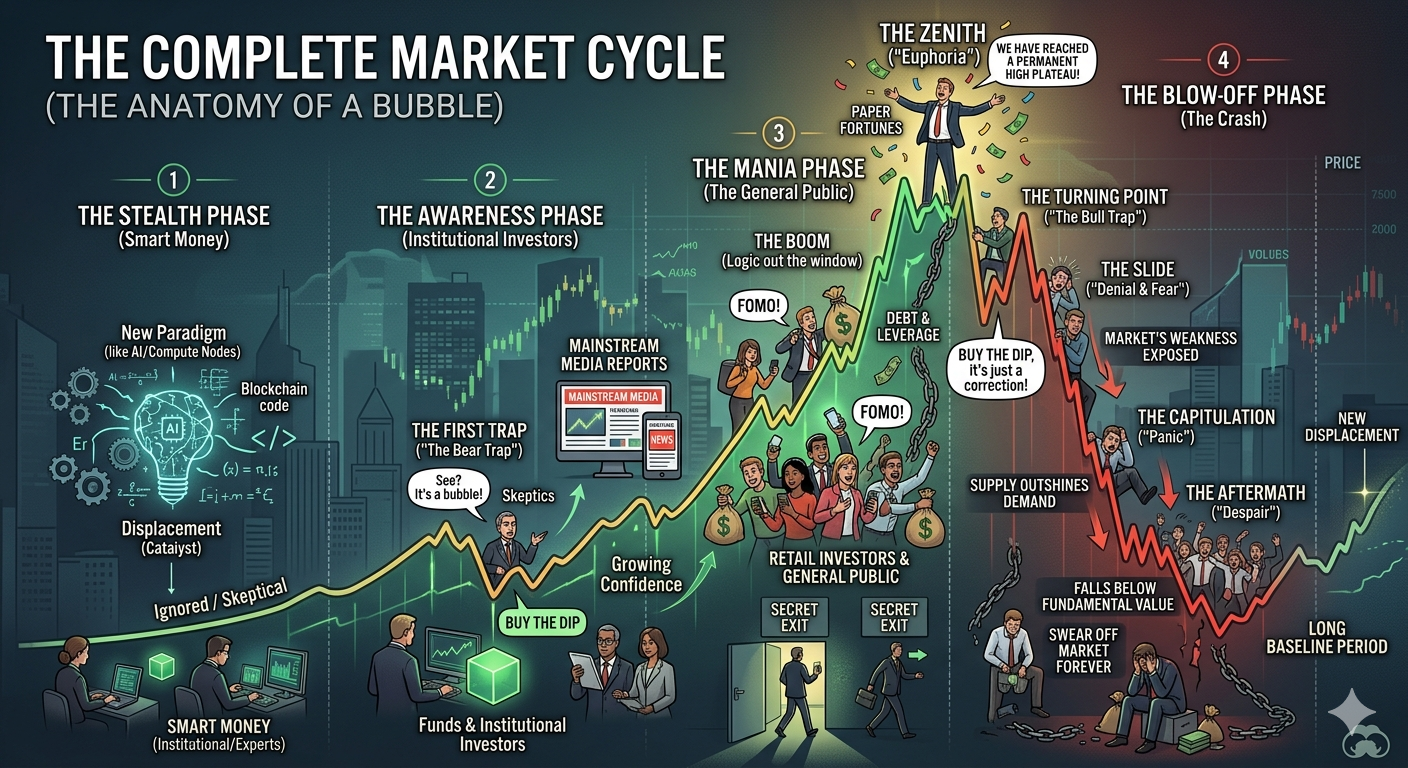
This image has been generated by Gemini AI to give a visual view of the process, there may be spelling errors, so please read the text below for full details.
1. The Stealth Phase (Smart Money)
The Catalyst ("Displacement"): A brand-new paradigm emerges—a breakthrough technology (like AI or the internet), a major shift in monetary policy, or a new asset class.
The Action: Only "Smart Money" (institutional investors and deep experts) notices the opportunity. They buy in quietly, cautiously, and cheaply.
The Sentiment: Ignored / Skeptical. Prices rise gradually, completely unnoticed by the general public.
2. The Awareness Phase (Institutional Investors)
The Momentum: More institutional investors and funds notice the steady upward trend and begin pouring money in.
The First Trap ("The Bear Trap"): Early investors cash in a few profits, causing a sudden, short-lived sell-off. Skeptics say, "See? It's a bubble!" But the smart money uses this dip to buy even more.
The Sentiment: Growing Confidence. Mainstream media begins noticing the trend and starts publishing highly positive reports.
3. The Mania Phase (The General Public)
The Boom: This is the steep, parabolic upward spike on the chart. Logic goes completely out the window, replaced entirely by psychology and FOMO (Fear Of Missing Out).
The Influx: Retail investors, the general public, and people with absolutely no understanding of market dynamics jump in. Money pours in rapidly, heavily backed by debt and leverage.
The Zenith ("Euphoria"): At the very absolute peak, "paper fortunes" are made daily. Experts make statements that "we have reached a permanent high plateau" and that "this time is different."
The Secret Exit: While the public is celebrating, the smart money and institutional investors are quietly pulling their money out and selling their assets.
4. The Blow-Off Phase (The Crash)
The Turning Point ("The Bull Trap"): A sudden drop occurs. The public, still trapped in euphoria, believes this is just a temporary dip and "buys the dip," thinking it will shoot back up. It doesn't.
The Slide ("Denial & Fear"): Prices keep dropping. Reality sets in. Investors try to defend their positions, but the market's fundamental weakness is exposed.
The Capitulation ("Panic"): The downward slope becomes vertical. The bubble completely bursts. High leverage turns into forced liquidations—everyone tries to sell at the same time to save whatever cash they have left. Supply drastically outshines demand, and the price drops as fast as it rose.
The Aftermath ("Despair"): The asset falls below its actual fundamental value. Investors are financially ruined, swear off the stock market forever, and the cycle bottoms out into a long baseline period until the next "displacement" begins the cycle anew.
| | |
|---|
Historic Stock Market Crashes ▲ |
|---|
1. Tulip Mania (1634–1637)
For a non-traditional asset class, the historic baseline is 17th-century Holland.
The Stealth/Awareness Phase: A mosaic virus introduced beautiful, unpredictable patterns onto tulip petals. Wealthy connoisseurs and botanists quietly paid premiums for rare bulbs.
The Mania Phase: The middle class and poor rushed in. People traded futures contracts (buying next year's harvest with money they didn't have). At the zenith, a single rare bulb was traded for properties, land, or an absurd list of livestock and luxury goods.
The Blow-Off Phase: In February 1637, an auction in Haarlem saw buyers fail to show up. Panic hit instantly. The curve went vertical as everyone tried to sell simultaneously to save whatever wealth they had left, leaving people holding worthless, unplanted roots.
2. The South Sea Bubble (1711–1720)
For an early model of corporate equity and government debt, the baseline is 18th-century Great Britain.
The Stealth Phase: In 1711, the British government faced massive national debt from the War of the Spanish Succession. In a grand "displacement," they created the South Sea Company, granting it a monopoly on British trade with Spanish America. "Smart money" insiders quietly bought shares cheaply, betting on government backing.
The Awareness Phase: By early 1720, peace was near, and the company offered to take over Britain's entire national debt. Capital from major funds and elite investors poured in, driving steady upward momentum. Brief profit-taking created a "Bear Trap," but institutional buyers bought the dip, and Parliament's official approval fueled media hype and growing confidence.
The Mania Phase: By summer 1720, logic evaporated into pure FOMO. The general public, lords, and servants alike rushed in, heavily leveraging themselves on 10% down payments. At the zenith, the stock went vertical to £1,000 per share, and absurd copycat "Bubble Companies" raised fortunes daily. Meanwhile, company directors and smart money quietly executed a secret exit, liquidating their holdings at the peak.
The Blow-Off Phase: In late August 1720, the tide turned. A sudden drop triggered a "Bull Trap" as the public tried to buy the dip, but the company's lack of actual trade revenue was exposed. Panic hit Exchange Alley. Forced debt liquidations caused a vertical freefall down to £124 by December, financially ruining thousands and entering a long baseline period of despair and harsh legal restrictions.
3. Railway Mania (Great Britain, 1840s)
For the quintessential example of an industrial infrastructure bubble, the baseline is 19th-century Britain.
The Stealth Phase: In the 1830s, steam-powered locomotives emerged as a world-changing technology (the displacement). Early engineering firms and astute industrial magnates quietly bought land and laid initial tracks, realizing railroads were massively more efficient than canals.
The Awareness Phase: By the early 1840s, the profitability of early lines became obvious to institutional capital. Parliament started streamlining the approval process for new track construction. Growing confidence rippled through London, and the media began hailing railways as the ultimate driver of human progress.
The Mania Phase: By 1845, logic vanished. The middle class, enticed by low interest rates, threw their life savings into railway stock. Thousands of competing companies formed, proposing redundant tracks that often made zero geographical sense. At the zenith, the "smart money" realized the country was building more tracks than the population could ever use and quietly dumped their shares.
The Blow-Off Phase: In late 1845, the Bank of England raised interest rates to combat inflation. A sharp market drop trapped retail investors who tried to "buy the dip." By 1846, the reality of unbuilt, useless lines caused a massive panic. The bubble burst vertically, bankrupting thousands of families and bringing British rail construction to a grinding halt for a generation.
4. The Wall Street Crash & Great Depression (1920s–1930s)
The Stealth Phase: Following WWI, groundbreaking new technologies emerged—automobiles, radio, commercial aviation, and widespread electricity. Smart money invested heavily in the industrial revolution of assembly lines.
The Awareness Phase: Banks and investment trusts caught on, creating massive funds to buy corporate shares, driving steady, confident upward momentum throughout the mid-1920s.
The Mania Phase: The "Roaring Twenties" saw the general public rush into the market. It was heavily fueled by debt—retail investors were buying stocks "on margin," needing only 10% cash down. Economists famously declared the market had reached a "permanently high plateau."
The Blow-Off Phase: In October 1929, the bubble burst. Initial dips were met with wealthy bankers trying to prop up the market (a temporary Bull Trap), but the sheer volume of forced margin liquidations caused a vertical freefall on Black Tuesday. The market collapsed 79%, entering a brutal decade of "Despair" known as the Great Depression.
5. The Japanese Asset Price Bubble (1986–1991)
The Stealth Phase: Following the 1985 Plaza Accord, the yen strengthened dramatically, threatening Japan’s export-driven economy. To compensate, the Bank of Japan slashed interest rates, flooding the system with cheap money (the displacement). Sophisticated corporations and major banks quietly began hoarding commercial property.
The Awareness Phase: As asset prices steadily ticked up, massive institutional funds and conglomerates began aggressively leveraging their existing property portfolios to borrow even more money, steadily pushing stock and real estate prices higher through the mid-1980s.
The Mania Phase: By 1989, absolute euphoria took over. The general public and corporations bought real estate on the assumption that "land prices in Japan never drop." At the absolute peak, the grounds of the Tokyo Imperial Palace were fictionally valued at more than all the real estate in the state of California combined. While the public celebrated the "Japanese Economic Miracle," smart foreign funds and savvy domestic insiders quietly began unwinding their equity exposures.
The Blow-Off Phase: In early 1990, the central bank drastically raised rates to pop the bubble. An immediate market slide caught retail investors off guard, but they stayed in denial, expecting government intervention. Instead, credit markets froze, triggering a massive, vertical unwinding of debt. Real estate and Nikkei stock prices plummeted over 60%, sending Japan into a decades-long baseline period of economic stagnation known as the "Lost Decades".
6. The Dot-Com Bubble (1995–2001)
The Stealth Phase: In the early 1990s, the internet emerged as the "Displacement". Early tech experts and venture capitalists began investing quietly in fundamental infrastructure, networking hardware (like Cisco), and early web software.
The Awareness Phase: By the mid-to-late 90s, institutional capital poured in. There were sharp pullbacks—such as fears surrounding the Asian Financial Crisis in 1997—which served as "Bear Traps," but institutional money bought the dip, and mainstream media heralded the internet as the "New Economy".
The Mania Phase: By 1999, logic was completely gone. Companies with no revenue added ".com" to their names and saw their stock double overnight. During the 2000 Super Bowl, 20% of all commercials were bought by dot-com startups. At the absolute zenith, tech leaders made statements that old valuation metrics no longer applied. Meanwhile, insiders and "smart money" executives quietly liquidated billions in stock.
The Blow-Off Phase: The NASDAQ peaked in March 2000. A minor drop was met with fierce "buy the dip" rhetoric (the Bull Trap). But reality set in as companies ran out of cash. Panic took over, liquidations forced vertical drops, and highly hyped companies like Pets.com completely vanished. It took over a decade for the market to fully recover.
7. The U.S. Housing Bubble (2000s–2008)
The Stealth Phase: After the Dot-Com crash, the Federal Reserve slashed interest rates. Smart money noticed a major displacement: complex financial engineering (Mortgage-Backed Securities and CDOs) allowed mortgages to be packaged and sold seamlessly.
The Awareness Phase: Major investment banks and hedge funds began buying up these mortgage packages in massive volumes, driving housing prices steadily upward.
The Mania Phase: By 2005, FOMO swept the general public. Ordinary people with no financial background were buying multiple properties using zero-down, adjustable-rate debt. The consensus was that "housing prices never go down." At the peak, the smart money (famously chronicled in The Big Short) realized the underlying loans were worthless and quietly shorted the market or exited their positions.
The Blow-Off Phase: In 2007, housing prices plateaued and started dropping. The "Bull Trap" convinced many that it was a local correction. By 2008, systemic weakness exposed major investment banks, leading to panic, forced liquidations, and the Global Financial Crisis.
| | |
|---|
The Mega-Rich Generational Lifecycle ▲ |
|---|
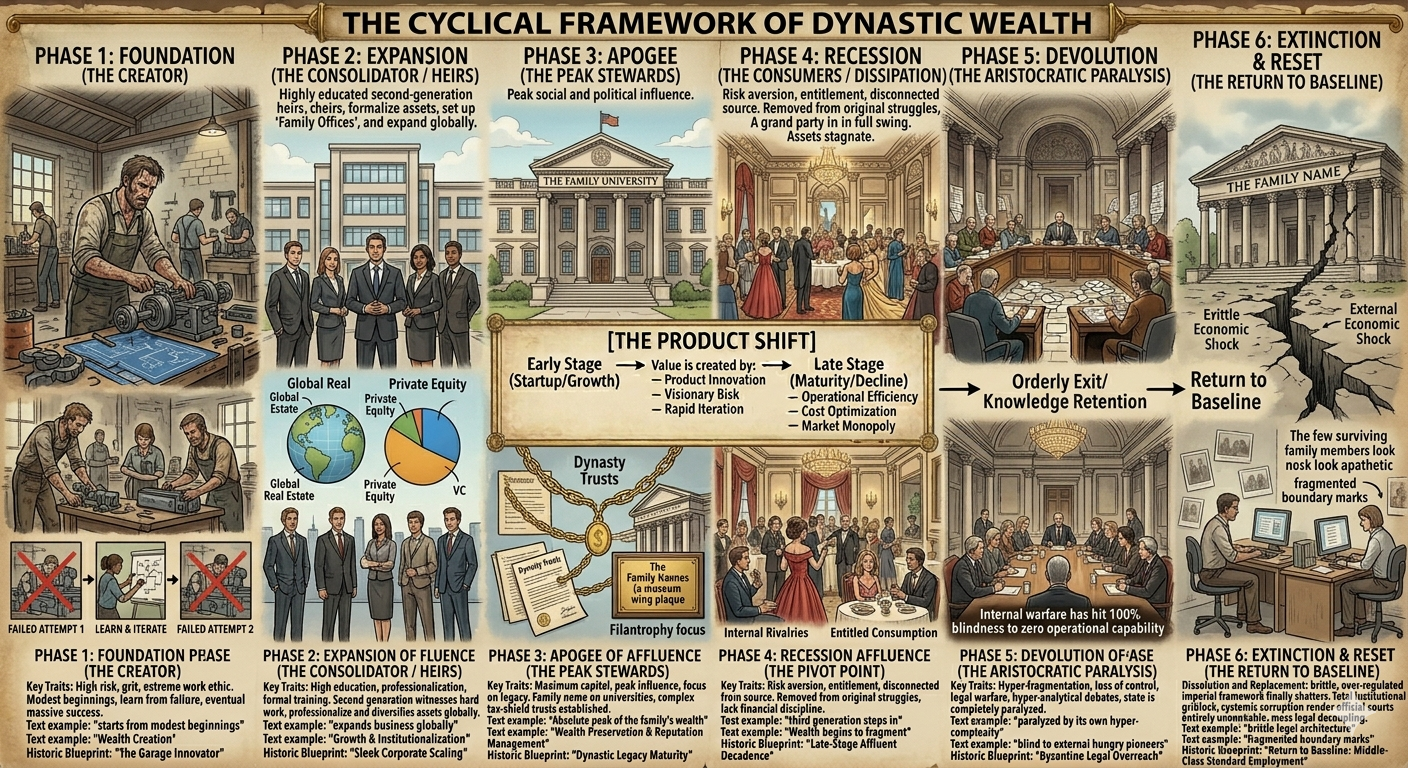
This image has been generated by Gemini AI to give a visual view of the process, there may be spelling errors, so please read the text below for full details.
1. Foundation (The Creator)
Key Traits: High risk tolerance, extreme work ethic, grit, and sacrifice.
The Reality: The first generation typically starts from modest or austere beginnings. They suffer multiple failed business attempts, learn from them, and eventually strike massive success.
Financial Mindset: Wealth Creation. Money is viewed as a fluid tool for leverage and expansion. They spend very little on luxury early on because they are addicted to the grind of building the empire.
2. Expansion (The Consolidator / Heirs)
Key Traits: High education, formal training, professionalization of assets.
The Reality: The second generation grows up in the presence of capital but still remembers or witnesses the hard work of the parents. They focus on expanding the business globally, setting up Family Offices, and diversifying into institutional real estate, private equity, and venture capital.
Financial Mindset: Growth & Institutionalization. The risk appetite begins to drop slightly compared to the founder, but they possess the institutional knowledge to scale the wealth safely.
3. Apogee (The Peak Stewards)
Key Traits: Maximum capital, peak social/political influence, heavy focus on legacy and philanthropy.
The Reality: This is the absolute peak of the family’s wealth and power. The family name is on university buildings or museum wings. Complex legal structures like Dynasty Trusts, irrevocable trusts, and private foundations are established to shield the wealth from taxes.
Financial Mindset: Wealth Preservation & Reputation Management. The strategy shifts entirely from "how do we make more" to "how do we not lose it".
4. Recession (The Consumers / Dissipation)
Key Traits: Risk aversion, disconnection from the source of wealth, entitlement.
The Reality: This is usually where the third generation steps in. Removed from the original struggles of the founder, they often lack the financial discipline, economic education, or emotional attachment to the family business.
The Downward Slide: Wealth begins to fragment drastically because the family pool has grown larger (more cousins, aunts, uncles drawing from the same pot). Entitled consumption rises while asset performance stagnates due to poor governance, internal family rivalries, and a lack of entrepreneurial drive.
5. Devolution (The Aristocratic Paralysis)
Key Traits: Hyper-fragmentation of assets, acute entitlement, loss of operating control, and legal warfare.
The Reality: The wealth is split into so many small trust distributions among dozens of distant heirs that it loses its concentrated "mega" status. The family business or family office is no longer run by visionaries, but is entirely managed by expensive, risk-averse third-party trustees, compliance officers, and lawyers.
The Downward Slide: Internal family rivalries turn toxic. Core capital is aggressively eroded not by market failures, but by devastating divorce settlements, lifestyle inflation, luxury upkeep, and multi-million dollar lawsuits between family members fighting over a shrinking pot. The family is utterly blind to the reality that their operational capability has hit zero.
6. Extinction & Reset (The Return to Baseline)
Key Traits: Complete capital depletion, total loss of status, and transition back to standard employment.
The Reality: The final, brittle remnants of the dynasty completely shatter under the weight of inflation, tax events, or an external economic shock. The remaining trusts dissolve entirely. The family name is quietly stripped off buildings or forgotten, and the descendants lose all access to institutional privilege.
The Cycle Closes: The family effectively transitions completely back to the middle class, working regular nine-to-five jobs. They possess nothing of the founder’s empire except old stories and faded photographs. The "civic muscle" of wealth creation has been totally reset to zero, leaving the next generation with no choice but to start the entire lifecycle all over again from scratch.
How the 1% Break the Cycle:
The very few families who survive this lifecycle for centuries (like the Rothschilds or Rockefellers) do so by transitioning from a family business to a strict Family Governance System. They treat descendants not as consumers of a pool of money, but as "stewards of a corporate legacy," actively cutting off heirs who refuse to undergo rigorous financial literacy training.
| | |
|---|
Other Rise and Decline documents ▲ |
|---|
|
The pages below show links to documents that reference pages concerning Rise and Decline.
For the individual pages please click on the links, new documents will be auto populated as and when these
are written.
| |
|
|
;)










)
)