| Battle of Hastings 1066AD - D - Sailing - Dives sur Mer to St Valerie |
|---|
| Research Brief: Meteorological Modeling and the Dual Naval Crisis of the Dives-to-Somme Transit (September 1066) |
|---|
|
Abstract: This section analyzes the turbulent maritime movements of the Anglo-Norman and Anglo-Saxon fleets during the early September storm of 1066, reconstructing the micro-meteorological event that altered the defensive balance of the English Channel. Driven by a fast-moving Atlantic low-pressure system displacing a persistent blocking high, the storm simultaneously caught both rival armadas at sea. For Duke William, the veering west-northwest winds forced a hazardous coastwise relocation from Dives-sur-Mer to Saint-Valery-sur-Somme; a quantitative audit cross-referencing the Ship List at Dives (777 hulls) against Master Wace’s count at the Somme (694 hulls) reveals a net loss of roughly 83 supply vessels along the Alabaster Coast. Crucially, the same system struck King Harold Godwinson’s fleet on its return to London. Many of the Saxon vessels foundered in the Channel or were driven aground along the southern coast. This single meteorological anomaly effectively damaged both William and Harold's fleets
|
| |
|---|
Introduction ▲ |
|---|
William the Conqueror's invasion of England in 1066 is one of the most studied military operations in history. But between the assembly of the fleet at Dives-sur-Mer and its eventual crossing to England, something went badly wrong — and William went to considerable lengths to make sure nobody found out.
A storm appears to have struck the Norman fleet as it left Dives. The slower, non-oared transport and supply ships were driven along the Alabaster Coast by a wind that veered from west to north-west, and as the low-pressure system approached, the pressure gradient between it and the residual high to the north would have increased, leading to strengthening winds. This escalation in wind strength, combined with a veering wind direction, would have made control of slower supply vessels particularly difficult, increasing the likelihood of wrecks along the exposed French coast.
The faster warships with oarsmen fought through to St Valérie-sur-Somme. William had his drowned men buried in secret.
The difference between the ship count recorded in the Ship List at Dives — 777 vessels — and Master Wace's figure of 694 ships leaving St Valérie suggests that approximately 83 ships were lost. At the likely composition of those vessels, this was not primarily a loss of fighting men. It was a loss of horses, fodder, food and equipment — the supplies an invading army needed to survive once it landed.
This page examines what the storm did, why the secrecy mattered, and what the weeks of further delay at St Valérie may really have been about. The wind was part of it. But William may also have been waiting for something else entirely.
The movement of the fleet from Dives to Saint-Valery-sur-Somme can be interpreted within a wider atmospheric pattern affecting September 1066. A persistent high-pressure system over northern England or the North Sea likely produced prolonged northerly winds in the Channel, preventing a direct crossing. The events described here may represent a transitional phase as this blocking pattern began to weaken.
|
| |
|---|
Dives to St Valerie ▲ |
|---|
There is only one Chronicle referring to this event, so it is not corroborated hence shown in red:
There is very little documentary evidence for this part of the journey, however the following is from the 'The Gesta Guillelmi of William of Poitiers':
Presently the whole fleet, equipped with great foresight, was blown from the mouth of the Dives and the neighboring ports, where they had waited for a south wind to carry them across, and was driven by the breath of the west wind to moorings at Saint-Valery.
There too the leader, whom neither the delay and contrary wind nor the terrible shipwrecks nor the craven flight of many who had pledged their faith in him could shake, committed himself with the utmost confidence of prayers, gifts and vows, to the protection of heaven.
Indeed meeting adversity with good council, he concealed (as far as he could) the loss of those who drowned, by burying them in secret; and by daily increasing supplies he alleviated want. By divers encouragements he retained the terrified and put heart into the fearful.
|
The trip from Dives appears to have been very bad, so most likely the wind started from the South which would take the fleet into the Channel and then the wind veered to the West and built up into a storm which blew the fleet along the Normandy Coast to St Valerie, where a large number of ships were destroyed.
The daily increase in supplies could have meant that the fleet support ships had been wrecked and that William was desperately trying to get supplies from the towns near to St Valerie. These would all take time to reach the port, but as time passes more and more would reach St Valerie.
Master Wace has a different version
The duke rejoiced greatly at receiving the gonfanon, and the license which the apostle gave him. He got together carpenters smiths and other workmen, so that great stir was seen at all the ports of Normandy, in the collecting of wood and materials, cutting of planks, framing of ships and boats, stretching sails, and rearing masts, with great pains and at great cost. They spent all one summer and autumn in fitting up the fleet and collecting the forces; and there was no knight in the land, no good Serjeant, archer, nor peasant of stout heart, and of age for battle, that the duke did not summon to go with him to England: promising rents to the vavassors, and honors to the barons.
When the ships were ready, they were moored in the Somme at St Valeri, and there delivered to the barons. Many were the ships and boats in the river there, which is called the Somme, and separates Ponthieu and Vimou. Vimou extends as far as Ou, which separates Normandy from Vimou, a country under different government. Ou is a river, and Ou is also a fair castle situate upon that river.
Master Wace Chronicle was written some time after the event so the story of the storm and loss of life may have been removed by William.
As St Valerie was not part of Normandy then it would seem unlikely that William would risk his ships being brought together in a foreign country, and Dives would seem more likely.
There is another issue with St Valerie, as it is close to the coastal cliffs of Northern France the wind needs to come from the South or South East for sailing ships to leave the Somme estuary safely, whereas in Dives you can leave the harbour with a South West, South or South East breeze. The prevailing wind in the Channel is South West hence Dives is a better harbour to sail from.
|
A likely course of the storm ▲ |
|---|
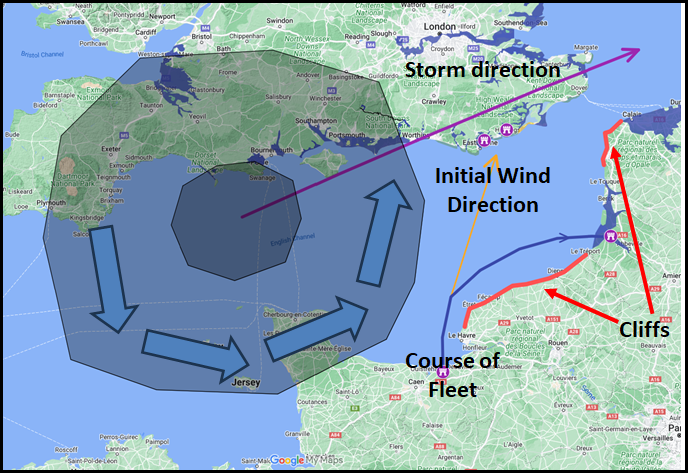
The above map shows a possible scenario that explains why William's fleet landed at St Valerie sur Somme.
While low-pressure systems rotate anti-clockwise, the key factor for the fleet would have been the shifting wind field on the southern edge of the system, rather than the precise track of the storm centre.
The Normans leave Dives with a South West wind heading towards Pevensey (orange line) as they reach the Channel the storm moves quickly up the channel (purple line). The wind would then veer to the West and push the ships along the Alabaster Coast. As they start to get towards St Valerie, the storm would then make the wind direction change from West to North West pushing the ships towards the cliffs on the French Coast (shown in red). The faster ships with rowers carrying the troops would probably made it to St Valerie, but the slower non oared supply ships would have been wrecked probably between Dieppe and Le Treport by being blown onto the cliffs.
A more meteorologicaly correct explanation is that the fleet departed Dives during a brief southerly or south-westerly airflow on the southern flank of a high-pressure system. As the blocking pattern weakened, Atlantic low-pressure systems would have begun to move in from the west. This would cause the wind to veer progressively from south-west to west and then north-west, increasing in strength as the pressure gradient tightened.
Such a sequence would naturally drive vessels eastward along the Normandy coast and then towards the cliffs between Dieppe and Le Tréport, accounting for the reported losses.
|
| |
|---|
The Path of Storm Benjamin 23rd Oct 2025 ▲ |
|---|
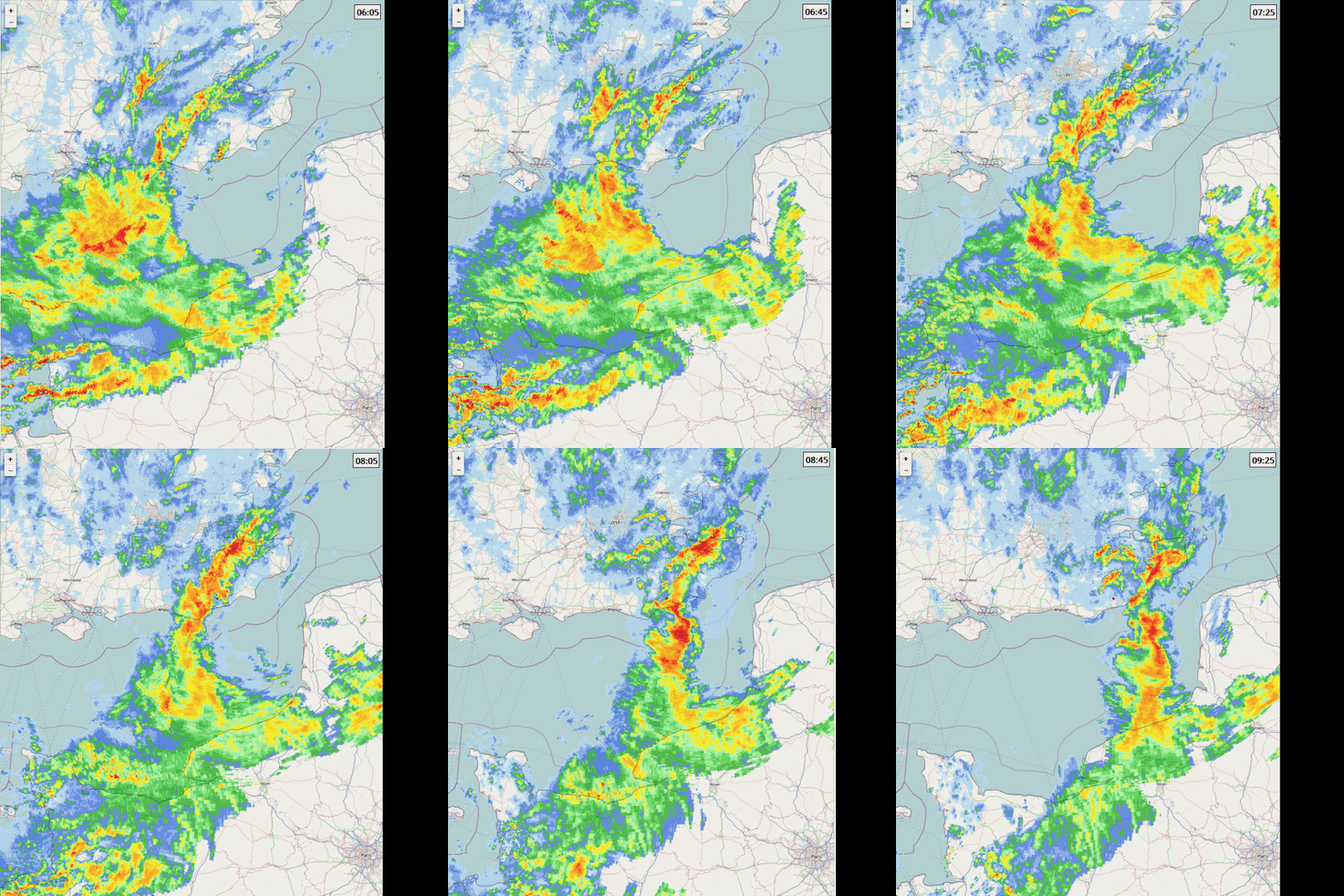
This is an animation of Storm Benjamin that passed by 23/10/2025 that shows the wind changes along the French coast and in the Channel, this animation is based on a time lapse from https://www.netweather.tv, and shows the type of storm from the last image. My interpretation of the 1066AD Storm is that it took an North Westerly course as the weather in the Channel normally takes.
|
Damage to the Norman Fleet between Dives and St Valerie ▲ |
|---|
There are two sources of information regarding the vessels sailing to Britain, the first is the Ship List of William the Conqueror which describes the Williams Fleet presumably before leaving Dives with 777 ships.
The second reference is from Master Wace who reports'but I heard my father say I remember it well, although I was but a lad that there were seven hundred ships, less four, when they sailed from St. Valeri ; and that there were besides these ships, boats and skiffs for the purpose of carrying the arms and harness. I have found it written (but I know not whether it be true) that there were in all three thousand vessels bearing sails and masts. Any one will know that there must have been a great many men to have furnished out so many vessels.'
For further ideas about the weather in September 1066 please click here.
|
The Saxon Fleet in the Same Storm ▲ |
|---|
|
The Anglo-Saxon Chronicle records that on 8 September 1066, Harold stood down his army and fleet at the Isle of Wight, no longer able to keep them provisioned. The ships were driven to London, and the Chronicle notes plainly that many perished before they came thither — losses that standard accounts pass over almost without comment. The most probable route took the fleet east to Pevensey on the 8th, staging overnight, before continuing northeast toward the Thames on the 9th. Within the same timeframe, William's fleet attempted its crossing from Dives-sur-Mer.
The meteorological picture that emerges is of a single fast-moving depression tracking northeast up the Channel. The Normans at Dives used an initial southeasterly to clear harbour and enter the Channel, the wind backing through east as the system approached, before the trailing westerlies drove the slower supply ships northeast along the Alabaster Coast to Saint-Valery. The Saxon fleet ahead of the storm would initially have had an easterly following wind on the passage toward the Thames — useful, fast, unremarkable — until the depression overtook them near Dover and the wind shifted abruptly to northwesterly, turning their following wind into a trap and driving them onto the lee shore of the Kent coast with no sea room to claw off.
Both fleets were caught on opposite sides of the same rotating depression, within hours of each other, on a channel barely twenty-five miles wide at the Strait. Standard histories keep these two disasters in separate chapters — one English, one Norman — and so miss what the dates and geography together suggest: a single cross-Channel fleet crisis, both navies crippled by the same September storm.
|
| |
|---|
The Hastings Intelligence Connection ▲ |
|---|
|
The composition of Harold's fleet at the Isle of Wight can be inferred from the Anglo-Saxon Chronicle's 1052 entry, which records Earl Godwin collecting ships from Hastings, Romney, Hythe, Folkestone, Dover, Sandwich and Pevensey on his return from exile. The same ports would have furnished ships to Harold's fleet fourteen years later. Among them, Hastings occupied a singular position. The town had attacked Harold's brother Swein in 1049, had been administered by Fécamp Abbey for fifty years, and had structural economic ties to Normandy through the fish trade and wine imports that the abbey controlled. Hastings loyalty lay with the Norman royal line, not the Godwins. When Harold stood down his fleet on 8 September and the ships dispersed toward Pevensey, one Hastings vessel crossing south rather than east would have been unremarkable in the general movement. The crossing from the Isle of Wight to the Normandy coast is some eighty miles — achievable within a day. If such a vessel reached Dives on the 8th or 9th, it would explain what has never been satisfactorily accounted for: why William moved when he did. Hastings may have been feeding intelligence to Normandy throughout the summer, and the stand-down of the Saxon fleet was simply the last and most important report. That William rewarded Hastings with the headship of the Cinque Ports after the Conquest — granting it primacy over the entire English coastal administration, including Sandwich which held the superior naval infrastructure — was not simply administrative convenience. It was a debt repaid in institutional form.
|
| |
|---|
Conclusion ▲ |
|---|
If the Williams Ship List showing 777 ships and Master Wace's 694 ships leaving St Valerie are true then the fleet would have lost 83 ships between Dives and St Valerie.
If the figures recorded in later sources are broadly accurate, the fleet may have suffered significant losses during this phase, potentially exceeding 10%. However, given the limited and conflicting sources, this should be treated as indicative rather than definitive. This would make the report from William of Poitiers of concealment of the drowned fairly important, as there would have been a significant number possibly in the hundreds of troops, horses and a great deal of supplies.
William secretly buried the drowned, and simultaneously faced an urgent shortage of supplies that required daily replenishment from the surrounding area.
The most logical explanation linking these two facts is that the ships lost in the storm were predominantly the slower, non-oared transport and supply vessels. These would have been the last to leave Dives, the least able to fight the storm, and the most likely to be wrecked on the Alabaster Coast cliffs as the wind shifted from West to North West. The faster troop-carrying warships, with oarsmen able to work against the weather, would have made St Valerie.
This means William arrived at St Valerie with most of his army largely intact — but critically short of food, fodder for the horses, and equipment. The secret burials were not simply about morale. A public count of 83 lost ships would have immediately revealed the scale of the supply crisis to every soldier waiting on the beach. Panic and mass desertion would have followed.
The urgent sourcing of replacement supplies from towns near St Valerie, and the weeks of further delay at St Valerie waiting for a favourable wind, now take on a different meaning: William may not simply have been waiting for the wind. He may also have been waiting until he had enough food to sustain an invasion.
|
Bibliography ▲ |
|---|
Primary Sources (as cited on this page)
Taylor, Edgar, trans. Master Wace: His Chronicle of the Norman Conquest from the Roman de Rou. London: William Pickering, 1837.
→ Source for the fleet size at St Valerie (694 ships) and the description of the Somme anchorage.
William of Poitiers. The Gesta Guillelmi of William of Poitiers. Edited and translated by R. H. C. Davis and Marjorie Chibnall. Oxford Medieval Texts. Oxford: Clarendon Press, 1998.
→ Sole contemporary account of the storm-driven passage from Dives to St Valerie, including the secret burials and supply crisis.
Fleet Lists & Naval Logistics
“The Ship List of William the Conqueror.” [Manuscript source to be confirmed by site owner].
→ Cited as the source for 777 ships at Dives. Requires verification and full citation.
Meteorological Data & Storm Modelling
Netweather.tv. “Storm Benjamin – 23rd October 2025.” Time-lapse animation. https://www.netweather.tv.
→ Real-time storm track used as a modern analogue for the 1066 weather system. Demonstrates anti-clockwise rotation and wind veering from SW → W → NW.
AI Historical Analysis
DeepSeek AI. “Is it probable that the Norman fleet in 1066AD was blown by a storm from Dives sur Mer to St Valerie?” Generated for SaxonHistory.co.uk, November 2025. https://saxonhistory.co.uk/FORMS-Page-Builder.php?Pg=1066AD_Williams_route_across_the_Channel_Dives.
→ Synthesis of primary sources and meteorological probability, published integrally on this page.
|
|
;)

)
)