| Battle of Hastings 1066AD - O -
The Long March from York - The Messenger Network |
|---|
| Introduction ▲ |
|---|
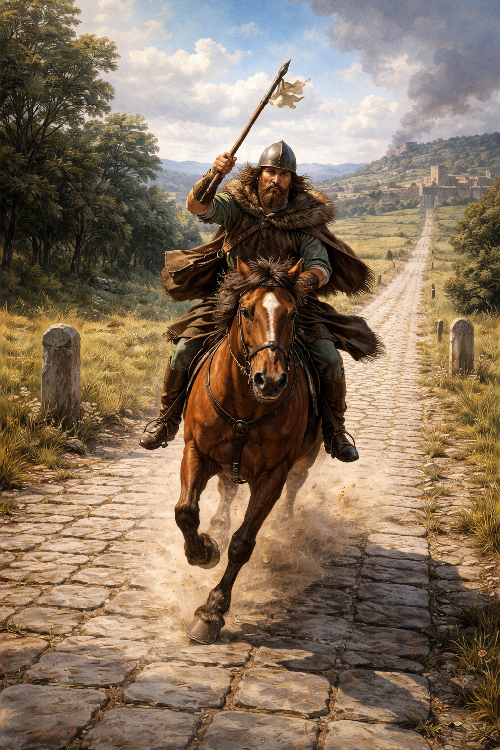 When William's fleet landed at Pevensey on 28th September 1066, Harold was in York celebrating his victory at Stamford Bridge. The news had to travel 280 miles north before he could respond, and then a summons had to fan out simultaneously across the entire kingdom. The speed at which that happened determined not just when Harold marched, but which troops from which counties could reach Hastings before 14th October.
Master Wace, writing around 1160, records the following counties as having sent troops to fight at Hastings:
"Those of London had come at once, and those of Kent, of Herfort, and of Essesse; those of Suree and Sussesse, of St. Edmund and Sufoc; of Norwis and Norfoc; of Cantorbierre and Stanfort; Bedefort and Hundetone. The men of Northanton also came; and those of Eurowic and Bokin keham, of Bed and Notinkeham, Lindesie and Nichole. There came also from the west all who heard the summons; and very many were to be seen coming from Salebiere and Dorset, from Bat and from Sumerset. Many came too from about Glocestre, and many from Wirecestre, from Wincestre, Hontesire, and Brichesire; and many more from other counties that we have not named, and cannot indeed recount."
This is not a list of counties close to Hastings. It includes Gloucester, Worcester, Somerset, Norfolk, Yorkshire and Chester — places between 130 and 300 miles from the battlefield. For troops from those counties to have arrived in time, the summons must have reached them within days of William's landing. The calculations on Page L2 show that a messenger speed of approximately 70 miles a day is not a best-case assumption — it is a minimum requirement. Drop below it and the counties Wace names start disappearing from the possible list. The messenger system either worked at close to 70 miles a day, or Wace's account of the army's composition is wrong. Since Wace's county list is detailed and otherwise coherent, the more productive question is what kind of system could have sustained that speed — and how long it had been operating.
It is important to be clear about what follows. There is no document that directly describes a Saxon royal messenger network. No chronicle names the waypoints, no administrative record lists the horses, no royal decree survives ordering the system into operation.
What is presented here is reasoned inference from circumstantial evidence — the Roman infrastructure that preceded it, the Saxon institutions that could have sustained it, the military behaviour of successful Saxon kings that is difficult to explain without it, and above all Wace's county list, which is the closest thing we have to a performance record of the system in operation. The argument is that this is the most parsimonious explanation for evidence that would otherwise be very hard to account for. Readers should weigh it as inference, not established fact — but inference grounded in six centuries of institutional continuity and the hard arithmetic of who could have reached Hastings in time.
The answer takes us back not to 1066, but to 43AD.
|
Chronicle references — the warning reaches Harold ▲ |
|---|
Master Wace gives the most detailed account.
A knight from the local area concealed himself behind a hill and watched the Norman landing carefully — the archers coming ashore, the knights following, the carpenters unloading timber, the fort being constructed, the fosse dug around it. Only when he had seen and understood the full scale of what had arrived did he gird his sword, take his lance, and ride for Harold. Wace then describes him journeying on by night and by day, resting late and rising early. Two things are worth noting. First, the knight did not leave the moment the ships appeared — he waited long enough to observe the fort being built, which takes hours. The delay is small but it matters for the timeline. Second, this is one man on one horse riding through the night — the image of individual heroism that serves a Norman narrative purpose, as discussed below.
The Carmen de Triumpho Normannico
describes a man hiding under a sea cliff who watches the invasion, then runs to mount a horse and rides to find the king. The Carmen then adds a detail that contradicts Wace's implied endpoint: the king returns from war bearing joyful spoils — the messenger meets him. Harold is not in York when the messenger finds him. He is already moving — returning south from Stamford Bridge, still on the road, when the warning arrives. The messenger does not ride all the way to York. He intercepts Harold somewhere on the journey south.
The Quedam Exceptiones supports this directly:
while he was returning from this slaughter he met a messenger on the way who revealed the fleet of the Normans had landed at Hastingas. Again Harold is on the road, not in York. The messenger meets him in transit.
Henry of Huntingdon contradicts both.
He places Harold at dinner in York when the messenger arrives. This is the most dramatic version — the king celebrating his great victory, the messenger bursting in with catastrophic news — and it may be the least reliable for exactly that reason. It is a better scene than a chance meeting on a road in Lincolnshire.
The balance of the evidence favours the Carmen and Quedam Exceptiones over Henry of Huntingdon. Two independent sources agree that Harold was already moving south when the warning found him — which is entirely plausible given that Stamford Bridge was fought on 25th September and Harold had no military reason to remain in York once the battle was won. If he left York on 26th or 27th September and the messenger rode north from Hastings on 28th September, they could have met somewhere on Ermine Street between York and Lincoln as early as 1st or 2nd October.
This has a significant implication for the timeline. If Harold received the news on the road rather than in York, and immediately activated the messenger network from whatever point on Ermine Street the meeting occurred, the summons begins propagating through the network a day or two earlier than the York arrival model allows. Every hub on every road receives the message sooner. Every county gets more time. Every marginal county on Wace's list moves from borderline to achievable.
The single knight riding day and night remains in the sources.
What the sources do not tell us — and what the county list proves must have happened — is what followed the moment Harold received that knight's news. The single messenger activated a network. The network did the rest.
|
The Roman Foundation ▲ |
|---|
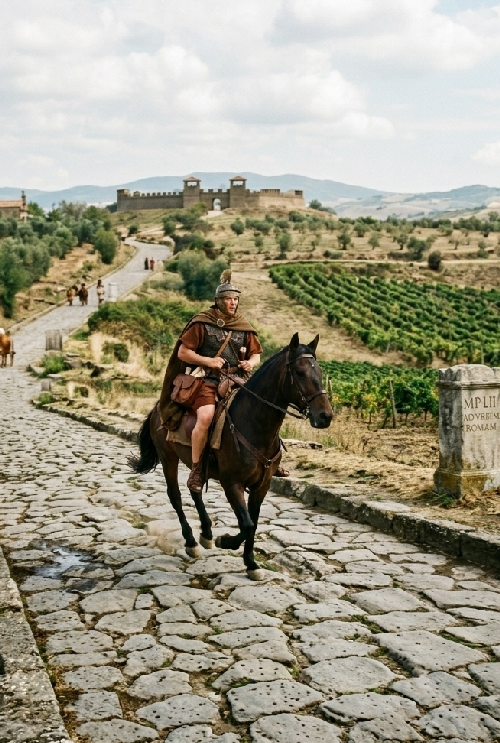 The Romans built the cursus publicus — a state courier relay system covering the entire empire, running along all major roads, with way stations (mansiones) at approximately one day's ride apart. Fresh horses were available at each station, accommodation provided for official travellers, and the whole system was maintained by imperial taxation and administration. In Britain this network followed the roads radiating from London: north on Ermine Street, northwest on Watling Street, southwest toward Winchester and the west, northeast toward Colchester and Norfolk. It allowed messages to travel at sustained speeds no single horse and rider could achieve — because it was a relay system, not an endurance ride.
The speed the cursus publicus could achieve is documented in Roman sources and gives us a baseline against which to measure what the Saxon system needed to deliver. The service operated at two tiers. The slower wagon service (cursus clabularis) carried heavy government supplies at approximately 25 to 30 miles a day — the equivalent of a baggage train. The fast courier service (cursus velox) used relay horses changed at every mansio, and official records suggest this could sustain 50 miles a day routinely for military dispatches, rising to 100 miles a day for urgent imperial communications. Julius Caesar recorded travelling 100 miles a day on campaign. Tiberius is recorded as covering 200 miles in a single day to reach his dying brother Drusus, though that is considered exceptional even by Roman standards.
The figure historians use for routine official military communication in the Roman system is 50 miles a day sustained over multiple days, with genuine emergencies pushing toward 100. The 70 miles a day that Wace's county list requires of the Saxon system in 1066 sits comfortably within that range — above routine Roman operational speed but well below emergency Roman speed. This is not a claim that the Saxons achieved something the Romans could not. It is a claim that they maintained something close to routine Roman operational performance using the same physical infrastructure, with Saxon institutions — burhs, monasteries, thane households — replacing the Roman mansiones as the waypoints. That is a conservative claim, not an ambitious one, and the Roman speed record is what makes it so.
The cursus publicus operated in Britain for approximately 360 years, from the Claudian invasion of 43AD to the early 5th century. Three and a half centuries is long enough for a communication system to become embedded not just in administration but in the physical landscape and institutional habit of a province. The roads, the towns at intervals along them, and the expectation that important messages travelled fast along those roads — all of this was part of how Britain functioned for longer than the gap between the Norman Conquest and the present day.
When Roman administration withdrew in the early 5th century, the formal cursus publicus ceased to be maintained as a state institution. But the roads remained. The towns remained, many still inhabited. And the knowledge of how to use them remained in the minds of everyone who had grown up in a province where fast long-distance communication was normal.
|
The Saxon warlords and the communication inheritance ▲ |
|---|
The Saxon warlords who arrived in Britain from the mid 5th century onward were operating in a landscape that Roman occupation had made uniquely legible. Straight roads connecting major centres, river crossings at known points, towns at regular intervals — this was infrastructure that rewarded anyone capable of using it systematically.
The warlords who built durable kingdoms rather than merely raiding were precisely the ones who understood this. Military success in post-Roman Britain depended on the ability to concentrate forces faster than an enemy expected, to respond to threats across wide territory, and to coordinate action between separated groups. All of these capabilities depend on communication. A warlord who could send a message from Kent to the Thames valley and receive a response within two days had a decisive advantage over one who could not.
The Roman roads were the obvious medium. The former Roman towns and settlements along them were the obvious waypoints. The Saxon kingdoms that succeeded — Mercia controlling the midland road network, Northumbria controlling the north, Wessex controlling the southwest — were precisely the kingdoms whose territories aligned with the major Roman road arteries. This is not coincidental. Control of the roads was control of communication, and control of communication was the foundation of political and military power.
There is no document from the 5th or 6th century that describes a Saxon courier relay system. But the absence of documentation is not evidence of absence — this period is almost entirely undocumented. What we can observe is that the successful Saxon kingdoms behaved in ways that are difficult to explain without fast long-distance communication. The coordination implied by the early Saxon Chronicle entries, the speed with which kings responded to threats on their borders, the ability to assemble forces from dispersed territories — none of this is consistent with a communication system limited to the speed of a single horse and rider.
|
Alfred and the Viking problem ▲ |
|---|
The Viking raids from the 790s onward created the most demanding communication problem early medieval Britain had faced since the Roman period. A longship fleet could appear anywhere on a coastline and move inland faster than news of its arrival could travel by conventional means. The kingdoms that survived the early Viking raids were those that could warn, concentrate and respond quickly enough to intercept or contain raiders before they dispersed with their plunder.
Alfred's achievement against the Vikings is usually framed in terms of military genius and the burh network. Both are real. But neither explains his success without the communication infrastructure that made them effective. The burhs are a permanent defensive answer to the Viking threat — but they only work if the garrison knows where the threat is. Alfred could not have coordinated the campaigns of the 870s and 880s, withdrawn to Athelney, rebuilt his forces and returned to defeat Guthrum at Edington without the ability to communicate across Wessex faster than his enemies could move.
The Burghal Hideage of 914AD documents the burh network systematically. What it does not document, but what the network implies, is a communication system connecting the burhs. A chain of garrisoned fortified towns along the Roman roads is also, if the king chooses to use it that way, a relay network. Each burh has horses, men under military obligation, and a commander answerable to the king. The infrastructure of the courier relay and the infrastructure of the defensive network are the same infrastructure.
Alfred's successors — Edward the Elder, Athelstan, Edgar — extended both the burh network and the reach of the English kingdom northward. By the time of Æthelred and Cnut, England was a single administrative unit covering most of the island. That administrative coherence — tax collection, law enforcement, military levy — cannot be sustained across that geography without fast reliable communication. The hide system and the fyrd obligation that Domesday Book still records in 1086 are national systems. National systems require national communication.
|
The route — from Hastings to York and outward through the network ▲ |
|---|
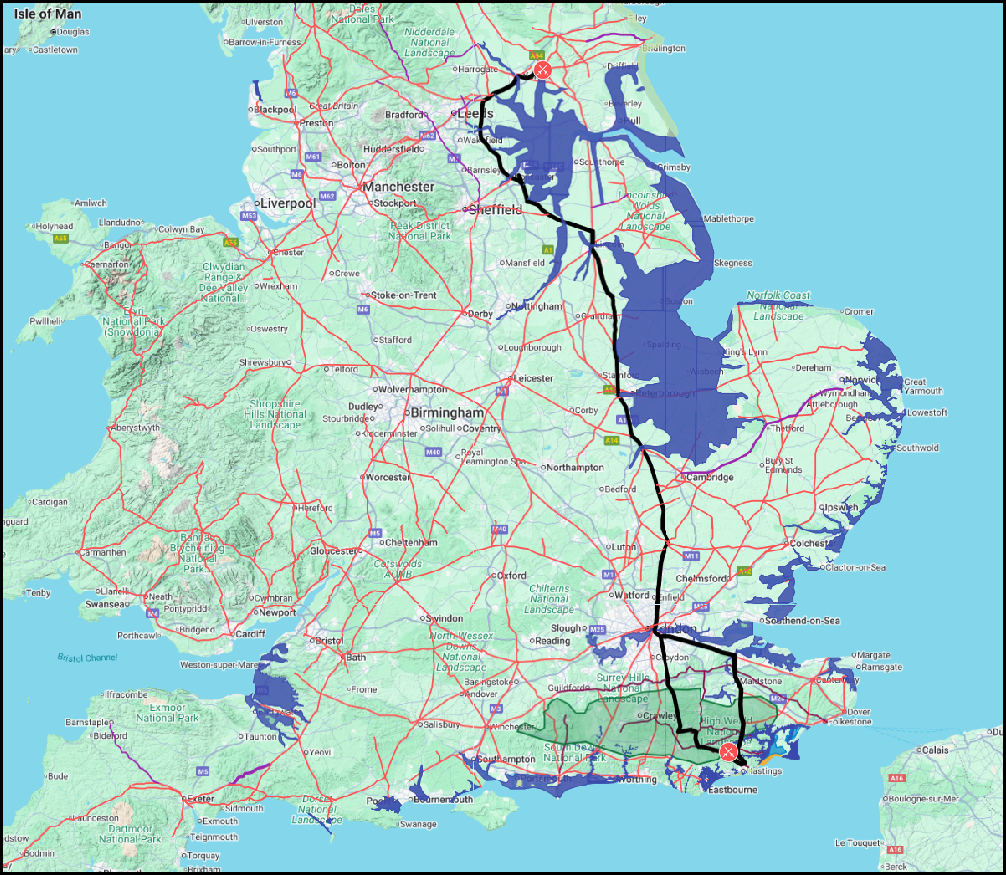
|
The northward journey ▲ |
|---|
The messenger who watched the Norman landing at Pevensey on 28th September had two possible routes north. The first ran from Hastings along the Roman road toward Rochester — Ivan Margary's road M13 — crossing the Thames at London and then north on Ermine Street through Hertford, Huntingdon, Stamford, Lincoln and on to York. The second took the old ridgeways north from Hastings to Crowborough, joining the Lewes to London Roman road and then the same Ermine Street northward from London. There is not a great deal of difference between the two routes in total distance — both reach York at approximately 280 miles from Hastings.
The messenger would have used whichever route offered the best going and the most reliable waypoints. Both routes pass through London, which by 1066 was the largest town in England and the principal hub of the southern road network. Both then follow Ermine Street north — the best-maintained long-distance road in the kingdom, running straight through Lincoln to York with major Roman towns at regular intervals along its length.
At 70 miles a day on a relay system, the messenger reaches York in four days — arriving approximately 2nd October. If the Carmen and Quedam Exceptiones accounts are correct and Harold was already moving south from York after Stamford Bridge, the meeting could have occurred somewhere on Ermine Street between York and Lincoln as early as 1st or 2nd October, advancing the timeline by a day and giving every county on Wace's list slightly more time.
|
The outward network from York ▲ |
|---|
The moment Harold received the news — whether in York or on the road south — he activated the network. The summons did not travel as a single message along a single road. It propagated outward simultaneously along every Roman artery available, each major town receiving it and immediately dispatching riders along every outbound road.
The principal arteries from York and their hubs are as follows:
South on Ermine Street — York to Lincoln, approximately 60 miles. Lincoln was one of the four principal Roman cities of Britain and a major road hub. From Lincoln the summons continues south toward London, approximately 130 miles further, and simultaneously branches west toward Leicester and the midlands. Lincoln receiving the summons on approximately 2nd or 3rd October dispatches immediately in three directions — south, southwest and east.
Southwest on the Roman Ridge — York toward Doncaster, then connecting westward toward Chester and the northwest. This artery reaches the counties Wace names in the northwest — Chester, Lancashire — directly from York without routing through London. A messenger leaving York on 2nd October reaches Chester in approximately four days, arriving 6th October. Mounted Thanes from Chester leaving on 7th October, allowing one day to muster, cover the approximately 200 miles to Battle at 30 miles a day in just under seven days — arriving 13th or 14th October, marginally in time.
South through the midlands — from York via Doncaster and the road network through Nottingham and Leicester toward the west midlands. Leicester was a major Roman hub with roads connecting west toward Worcester and Gloucester, south toward London and east toward the coast. A messenger from York reaching Leicester on approximately 3rd October triggers Leicester to dispatch west toward Gloucester and Worcester simultaneously. Gloucester receives the summons on approximately 4th or 5th October — giving Gloucester Fyrd on foot nine to ten days to cover the 105 miles to Battle, which is achievable at 17 miles a day.
Southeast toward East Anglia — from York via Lincoln, then east toward the coast and south into Norfolk and Suffolk. Norfolk and Suffolk, which appear on Wace's list, receive the summons via Lincoln rather than via London — earlier than a London-dispatch model allows. Norwich receives the summons on approximately 3rd or 4th October. Mounted men from Norfolk have ten days to reach Battle — well within the possible range.
South on Ermine Street to London, then outward — London receives the summons from the north on approximately 4th or 5th October, several days before Harold himself arrives. London immediately re-dispatches along every outbound road — southeast into Kent and toward Canterbury, south into Sussex, southwest toward Winchester and Hampshire, east toward Essex and Colchester. The southern and southeastern counties — Kent, Sussex, Essex, Surrey, Hampshire — are the closest to Battle and have the most time. Their Fyrd on foot are the most likely to have arrived in full numbers. London in this model is not waiting for Harold — it is already dispatching the moment the summons arrives from the north.
|
Overall Picture ▲ |
|---|
The overall picture is a wave propagating outward from the point of contact — wherever Harold met the messenger on Ermine Street — through every hub simultaneously, each hub triggering further dispatch along every outbound road. By the time Harold reaches London on approximately 7th October the summons has been travelling for five days. The leading elements of contingents from the midlands, the west and East Anglia are already on the road toward Battle. The southern Fyrd are already moving. London is the concentration point where Harold's column and the converging streams from the north and midlands meet before the final march — not the origin of the summons, but the place where the army comes together.
The map on this page shows the Roman roads Harold's messengers would have used, together with the approximate propagation of the summons outward from the point of contact on Ermine Street on 2nd October. The distances and travel times for each county are examined in detail on Page M.
|
What Wace describes and what he knew ▲ |
|---|
Master Wace was writing in Normandy around 1160, a century after Hastings, for a Norman audience in a political context where the conquered English were not generally portrayed as sophisticated or well-organised.
His description of a single brave knight riding desperately through the night to warn Harold is a compelling image — but it is a Norman image, written from a Norman perspective, and it serves a Norman narrative purpose. A lone rider making an heroic personal journey is a better story than the activation of a royal courier network. It also conveniently diminishes the Saxon achievement — Harold had a primitive warning system depending on the initiative of one man, yet his army still nearly held the Norman line for seven hours. The single messenger narrative flatters the Norman conquest whether or not it reflects how the warning actually travelled.
Wace may simply not have known about the Saxon communication system. He was writing from Normandy about events in England a century earlier, drawing on oral tradition and earlier written sources. The institutional detail of how the English royal administration communicated across its territory was not the kind of thing that survived in Norman sources. His focus was on the drama of the events, not the administrative machinery behind them.
What Wace does preserve — apparently without recognising its significance — is the county list. And that list is the proof that the single knight narrative cannot be the whole story.
A man riding from Hastings to York tells Harold the news. It does not tell Gloucester, Worcester, Somerset, Norfolk and Northampton. For those counties to have sent troops that arrived in time, the summons cannot have waited until Harold reached London. London is 211 miles south of York. At 40 miles a day on horseback Harold takes five days to get there, arriving approximately 7th October. If the summons only goes out from London on the 7th, a messenger riding at 70 miles a day reaches Gloucester on the 9th at the earliest. Gloucester Fyrd on foot at 17 miles a day then have five days to cover 105 miles to Battle — they are still 20 miles short when the battle begins on the 14th. Even mounted Thanes from the furthest western counties become marginal or impossible.
The only model consistent with Wace's full list is one in which the summons radiated outward from York immediately, propagating through every major Roman town as a hub — each one receiving the message and immediately dispatching riders along every outward road, exactly as a network router receives and re-transmits a signal in every available direction. Lincoln receives the summons from York and re-dispatches south toward London, west toward the midlands and east toward the coast. Leicester receives it and re-dispatches toward Gloucester and the southwest. London receives it and re-dispatches into Kent, Sussex, Essex and Hampshire. No county on Wace's list depends on a single route — the message reaches each hub by the fastest available path, and each hub immediately propagates it further. The system is not a series of lines radiating from a single point. It is a network, and Harold activated the whole network the moment the messenger arrived in York.
|
The System in 1066AD ▲ |
|---|
By October 1066 the Saxon communication infrastructure had been in continuous development for over six centuries, built on Roman foundations and refined through the Viking wars, the unification of England under Alfred's successors, and the administrative demands of a kingdom that collected tax, enforced law and raised armies from Northumbria to Cornwall.
The physical components were the Roman roads — still the best routes across England and still the arteries along which military and administrative communication travelled. The institutional waypoints were the burhs, garrisoned towns at intervals along those roads with horses, men and royal obligation. Between them, monasteries and minsters provided hospitality, horses and onward connection. Thane households at intervals between the burhs provided the final tier — each owing military service to the king, each capable of passing a royal summons along the road to the next waypoint.
The critical feature of this network in 1066 was not its speed on any single route but its topology. To understand how it worked, consider the modern internet. The internet does not move data in a single line from sender to receiver — it breaks information into packets and routes each one through a mesh of interconnected nodes, each node receiving data from every inbound connection and immediately retransmitting it along every outbound connection. No single node controls the whole network. No single path carries all the traffic. If one node fails or one connection is broken, the network routes around it automatically, finding the next fastest path to the destination. The result is a system that is simultaneously fast, resilient and capable of delivering the same message to thousands of destinations at once.
The Saxon messenger network operated on precisely the same principle, using Roman roads as the connections and major towns as the nodes. Every major Roman town was a hub — receiving messages from every inbound road and immediately dispatching riders along every outbound road. York to Lincoln triggers Lincoln to dispatch west, south and east simultaneously. Lincoln to Leicester triggers Leicester to dispatch toward Gloucester and the southwest. Leicester to London triggers London to dispatch into Kent, Sussex, Essex and Hampshire. The message does not travel in a single line — it propagates through the network, reaching each county by the fastest available path, with no single point of failure. If one road is impassable, the summons arrives via another hub. If one waypoint fails, the network routes around it. The Romans had built the infrastructure. The Saxons had inherited it, adapted it to their own institutions, and by 1066 were operating something that functioned, in its essential logic, like a 1,000 year old version of the internet.
Harold was an experienced military commander who had just coordinated a forced march from London to Yorkshire and destroyed a Viking army in a single engagement. The moment the messenger arrived in York on approximately 2nd October he dispatched riders simultaneously along every outbound road — south on Ermine Street, southwest on the Roman Ridge toward Doncaster and the northwest, south through Nottingham and Leicester toward the west midlands, southeast toward the coast and East Anglia. He did not wait for London. He activated the network from York because York was where he stood, and every major Roman town in the kingdom was reachable from York without routing through London at all.
By the time Harold himself leaves York on 2nd or 3rd October the summons has already been travelling for hours through the network. By the time he reaches London on approximately 7th October it has been propagating for five days. Huscarls and mounted Thanes from the midland counties, who received the summons on 4th or 5th October via the western and midland hubs, are already converging toward Battle. Southern Fyrd from Kent, Sussex, Hampshire and Essex, summoned via London and the southeastern hubs, are moving toward Battle directly without needing to pass through London at all. London is the concentration point where Harold's own column meets the converging streams from the midlands and north — not the origin of the summons, but the place where the army assembles before the final 67-mile march south.
Wace's county list, read in this light, is not a record of troops who assembled in London and marched together. It is a record of contingents converging on Battle from multiple directions simultaneously, propagated through a network of Roman road hubs that had been operating in one form or another since the 1st century AD — and activated in its entirety within hours of the news reaching York on 2nd October 1066.
|
Conclusion ▲ |
|---|
The Saxon messenger system that warned Harold's kingdom in October 1066 was not improvised for the occasion. It was the latest expression of a communication infrastructure embedded in the landscape of Britain since the Roman period, refined through the Viking wars, and integral to the administrative coherence of the English kingdom by the 11th century.
Wace's single knight is almost certainly a narrative simplification — either because he did not know how the system worked, or because a lone heroic rider served his Norman audience better than an acknowledgement that the Saxon kingdom was capable of alerting most of England within days. His county list, preserved apparently without appreciation of what it implies, is the better evidence — and it points unmistakably to a network operating at approximately 70 miles a day, propagating simultaneously from York through every major Roman town as a hub the moment Harold received the news.
The modern internet offers the closest analogy to what that network was doing. When a message enters the internet it does not travel in a straight line — it propagates through a mesh of interconnected nodes, each receiving and immediately retransmitting, finding the fastest path to every destination simultaneously, routing around failures automatically. The Saxon network worked the same way. Roman roads were the connections. Major towns were the nodes. Burhs, monasteries and thane households were the waypoints between them.
When Harold activated the network from York on 2nd October, the summons did not travel as a single message along a single road — it propagated outward through the mesh, reaching Lincoln, Leicester, London, Gloucester, Norwich and Canterbury not sequentially but as rapidly as each node could receive and retransmit. Every county on Wace's list was a destination the network could reach. Every county on Wace's list received the summons in time for at least its mounted men to reach Battle.
That network topology is the key insight. The system was not a wheel with York at the hub and counties at the rim — it was a mesh, where every major town both received and re-transmitted, where every county was reachable by multiple paths, and where the speed of propagation was determined not by the distance from York but by the distance from the nearest hub on the nearest Roman road. That is the only model consistent with Wace's full county list. That is the only model that gets Gloucester, Worcester, Norfolk and Somerset to Battle in time.
That speed is mandatory. Below 70 miles a day the network cannot explain Wace's list. At 70 miles a day it can — and the success of Alfred, the coherence of the late Saxon kingdom, and the composition of Harold's army at Hastings are all, in different ways, evidence that it did.
The Romans built the infrastructure. The Saxon warlords inherited it. Alfred refined it. Harold activated it. And a Norman writer a century later, describing a lone knight riding through the night, inadvertently preserved in his county list the best evidence that it worked.
Page L2 examines which specific troops from which counties could have reached Hastings given these messenger speeds and the York network origin, and what the travel tables reveal about the actual composition of Harold's army on the day of battle.
|
|
;)