|
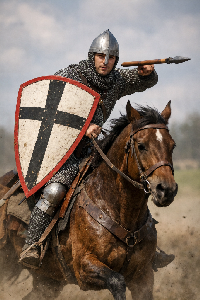
Norman knight | Anglo Saxon History 
Search Pages |  | |
| | Battle of Hastings 1066AD - O - The Intermediary |
|---|
| | The discussions between King Harold and Duke William |
|---|
This page discusses the details of a possible conversation between Duke William and King Harold prior to the Battle of Hastings.
This is only described by three of the Chronicles, and the Battle Abbey Chronicle one is not very detailed at all.
| | Documentary evidence ▲ |
|---|
William of Poitiers' Gesta Guillelmi
The duke sent a monk of Fécamp, as envoy to Harold, to urge him to keep his oath and relinquish a kingdom which was not his by right... But Harold, swollen with foolish pride, replied that he would not withdraw from the kingdom which the people had given him.
From Poitiers perspective we are looking for a Fécamp monk, who speaks both Norman French and English.
Carmen de Triumpho Normannico
A sage monk of eloquent speech was chosen
Who could be trusted to cautiously scout the camp of the duke
He sped on his way on a swift horse
Whatever the vain monk brought him, the duke held immaterial
To return an envoy prepared word for word
The monk was summoned. He took to the road without delay
Because the Duke had directed his envoy to proceed ever vigilant
The envoy detouring through the countryside
Approached unseen where the King was preparing the ambush
From the Carmen perspective we are looking for an eloquent monk, i.e one who speaks both Norman French and English. He would also need to know the local area if he detoured through the countryside.
Master Wace
Then Harold chose a messenger who knew the language of France, and sent him to duke William, charging him with these words ; ' Say to the duke that I desire he will not remind me of my covenant nor of my oath ....
From Master Wace perspective it implies the messenger was an English speaker who spoke fluent Norman French.
If we assume all three were valid documents we require monks and messengers who are fluent in both English and Norman French, the monk originating from Fécamp and who knew the local area.
| | Were the Fécamp monks from Rye involved ? ▲ |
|---|
When William landed on the Sussex coast he was within fifteen miles of the Fécamp priory at Rye. The monks there had been embedded in the local area since 1017 — nearly fifty years — and would have been bilingual as a matter of necessity, conducting their daily business in English with local tenants and fishermen while corresponding with Normandy in French and Latin. They knew the landscape, the roads, the people, and the politics of the area in a way that William's own chaplains from Caen or Rouen simply could not.
William of Poitiers names the envoy specifically as a monk of Fécamp. The Carmen describes him as eloquent, able to navigate the countryside unseen, and trusted to deliver a theologically charged ultimatum about Harold's oath-breaking. Both descriptions fit a Rye priory monk far better than a Norman court chaplain who had crossed the Channel with the fleet. The local monks were on the ground, knew the routes, spoke the language, and carried the authority of a religious house that Harold would have recognised.
The post-conquest rewards tell their own story. Fécamp retained Rye and Winchelsea until the twelfth century. William did not forget those who had served him.
| | Could the Messenger for both sides be the same person ? ▲ |
|---|
Wace and the Carmen are not contradictory — they are describing two separate diplomatic exchanges at different stages of events.
Wace records that Harold sent his own messenger to William, a man who spoke French, before the battle. This fits Harold's character — he was an experienced commander who would want to assess William's intentions and test whether negotiation was possible.
The Carmen describes William sending his monk to Harold after landing in England, delivering a final ultimatum invoking Harold's oath. This was not negotiation — it was a formal religious and legal warning designed to justify the battle that was about to follow, and to place Harold publicly in the position of a perjurer refusing a lawful demand.
Stage one was Harold's initiative, reaching out to William. Stage two was William's response, reaching back to Harold through a monk whose presence carried both religious authority and local credibility. The two accounts fit together cleanly once you accept they are not describing the same exchange.
| | Conclusion ▲ |
|---|
Three chronicles describe diplomatic contact between William and Harold before the battle. Read together rather than against each other, they describe a sequence: Harold sent his own French-speaking messenger to William, and William replied by sending a Fécamp monk — almost certainly from the priory at Rye — to deliver his formal ultimatum in person.
The monk fits every requirement. He was bilingual. He knew the country. He carried the authority of a house that had been part of the Hastings landscape for fifty years. Harold would have known who he was and what his presence meant.
That William used the local Fécamp network for this purpose, and that the same network had been providing him with intelligence about the English coast for years beforehand, suggests the invasion was far more carefully prepared than the chronicles alone reveal.
For the background to Fécamp's presence in Sussex see Page Hastings and its links to Fécamp Abbey.
|
|
|
|
|
|
| |
|
|
Local Interest
Just click an image |
|
|
|
|
|
|
|
|
|
|
|
|
| |
|
|
;)