| Roman Iron, Frontiers and Fragmentation — the economics of Roman decline |
|---|
| |
This page argues that the decline in Roman iron production from the late 2nd century onwards was not simply a symptom of imperial decline, but one of its causes — and that understanding the relationship between frontier construction, iron demand and provincial industry helps explain why the breakaway empires of Postumus and Carausius happened when and where they did.
|
| |
|---|
The construction phase and iron demand ▲ |
|---|
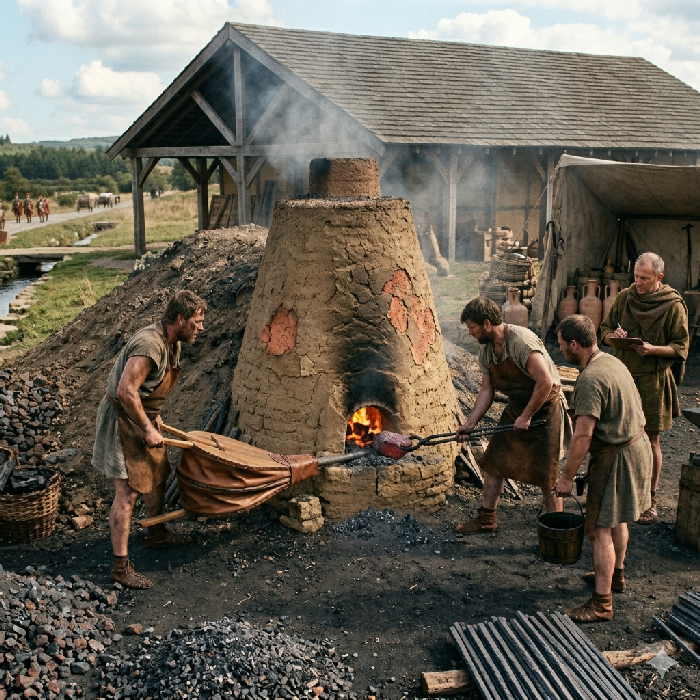 The Roman army was not merely a fighting force — it was the largest construction organisation the ancient world had ever seen. Roads, bridges, legionary fortresses, auxiliary forts, watchtowers, harbour installations and above all the great frontier systems consumed iron on a scale that is easy to underestimate. Every tool, every nail, every gate hinge, every artillery fitting, every ship fitting represented demand on the provincial iron industry.
The great frontier construction programmes — Hadrian's Wall (begun 122 AD), the Upper Germanic-Raetian Limes, the Antonine Wall (142 AD) and the successive generations of Danube fortifications — were built primarily during the late 1st and early 2nd centuries. This was a period of sustained, empire-wide capital expenditure in iron that would never be repeated.
|
| |
|---|
Iron production and legion numbers — do they correlate? ▲ |
|---|
Century
|
Legions
|
Iron production
(tonnes/century) |
Notes
|
| 1st century AD |
27 |
98,000 |
Conquest and early frontier construction |
| 2nd century AD |
30 |
131,500 |
Peak — Hadrian's Wall, Limes completion |
| 3rd century AD |
33 |
89,000 |
Crisis of the Third Century |
| 4th century AD |
45+ |
53,000 |
Diocletian reforms — smaller units |
When these figures are plotted together an unexpected pattern emerges. During the 1st and 2nd centuries both legion numbers and iron production rise together, consistent with an expanding army engaged in active construction. From the 3rd century onwards they diverge sharply — legion numbers continue rising while iron production falls steeply and does not recover. If iron demand were driven primarily by the number of soldiers the two lines should track each other. They do not, suggesting the army's iron consumption per man fell dramatically — and the most plausible explanation is that the great construction programmes were finished.
|
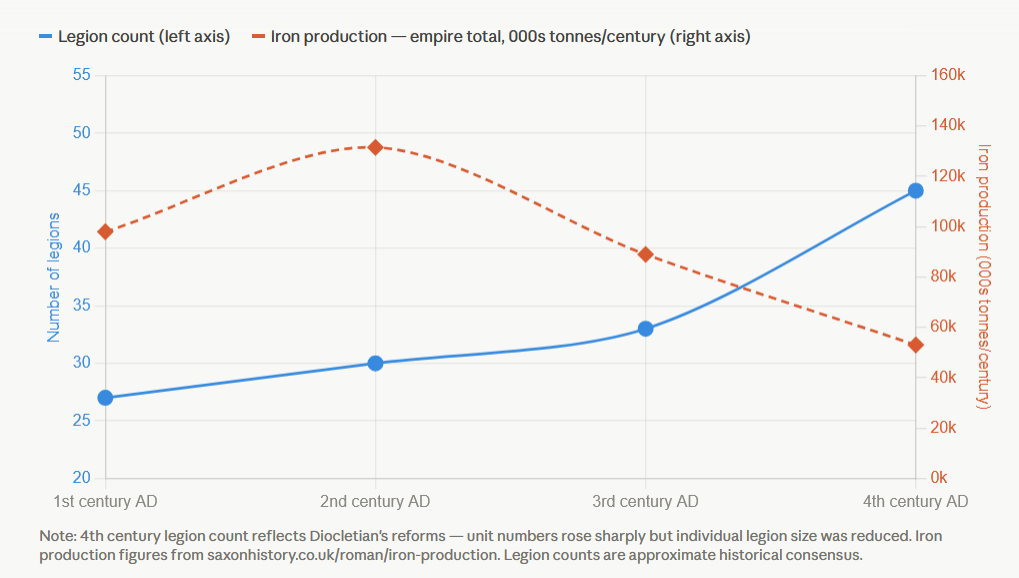
The chart above plots legion count against empire-wide iron production by century. The close correlation during the 1st and 2nd centuries gives way to a sharp divergence from the 3rd century onwards — iron production collapses while the army nominally grows. This is the signature of an army that has stopped building and started merely garrisoning.
|
| |
|---|
When construction stopped ▲ |
|---|
| Frontier |
Built |
Status by 180 AD |
| Hadrian's Wall |
122–128 AD |
Complete |
| Upper Germanic-Raetian Limes |
83–160 AD |
Complete |
| Antonine Wall |
142–160 AD |
Largely abandoned |
| Danube fortifications |
1st–2nd c. |
Substantially complete |
The peak of Roman frontier construction falls squarely within the period of peak iron production. By around 165–180 AD the major frontier infrastructure of the western empire was essentially built. What followed was a maintenance economy rather than a construction economy. Garrisons needed equipment repaired and replaced, but the one-off capital demand of building 73 miles of stone wall, 16 forts, 80 milecastles and 160 turrets — and the equivalent across hundreds of miles of Rhine and Danube frontier — was gone.
The iron industry had expanded to meet that demand. When the demand fell, the industry contracted, and provincial commanders found themselves presiding over a shrinking productive base at precisely the moment when political instability was making central coordination increasingly difficult.
|
| |
|---|
Postumus and the Gallic Empire ▲ |
|---|
| | Detail | |
|---|
| Breakaway | | 260AD | |
| Duration | | 260-274AD | |
| Power Base | | Rhine frontier provinces | |
| Recovered By | | Aurelian, 274 AD | |
Marcus Cassianius Latinius Postumus broke away from central Roman authority in 260 AD and established the Gallic Empire. His powerbase was the Rhine frontier — the very region whose construction had been one of the primary drivers of iron demand in the preceding century. By 260 AD the Rhine frontier was built and garrisoned but no longer generating the economic activity that construction had brought.
A capable local commander who could redirect that productive capacity — and who could offer the frontier garrisons both pay and a credible local defence — had every practical advantage over a distant and unstable central government.
Postumus did not break away because he was ambitious, though he may have been. He broke away because the economic logic of the frontier, once its construction phase was complete, pointed toward local rather than central control. For more detail on the Gallic Empire see the Gallic Empire page.
|
| |
|---|
Carausius and the British iron industry ▲ |
|---|
| | Detail | |
|---|
| Breakaway | | 286AD | |
| Duration | | 286-296AD | |
| Assassinated by | | 293AD | |
| Power Base | | Classis Britannica, Wealden industry | |
| Wealden share of empire output before | | 40% | |
| Wealden share of empire output after | | 20% | |
| Recovered By | | Constantius Chlorus, 296 AD | |
Marcus Aurelius Mausaeus Carausius repeated the pattern in Britain a generation later. The Wealden iron industry of southeast England was one of the most productive in the entire empire, controlled and operated by the Classis Britannica. When Carausius seized the fleet in 286 AD he was not simply taking command of ships — he was taking control of the single most strategically important manufacturing complex in Roman Britain.
The iron production data reflects this directly: after Carausius, the Weald's estimated share of empire output drops from around 40% to around 20%, suggesting British iron was being redirected toward his own fleet and fortifications rather than flowing to the imperial treasury.
The fort at Pevensey — almost certainly the Novus Portus recorded by Ptolemy — sits at the point where the tidal estuary met the oak forest and the iron deposits, and was in all likelihood the principal shipbuilding yard of the Classis Britannica long before Carausius built his massive shore fort there. For the full narrative of Carausius and Pevensey see the Carausius, Allectus and Pevensey page .
|
| |
|---|
The fragmentation of the supply network ▲ |
|---|
Century
|
Empire-wide iron
(tonnes) |
Key event
|
| 2nd century |
131,500 |
Peak — centralised construction programme |
| 3rd century |
89,000 |
Crisis, Gallic Empire breakaway |
| 4th century |
53,000 |
Permanent fragmentation of supply network |
What Postumus and Carausius demonstrated — and what the iron production figures make visible — is that the Roman empire's military strength depended on a centralised supply network that was only sustainable while central authority was strong enough to coordinate it. The great frontier construction programmes had been possible because Rome could direct iron production from Britain, Gaul, the Rhineland and the Balkans toward a single integrated programme. When that central coordination weakened, provincial commanders with direct control of productive capacity found themselves more powerful than the distant emperors they nominally served.
The 4th century iron production figures — down to roughly half the 2nd century peak — reflect not just economic decline but the permanent fragmentation of that network. Production did not stop, but it was no longer coordinated. Iron produced in Britain stayed in Britain. Iron produced on the Rhine stayed on the Rhine. The empire that had built the frontiers had been, in a very practical sense, an iron-distribution system. When the distribution system failed, the frontiers it had built could no longer be maintained.
|
| |
|---|
Conclusion ▲ |
|---|
|
The decline in Roman iron production from the late 2nd century is usually treated as a consequence of imperial decline. This page suggests the relationship was more complex — that the end of the frontier construction phase removed the primary driver of iron demand, weakened the economic rationale for centralised production, and created the conditions in which local commanders controlling surviving productive capacity could successfully break away from central authority.
Postumus on the Rhine and Carausius in Britain were not aberrations. They were the predictable consequence of an empire whose most important economic activity — building its own defences — had come to an end.
|
|
;)

)