| The History of Carausius & Pevensey Fort |
|---|
| |
|---|
Introduction |
|---|
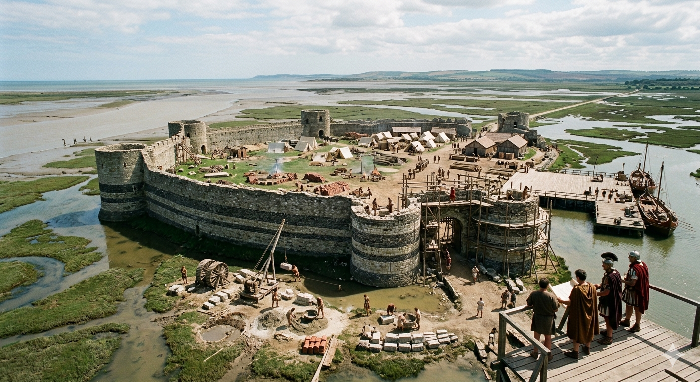
In 285 AD a Menapian naval commander named Marcus Aurelius Mausaeus Carausius was given charge of the Classis Britannica — the Roman Channel Fleet — with orders to suppress Frankish and Saxon piracy along the British and Gallic coasts. What followed was one of the most remarkable episodes in the late Roman history of Britain: a rebellion that lasted a decade, produced its own coinage, and left behind one of the most formidable fortifications in the Roman world.
The purpose of this page is to lay out a plausible narrative timeline for the events of 285–296 AD, with particular attention to the construction and strategic role of the fort at Pevensey (Anderida). The argument is that Pevensey was not simply a shore fort built as part of a general coastal defence programme, but a deliberately constructed naval headquarters — funded by Carausius during his rebellion and completed at the moment of his greatest vulnerability.
This timeline should be read alongside the landscape pages for Pevensey and the Pevensey Marsh, as the geography of the peninsula is inseparable from the strategic logic described here. The sea levels in this period were significantly higher than today, and the approaches to the site by land were constrained by tidal inlets and the forest of Andredsweald in ways that made Pevensey almost uniquely defensible.
The narrative below is a structured historical hypothesis. Where the evidence is direct it is stated as such. Where it involves inference from the available record it is presented as the most plausible interpretation. Readers are encouraged to disagree and to look at the source material themselves.
| | |
|---|
Phase I — The Expansion Phase 285–289 AD |
|---|
| |
|---|
285AD — Carausius takes command |
|---|
 Carausius is appointed commander of the Classis Britannica. What follows over the next year is, on the surface, a legitimate military expansion — scaling up the fleet, suppressing Channel pirates, demonstrating capability in the Bagaudae campaign in Gaul. But the accumulation of evidence suggests that by the time Carausius accepted this appointment, or very shortly afterwards, he had already decided where it would lead. The question is not whether he intended to become emperor. The question is how long he had been planning it.
To understand Carausius it helps to understand the world he grew up in. He was almost certainly born around 240–250 AD, which places his entire childhood and early military career inside the period historians call the Crisis of the Third Century — arguably the most catastrophic sustained period in Roman history. Between 235 and 284 AD, the empire saw more than fifty emperors or claimants, most of whom were assassinated. The western provinces including Britain had already broken away once, under the Gallic Empire of Postumus in 260 AD, and had only been forcibly reabsorbed by Aurelian in 274 AD — when Carausius would have been roughly thirty years old and already in military service.
A man of his background and generation would have watched the empire fracture and be reassembled once within his own lifetime. He would have drawn his own conclusions about what the right fleet, the right fortress, and the right moment could achieve. For the wider context of the Gallic breakaway that preceded and in many ways enabled his own rebellion, see the Gallic Empire page.
Carausius is appointed commander of the Classis Britannica.
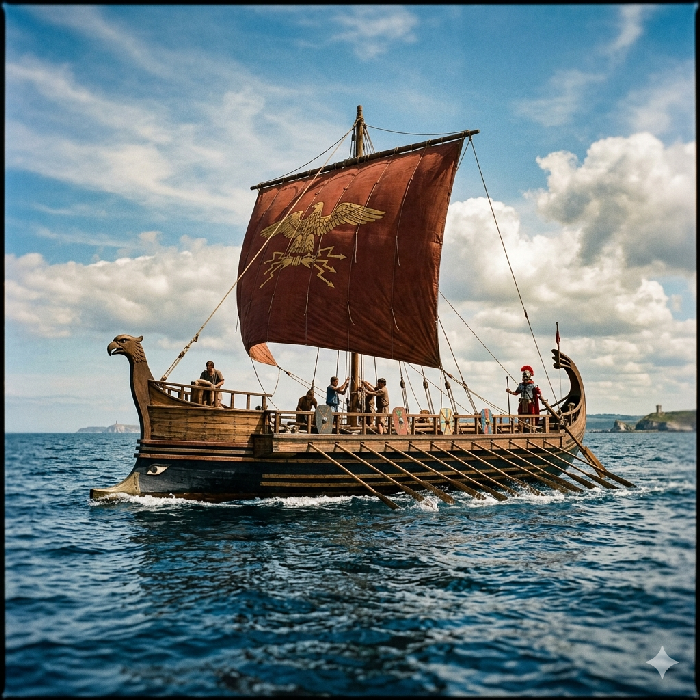
He immediately begins expanding the fleet beyond its standing strength, scaling up production of the established oak-hulled designs that had served the Channel Fleet for a century. This is a legitimate military expansion at this point — he has the authority and the resources of the imperial fleet behind him. The choice of Pevensey as the eventual site for his headquarters was not arbitrary.
The great oak forest of Andredsweald — Silva Anderida to the Romans — covered the high ground directly behind the fort, and the tidal estuary at that period reached deep into the woodland, giving direct water access to the principal timber supply. The fort sat, quite literally, at the entrance to the forest that built the fleet. For the strategic logic of why Carausius chose this location above all others, see the Andredsweald page.
The name of the fort said it plainly to anyone who read Latin. Anderida — the entrance. Silva Anderida — the entrance to the forest. The Romans had named both the fort and the woodland after the same geographical fact: this was where the sea met the oak, where a fleet could be supplied indefinitely from the timber that stood directly behind its walls. For a commander planning to hold the Channel against Rome itself, there was no better address in Britain.
The Classis Britannica had also been the dominant industrial operator across East Sussex for two centuries, controlling the Wealden iron bloomeries and the oak shipbuilding yards that depended on the same river systems. Carausius inherited not just a fleet but an entire military-industrial complex. For the detail of that industrial footprint see the Wealden Ironworking page.
The site was chosen, the resources were in place, and the funding was being
accumulated. What remained was the question of the men — and Carausius had been
working on that too.
| | |
|---|
285-286 AD — Securing the legions |
|---|
|
Carausius did not simply arrive in Britain and declare himself emperor. The support of the three British legions — Legio II Augusta at Caerleon, Legio VI Victrix at York, and Legio XX Valeria Victrix at Chester — had to be earned or bought or both, and the evidence suggests he had been working toward it systematically before the rebellion was declared.
His reputation preceded him. The Bagaudae campaign of 286 had demonstrated his capability as a land commander to an army that had seen too many administrators and too few fighters in positions of authority. His coinage, issued in good silver at a time when the central empire's currency had been debased almost to worthlessness, put real money in soldiers' pockets. The pirate cargo that Rome accused him of retaining may have funded not just the stones of Pevensey but the loyalty of the men who would defend it. And the institutional memory of the Gallic Empire — fourteen years of independent western rule that had ended only in 274 — meant that the legions were being asked to do something their predecessors had already done within living memory.
Carausius now has three legions, a fourth seized in Gaul, a fleet, a Frankish alliance, and a construction programme already funded and planned.
| | |
|---|
286AD — Construction begins at Pevensey. The rebellion begins. |
|---|
|
Construction work begins at Anderida (Pevensey). The dendrochronological evidence — tree-ring dating of wooden piles found underpinning the Roman walls in a 1994 excavation — places the felling of the foundation timbers at around 290 AD. Given the natural uncertainty in such dating (sapwood survival in mature oak means felling dates can only be estimated to within approximately 15–20 years), a start date of 286 is entirely consistent with this evidence. The scale of the finished structure — the longest oval enceinte in Roman Britain, with walls up to 4 metres thick — implies a building programme of five years or more in any case, and the 1994 date most plausibly reflects a middle or later phase of the foundation work rather than the first timber going into the ground.
The accusation against Carausius — that he was intercepting pirates after their raids and retaining the seized cargo rather than surrendering it to the imperial treasury — is usually treated as evidence of personal corruption. But the scale of what was built at Pevensey suggests a different interpretation. The seized cargoes would have included iron, timber, coin and trade goods: precisely the materials a major fortification project would consume. The Wealden bloomeries were already under Classis Britannica control, the forest was accessible via the tidal estuary, and Carausius had command of the shipping that moved both. A man enriching himself personally does not build the longest oval enceinte in Roman Britain. A man systematically redirecting intercepted wealth into a pre-planned construction programme does.
If this reading is correct, the rebellion takes on a different character. The standard narrative holds that Carausius revolted because Maximian ordered his execution for the theft. But if the theft was not personal enrichment but covert construction funding, then the execution order did not cause the rebellion — it merely set the clock running on a plan that was already well advanced. The fort at Pevensey was not built in response to the crisis. It was built in preparation for it.
Maximian, newly elevated to co-emperor, discovers the scale of what Carausius has been building — both in stone and in political capital — and orders his execution. Rather than submit, Carausius seizes a fourth legion in Gaul, declares himself emperor, and crosses to Britain with his fleet. The rebellion is underway. The execution order did not create a crisis. It set a pre-prepared plan in motion.
| | |
|---|
289AD — The naval proof |
|---|
|
Maximian assembles an invasion fleet and attempts to retake Britain. He builds it inland on the Moselle and Rhine rivers — away from Carausius's reach — and floats it downstream into the Channel. This decision, born of necessity, carries a fatal consequence: the timbers available on the Rhine and Moselle were primarily softwoods and light riverine timber, not the seasoned Wealden oak that Carausius had been building with for years. The Roman fleet that entered the Channel in 289 was crewed by men with little experience of Channel conditions, in vessels built from inferior timber, facing the best naval commander of the period on his home water.
The result is not recorded honestly anywhere. A panegyric delivered shortly afterwards attributes the failure to bad weather. Carausius claimed it as a military victory. Eutropius, writing later, states that hostilities were rendered useless by Carausius's military skill. What the panegyrists conspicuously do not do is describe a campaign, name an engagement, or celebrate a fighting withdrawal. The silence is its own testimony. Roman propaganda celebrated defeats as storms and buried catastrophes in weather reports. The scale of what followed — Maximian forced to acknowledge Carausius as a colleague emperor and seven years required to rebuild a credible invasion force — is not consistent with losing a few ships to bad weather. It is consistent with the destruction of a fleet and the loss of most of the men in it.
This matters beyond the immediate military humiliation. A Roman fleet was not simply ships — it was a specialist fighting formation: trained crews, experienced pilots, navigators who understood Channel tides and currents. Losing that formation meant losing men who could not be quickly replaced. The years between 289 and 296 represent not merely a shipbuilding programme but the reconstruction of a trained naval force effectively from nothing. In practical terms, Rome had lost the equivalent of a legion at sea. It could not be acknowledged publicly, but the seven-year gap to rebuild tells the story clearly enough.
The expanded Wealden-oak fleet, using the heavier hull designs refined by the local iron industry, had outfought and out-massed the Roman galleys in open water. Pevensey itself — still a rising work in progress — is never threatened. Maximian is forced to acknowledge Carausius as a colleague emperor, at least for the time being.
This is the high-water mark of Carausius's power.
It is also worth placing this loss in its broader context. The destruction of Maximian's Channel fleet in 289 did not occur in a vacuum. Rome was still carrying the consequences of Châlons fifteen years earlier — 50,000 Rhine garrison troops lost, their specialist frontier knowledge lost with them, the recovery still incomplete. Two large unrecovered specialist military losses within fifteen years, in two different theatres, left the western empire with no quick options. Constantius, when he finally moved against Allectus in 296, had to hold the Rhine frontier, pacify Gaul, build a fleet from scratch, and train crews capable of Channel navigation — all simultaneously, all against the clock. The seven years between the destruction of Maximian's fleet and the final invasion of Britain are not evidence of Roman indecision. They are the minimum that the arithmetic of military recovery allowed.
| | |
|---|
Phase II — The Turnkey Handover 290–293AD |
|---|
| |
|---|
291AD — Pevensey is finished |
|---|
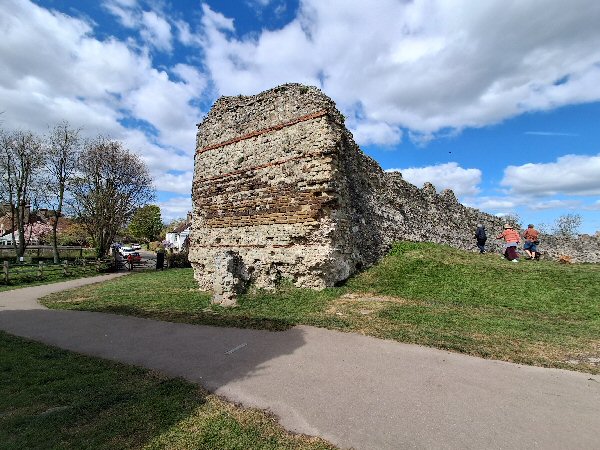
After approximately five years of construction, the fort at Anderida is complete. This date is consistent with the dendrochronological evidence, which clusters around 290 AD — the timber piles sampled in 1994 are most plausibly the product of the later stages of a build that began at rebellion in 286.
It is worth noting that earlier dating attempts were compromised by fraud: tiles stamped HON AUG ANDRIA, found in excavations of 1906–08, had been used to attribute the fort's construction to the early fifth-century Emperor Honorius, but thermoluminescence dating later showed they had been manufactured around the time of the excavation itself. Charles Dawson, better known as the architect of the Piltdown Man hoax, is the suspected forger. The 1994 dendrochronology replaced a fabricated foundation date with a legitimate one, and placed the construction firmly within the Carausian period where the coin evidence had always suggested it belonged.
The finished structure is formidable by any standard: massive external bastions designed for artillery, walls of coursed stone with tile bonding courses, and a position on a peninsula that renders a land assault almost impossible. The entire command structure of the breakaway empire now has a headquarters that is, in the military language of the period, genuinely impregnable — provided it is not isolated by the loss of the fleet.
| | |
|---|
292AD — A year of stability. Allectus is watching. |
|---|
|
Carausius is at the height of his power in terms of physical assets. His coinage is accomplished — he issues silver coins of a purity the central empire could not match, and his propaganda is sophisticated enough to include Virgilian literary allusions on the coinage itself. His fleet is strong, and his fortress is complete. But his treasurer and deputy, Allectus — formally his rationalis summarum, the finance minister of the breakaway empire — has had years to assess the real financial position. He has also watched the construction of Pevensey, understood its strategic value, and understood that whoever controls the fort controls the naval headquarters.
A calculation is being made.
| | |
|---|
Early 293AD — Boulogne falls. The fallback position is already ready. |
|---|
|
Constantius Chlorus moves against Carausius with a precision that the 289 campaign entirely lacked. He first deploys small naval units into the rivers of northern Gaul, cutting off Carausius's ability to move forces by water across his continental holdings. He then constructs a mole across the harbour entrance at Gesoriacum (Boulogne) and cuts off the garrison by sea. The port falls after a prolonged siege.
The standard reading treats this as a devastating strategic blow. In one sense it was — Carausius lost his principal continental base and with it his ability to project power into Gaul. But it is worth asking whether Carausius regarded this as the catastrophe it is usually presented as, or whether he had seen it coming for years and built accordingly.
The 289 campaign had demonstrated something important: the Channel was Carausius's real defensive line, not any fixed point on the continental shore. A fleet operating from a prepared tidal peninsula with deep woodland behind it and open water in front was a fundamentally different proposition from a port that a determined land army could approach and besiege.
Boulogne was always vulnerable to exactly what Constantius did — a mole across a harbour entrance is a straightforward piece of Roman military engineering applied to a fixed and predictable target. Pevensey was not that kind of target. It could not be approached easily by land, could not be blockaded from the sea without first defeating the fleet, and had its own supply of timber and iron immediately behind it.
If Pevensey was always intended as the primary base rather than a fallback, then the loss of Boulogne was not a shock that exposed a fatal weakness — it was the anticipated end of a continental forward position that had served its purpose while it lasted. Carausius had spent the years since 286 building the position he intended to fight from all along. By 291 it was finished. When Boulogne fell in 293 the real headquarters was already fully operational.
Crucially, Constantius still cannot invade immediately even after taking Boulogne. He must build a fleet capable of crossing the Channel against a force that had already destroyed one Roman invasion attempt. That fleet will take time — new ships, new trained crews, new Channel pilots who understand the tides. Taking Boulogne was the precondition for the campaign, not the campaign itself. And Carausius, watching from Pevensey, had known that was how it would unfold.
What Carausius could not plan for was Allectus.
| | |
|---|
Late 293AD — The calculated assassination |
|---|
|
Allectus murders Carausius and seizes power. The timing is critical and appears deliberate. Allectus does not move while Boulogne is still held — he waits until the crisis is already established and the retreat to Britain is secured. Once the command structure has pulled back inside the finished walls of Pevensey, Carausius is killed and Allectus inherits both the fort and the fleet in a single move. He did not build Pevensey. He waited patiently for Carausius to finish it, and then took it.
| | |
|---|
Phase III — The Static End 294–296 AD |
|---|
| |
|---|
294–295AD — Allectus sits behind the walls |
|---|
|
Allectus holds the best fort in Britain and the strongest fleet in the Channel. But he is not Carausius. Where Carausius had been an aggressive, technically capable naval commander who understood that the fleet was an offensive as much as a defensive instrument, Allectus is an administrator. He adopts a passive strategy: the walls will do the work. The fleet is held close to the peninsula rather than used to contest the Channel approaches. This is the critical error, though it will not become apparent for two more years.
| | |
|---|
296AD — The strategic bypass |
|---|
|
Constantius launches his invasion in two divisions. Asclepiodotus commands the main force and uses fog to slip past the Carausian fleet anchored off the Isle of Wight. He lands — the traditional location is the Hampshire coast, though Bexhill and the Sussex approaches have also been argued — and burns his ships. Constantius himself follows with a second force.
Allectus marches to meet the Roman force rather than holding the fort. He is killed in the engagement that follows. The army disintegrates and a portion apparently reaches London and begins looting before Constantius's forces arrive. Pevensey, the 'impregnable' fortress that Allectus had waited so patiently to inherit, is surrendered without a siege. Not a stone is chipped.
The absence of any evidence for a siege or destruction layer at Pevensey at this date is consistent with the fort having been handed over intact. The Roman government subsequently garrisoned and retained it — Pevensey continued in occupation and appears in the Notitia Dignitatum as the base of the Numerus Abulcorum, a functioning infantry unit of the limitanei border forces. A building you have burned or slighted is not one you immediately garrison.
| | |
|---|
Conclusion |
|---|
|
The narrative laid out above is internally consistent and not contradicted by the available historical and archaeological evidence. The key argument is that Pevensey (Anderida) is best understood not as a generic shore fort but as a deliberate strategic project — a naval headquarters conceived and begun by Carausius at the moment of his rebellion, completed after approximately five years of construction, and then immediately inherited by Allectus at the moment of the assassination.
The destruction of Maximian's 289 fleet — built from inferior inland timber by inexperienced crews and sent into the Channel against the finest naval commander of the period — established Carausius's dominance so completely that Rome required seven years to rebuild a credible invasion force. The panegyrists called it bad weather. The seven-year silence afterwards tells a different story.
The irony at the heart of the story is architectural. Carausius built the most defensible position in Roman Britain. He built it during the years of his greatest strength, on a peninsula that the sea levels of the period made almost an island. He equipped it to house a fleet and a command structure. And then his treasurer waited for it to be finished, killed him, and moved in.
Allectus then made the opposite mistake. He had inherited the masterpiece but not the spirit that built it. He treated the walls as a guarantee rather than as a resource, held his fleet passively, and when the Romans came they bypassed both the fleet and the fort. The peninsula that had been Carausius's greatest asset was rendered irrelevant by fog and a landing on a different stretch of coast.
The fort at Pevensey survived all of this intact. It was too well built to be worth destroying. It would continue to be used, in various forms, for the next thousand years — but that is a story for a different page.
| | |
|---|
References |
|---|
|
Panegyrics
The relevant panegyric is the anonymous Panegyric of Constantius (297 AD), numbered VIII in the Panegyrici Latini. It describes Carausius, the fall of Boulogne and the recovery of Britain. The best freely accessible reference is the Wikipedia article on the Panegyrici Latini which gives the context and numbering:
https://en.wikipedia.org/wiki/Panegyrici_Latini
For the scholarly edition, Nixon and Rodgers (1994) is the standard translation but paywalled.
The digilibLT digital library has the Latin texts free online:
https://digiliblt.uniupo.it/opera.php?id=DLT000386
Coins
The best free online resource is OCRE — Online Coins of the Roman Empire, run by the American Numismatic Society. It has the full Carausius coin catalogue with images, mint attributions and RIC references.
The Carausius search page is:
http://numismatics.org/ocre/results?q=carausius
Individual coin types are at URLs in the format:
http://numismatics.org/ocre/id/ric.5.cara.101
Wildwinds also has a free browsable catalogue of Carausius coins with images:
https://www.wildwinds.com/coins/ric/carausius/i.html
CL BR tiles
The definitive academic reference with free online access is the Roman Inscriptions of Britain entry RIB 2481, which covers all Classis Britannica tile stamps, their distribution, the Wealden ironworking connection, and the Lympne evidence specifically:
https://romaninscriptionsofbritain.org/instrumentum/2481
The Wikipedia Classis Britannica article is a good readable overview with the ironworking connection clearly stated:
https://en.wikipedia.org/wiki/Classis_Britannica
The Folkestone Museum also has a good accessible entry on a physical CL BR stamped tile with photograph:
https://learn.folkestonemuseum.co.uk/objects/roman-floor-tile-classis-britannica-stamp/
|
|
|
;)
)
)