| Battle of Hastings 1066AD Observations - 8 Wooden Spades at the Battle of Hastings |
|---|
| Digging around for clues ! |
|---|
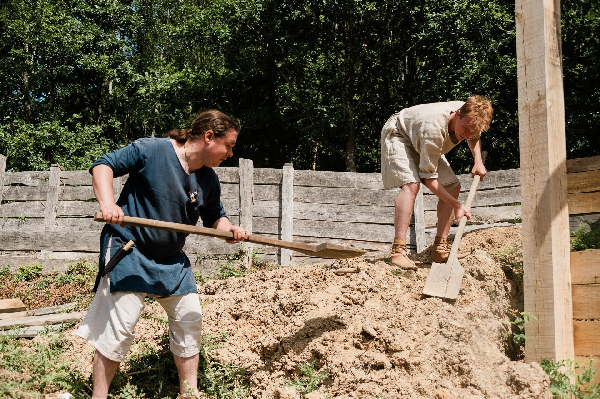 So is there evidence to imply that wooden spades could be made in the area:
The following is a really interesting article on Saxon housebuilding.
I found some experimental archaeology and documentation that show that wooden spades were extremely likely, an example of the use of oak spades can be found on Facebook please click the image to the left for the article.
Wessex archaeology have discovered an old oak spade from the - bronze age.
Another article on this spade from the woodworkingnetwork.
From the York Archaelogical trust an excellent article on Saxon spades and shovels.
|
Information from the Chronicles. |
|---|
The Anglo Saxon Chronicles describe the Saxons meeting at the Haran Apuldran ('The Old Apple Tree' - not my translation) mine is The Hare Orchard.
Master Wace describes the Fyrd - The English peasants carried hatchets, and keen edged bills
|
A possible Scenario for spade manufacture. |
|---|
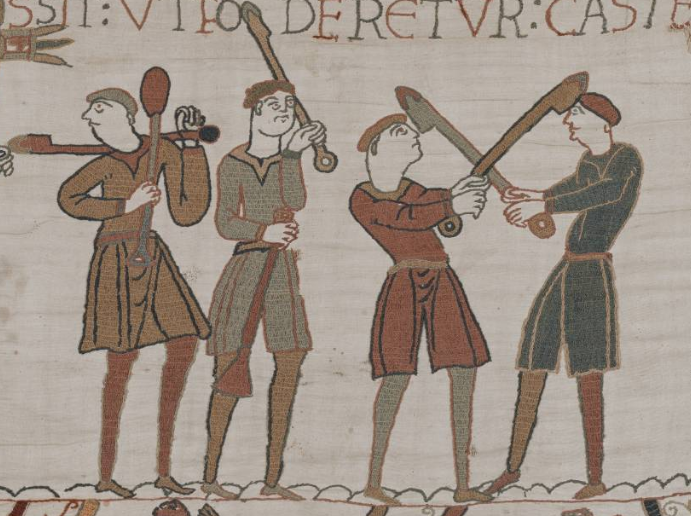 Please Note: the following paragraph is my educated guess as to the production of shovels and spades, there is no evidence for this but logic implies that they would have needed these tools to build a fosse.
This mustering point was likely to be on the northern edge or more likely inside the Forest of Andredsweald.
If this was the case and Harold knew the land layout, then the early arrivers, probably the Huscarls on horseback could arrange for oak spades or shovels to be made from the Oak in the forest, ready to construct the fosse that Wace records around the Saxon position.
(This would also imply that Harold knew where he was going to fight, and also implies that he was expecting the Normans to attack)
The Huscarls riding on horseback had reached the mustering point relatively early and started chopping down oak trees with their Viking Axes, this would blunt the weapons. However once the trees are felled and branches removed and the wood split into planks, the the remainder of the tree then handed over to the Fyrd for spade manufacture using their hachets, at that point the axes could be resharpened.
This would mean that the later arriving Fyrd could pick up these spades/shovels when they reached the mustering point. The Fyrd would arrive in small units from the individual towns or shires mentioned by Wace so this would be possible. This would also imply that the mustering point if in the Forest would need to be in an open Heathland area.
|
Building the Fosse and the barricade. |
|---|
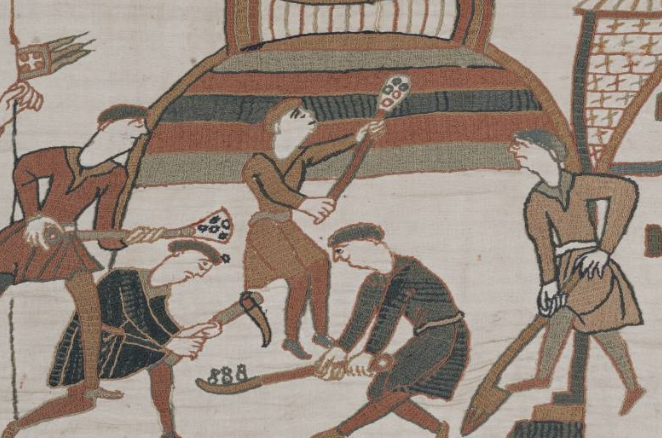 Please Note: the following paragraph is my educated guess as to the creation of the fosse and wattled barrier as described by a number of Chroniclers.
Firstly the mustering point would need to be a few miles from the edge of the Forest to try to prevent the Normans discovering the location and massacring the Fyrd piecemeal as they arrived. To prevent this then the Huscarls on horseback need to arrive before the Fyrd and set up perimeter defences and block road access. The Fyrd on foot then arrive in small town/shire units with a Thane leading them, and start working on the digging tools.
Once the army is assembled, or at least enough to make a fighting force then Harold leads them from the mustering point to the ridge to make the defences. The Huscarls or Fyrd with axes would chop down small branches and build a wattle fence across the battlefield, Wace suggest it is on three sides of the army, in turn implying it was against the forest or other impassible terrain to the rear to stop the Norman cavalry outflanking the Saxons and attacking the rear.
To build the fosse, the land would be broken up by either the Huscarls Viking axes or Fyrd seaxes, mattocks etc,
then the spoil shovelled back against the wattled barricade by more Fyrd using the shovels made at the mustering point. And then pointed stakes anchored to the bottom of the ditch to provide better defence against the cavalry.
Now all this could not be carried out in the three hours before the battle, hence this implies that Harold started preparing the defences on the 13th October, meaning he arrived at the battlefield the day before the battle.
|
Dates the Fyrd could arrive at Battle |
|---|
This chart shows how long it will take the Fyrð to travel at 17 miles per day from their County/Town firstly to London, then on to Battle the Normans at Hastings. Days to London show the number of days to reach London. Days to Battle means the number of days from their Town/County until they get to Battle. If the cell says impossible then they wouldn't be able to reach Battle until after the Battle.
County/Town |
News Arrives | Days To
London |
Arrive | Days To
Battle | Arrive |
| Bedfordshire(Bedford) | 04-Oct-66 | 2.9 | 08-Oct-66 | 6.4 | 12-Oct-66 |
| Berkshire(Thatcham) | 05-Oct-66 | 2.9 | 09-Oct-66 | 6.4 | 12-Oct-66 |
| Buckinghamshire(Buckingham) | 04-Oct-66 | 3.3 | 09-Oct-66 | 6.8 | 12-Oct-66 |
| Cambridgeshire(Cambridge) | 04-Oct-66 | 3.1 | 08-Oct-66 | 6.6 | 12-Oct-66 |
| Cheshire(Chester) | 04-Oct-66 | 10.5 | impossible | 14.0 | impossible |
| Cornwall(Plymouth) | 07-Oct-66 | 10.7 | impossible | 14.2 | impossible |
| Derbyshire(Derby) | 04-Oct-66 | 4.5 | 09-Oct-66 | 8.0 | 13-Oct-66 |
| Devon(Exeter) | 06-Oct-66 | 9.9 | impossible | 13.4 | impossible |
| Dorset(Salisbury) | 06-Oct-66 | 6.3 | impossible | 9.8 | impossible |
| Essex(Colchester) | 05-Oct-66 | 3.3 | 09-Oct-66 | 6.8 | 13-Oct-66 |
| Gloucestershire(Gloucester) | 05-Oct-66 | 5.1 | 11-Oct-66 | 8.6 | impossible |
| Hampshire(Winchester) | 05-Oct-66 | 3.3 | 10-Oct-66 | 6.8 | 13-Oct-66 |
| Herefordshire(Hereford) | 05-Oct-66 | 8.0 | impossible | 11.5 | impossible |
| Hertfordshire(Hertford) | 05-Oct-66 | 1.5 | 07-Oct-66 | 5.0 | 11-Oct-66 |
| Huntingdonshire(Huntingdon) | 04-Oct-66 | 3.9 | 09-Oct-66 | 7.4 | 12-Oct-66 |
| Kent(Canterbury) | 05-Oct-66 | 3.1 | 09-Oct-66 | 6.6 | 13-Oct-66 |
| Leicestershire(Leicester) | 04-Oct-66 | 5.1 | 10-Oct-66 | 8.6 | impossible |
| Lincolnshire(Lincoln) | 03-Oct-66 | 7.9 | 12-Oct-66 | 11.4 | impossible |
| Middlesex(London) | 05-Oct-66 | 0.0 | 06-Oct-66 | 3.5 | 10-Oct-66 |
| Norfolk(Norwich) | 05-Oct-66 | 5.9 | 11-Oct-66 | 9.4 | impossible |
| Northamptonshire(Northampton) | 04-Oct-66 | 3.4 | 08-Oct-66 | 6.9 | 12-Oct-66 |
| Nottinghamshire(Nottingham) | 04-Oct-66 | 4.4 | 09-Oct-66 | 7.9 | 13-Oct-66 |
| Oxfordshire(Oxford) | 05-Oct-66 | 2.8 | 09-Oct-66 | 6.3 | 12-Oct-66 |
| Rutland(Whitwell) | 04-Oct-66 | 5.6 | 10-Oct-66 | 9.1 | impossible |
| Shropshire(Kidderminster) | 04-Oct-66 | 6.4 | 12-Oct-66 | 9.9 | impossible |
| Somerset(Bath) | 05-Oct-66 | 5.9 | 12-Oct-66 | 9.4 | impossible |
| Staffordshire(Stafford) | 04-Oct-66 | 7.1 | 12-Oct-66 | 10.6 | impossible |
| Suffolk(Bury St Edmunds) | 05-Oct-66 | 4.1 | 10-Oct-66 | 7.6 | 13-Oct-66 |
| Surrey(Reigate) | 06-Oct-66 | 1.1 | 08-Oct-66 | 4.6 | 11-Oct-66 |
| Sussex(Chichester) | 06-Oct-66 | 4.0 | Coast Route | 10-Oct-66 |
| Warwickshire(Warwick) | 04-Oct-66 | 4.7 | 10-Oct-66 | 8.2 | 13-Oct-66 |
| Wiltshire(Salisbury) | 06-Oct-66 | 4.3 | 11-Oct-66 | 7.8 | impossible |
| Worcestershire(Worcester) | 04-Oct-66 | 8.3 | 13-Oct-66 | 11.8 | impossible |
| Yorkshire(York) | 02-Oct-66 | 10.6 | impossible | 14.1 | impossible |
This is an extract from our Warning to Harold and its implications page, which also shows estimated speed of messengers,thanes and huscarls to enable the battle to take place within the timescales and the record of Saxon troops taking part.
|
The order of the Fyrd arriving at the muster point |
|---|
From the above chart plus others from Battle of Hastings 1066AD - N - The Warning to Harold and its implications
| County | News
Arrives | Days To
London | Arrive
in London | Days To
Battle | Arrive
at Battle |
|---|
| Earliest arrivals could be the Huscarls below, but more likely they waited in London for Harold then once they knew what was going on they immediately left and arrived at the muster point on 11-Oct-66 marching with the earliest Fyrd. |
| Bedfordshire(Bedford) | 04-Oct-66 | 1.45 | 07-Oct-66 | 3.2 | 08-Oct-66 |
|---|
| Hertfordshire(Hertford) | 05-Oct-66 | 0.75 | 06-Oct-66 | 2.5 | 08-Oct-66 |
|---|
| Middlesex(London) | 05-Oct-66 | 0 | 06-Oct-66 | 1.76 | 08-Oct-66 |
|---|
Harold could arrive as early as the 10-Oct-66 but more likely 12-Oct-66 as he would then march down from London leaving on 09-Oct-66 at Fyrd speed with the majority of his troops |
| Harold(York) | 02-Oct-66 | 6 | 08-Oct-66 | 7.0 | 10-Oct-66 |
|---|
The following Fyrd can muster at the Hoar Apple tree |
| Sussex(Chichester) | 06-Oct-66 | Coast Route | 4.0 | 10-Oct-66 |
|---|
| Middlesex(London) | 05-Oct-66 | 0.0 | 06-Oct-66 | 3.5 | 10-Oct-66 |
|---|
| Hertfordshire(Hertford) | 05-Oct-66 | 1.5 | 07-Oct-66 | 5.0 | 11-Oct-66 |
|---|
| Surrey(Reigate) | 06-Oct-66 | 1.1 | 08-Oct-66 | 4.6 | 11-Oct-66 |
|---|
| Bedfordshire(Bedford) | 04-Oct-66 | 2.9 | 08-Oct-66 | 6.4 | 12-Oct-66 |
|---|
| Berkshire(Thatcham) | 05-Oct-66 | 2.9 | 09-Oct-66 | 6.4 | 12-Oct-66 |
|---|
| Buckinghamshire(Buckingham) | 04-Oct-66 | 3.3 | 09-Oct-66 | 6.8 | 12-Oct-66 |
|---|
| Cambridgeshire(Cambridge) | 04-Oct-66 | 3.1 | 08-Oct-66 | 6.6 | 12-Oct-66
|
|---|
| Huntingdonshire(Huntingdon) | 04-Oct-66 | 3.9 | 09-Oct-66 | 7.4 | 12-Oct-66 |
|---|
| Northamptonshire(Northampton) | 04-Oct-66 | 3.4 | 08-Oct-66 | 6.9 | 12-Oct-66 |
|---|
| Oxfordshire(Oxford) | 05-Oct-66 | 2.8 | 09-Oct-66 | 6.3 | 12-Oct-66 |
|---|
The following Fyrd would arrive directly at the site of the Defences and muster there instead of the mustering point |
| Nottinghamshire(Nottingham) | 04-Oct-66 | 4.4 | 09-Oct-66 | 7.9 | 13-Oct-66 |
|---|
| Derbyshire(Derby) | 04-Oct-66 | 4.5 | 09-Oct-66 | 8.0 | 13-Oct-66 |
|---|
| Essex(Colchester) | 05-Oct-66 | 3.3 | 09-Oct-66 | 6.8 | 13-Oct-66 |
|---|
| Hampshire(Winchester) | 05-Oct-66 | 3.3 | 10-Oct-66 | 6.8 | 13-Oct-66 |
|---|
| Kent(Canterbury) | 05-Oct-66 | 3.1 | 09-Oct-66 | 6.6 | 13-Oct-66 |
|---|
| Suffolk(Bury St Edmunds) | 05-Oct-66 | 4.1 | 10-Oct-66 | 7.6 | 13-Oct-66 |
|---|
| Warwickshire(Warwick) | 04-Oct-66 | 4.7 | 10-Oct-66 | 8.2 | 13-Oct-66 |
|---|
|
So does the army have time to make the digging tools ? |
|---|
If the leading Fyrd leave London with the early Huscarls to prepare for the main army which is a quite likely scenario, then they could prepare the timber to make the construction tools long before the full army arrives.
The full army would arrive in units and probably occupy at least 10 miles on old roman roads through a forest, whichever route Harold took. The early Huscarl and Fyrd units would arrive at least 5 hours before the trailing units, so a mustering site away from the site of the battlefield would be really important.
Using the above scenario, it would seem very likely that the Fyrd could prepare enough tools to create the wattle fence and the fosse in time for the battle.
|
A note on Viking Axes and Tree-Felling |
|---|
|
It has been claimed that Viking axes were too fragile to chop trees, but this requires clarification. Vikings used two distinct types of axes: lightweight fighting axes with thin blades designed for combat, and heavier broad axes or work axes specifically made for woodworking tasks such as felling trees and shaping timber. Axes were present in every Viking household for essential tasks like chopping wood and building, demonstrating their dual purpose as both weapons and practical tools. The Huscarls, as professional warriors often responsible for constructing fortifications and camps, would likely have carried or had access to appropriate woodworking tools alongside their battle weapons. Even if only fighting axes were available, they could accomplish tree-felling tasks, though less efficiently and with greater risk of damage to the weapon.
The Huscarls riding on horseback had reached the mustering point relatively early and started chopping down oak trees with their axes - either purpose-built work axes or, if necessary, their fighting axes which would risk blunting the weapons. However once the trees are felled and branches removed and the wood split into planks, the remainder of the tree then handed over to the Fyrd for spade manufacture using their hatchets, at that point any blunted axes could be resharpened.
|
| |
|---|
Conclusion |
|---|
The claim that the English army at the Battle of Hastings could not have constructed defensive earthworks because they did not carry spades is challenged by archaeological evidence of Saxon-era woodworking capabilities and logical analysis of the campaign circumstances. While no spades have been recovered directly from the Battle of Hastings site itself, archaeological discoveries demonstrate that wooden spades were well-established tools in pre-Norman England. Wessex Archaeology recovered an oak spade dating to the Bronze Age, proving the ancient tradition of wooden tool manufacture in Britain. The York Archaeological Trust has documented Saxon-era spades and shovels, confirming such implements were known and used during Harold's time.
Experimental archaeology has validated the effectiveness of oak spades for earth-moving tasks, demonstrating they were sufficiently robust for digging defensive ditches.
These archaeological findings establish that the Saxons possessed both the knowledge and capability to produce wooden spades. The practical circumstances of the 1066 campaign provided the opportunity to manufacture such tools on-site. The mustering of Harold's forces near the Forest of Andredsweald offered immediate access to oak timber. The Huscarls, equipped with Viking axes capable of felling trees, and the Fyrd carrying hatchets and bills suitable for shaping wood, formed a workforce with the necessary skills for tool production.
The travel-time analysis demonstrates that sufficient troops assembled by 13th October to undertake defensive construction work. This timeline aligns with chronicle accounts describing a fosse and wattled barricade, which would have required substantial preparation time—impossible to complete on the morning of battle alone. The archaeological evidence of Saxon woodworking traditions, combined with documented tool-making capabilities and the tactical necessities of Harold's position, makes a compelling case that the army manufactured the digging implements they needed from available resources, demonstrating the adaptability that characterised medieval defensive warfare.
|
|
;)