|
Norman archer | Anglo Saxon History

Search Pages |  | |
| Battle of Hastings 1066AD Observations - The Banners of William and Harold |
|---|
|
Introduction ▲
|
|---|
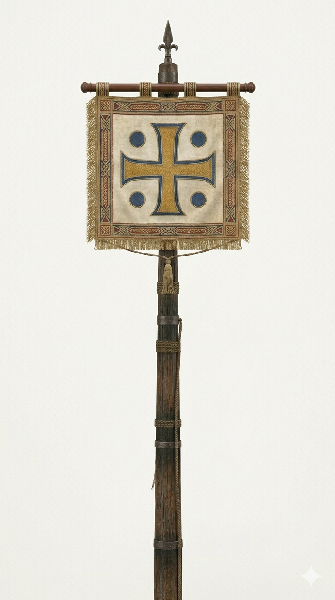 In the autumn of 1066, as Duke William of Normandy made his final preparations to cross the English Channel, he carried more than a dynastic claim and a formidable army. He carried a piece of embroidered silk — a consecrated battle banner sent to him personally by Pope Alexander II. This single object, known as a gonfanon, would transform what might otherwise have been regarded across Europe as an opportunistic land-grab into something far more powerful: a papally sanctioned holy war.
To understand why this mattered so profoundly, it helps to appreciate the political world of 1066. Europe in the mid-eleventh century was a continent in which the authority of the Church and the authority of secular rulers were deeply, sometimes violently, entangled. The Pope was not merely a spiritual figurehead — he was a political actor of the first rank, capable of legitimising or delegitimising the claims of kings and dukes. A ruler who could demonstrate papal favour carried with him a kind of divine legal title that no chronicle, no treaty, and no sword alone could match.
William's genius — or more precisely, the genius of his advisors — was to recognise this and exploit it to the full. In the months before the invasion, William sent envoys to Rome arguing that Harold Godwinson had perjured himself by breaking a sacred oath sworn on holy relics, and that the English Church had fallen into a state of corruption and disorder that demanded reform. Pope Alexander II, sympathetic to Norman ecclesiastical ambitions and persuaded by William's arguments, responded by sending a papal banner together with a ring said to contain a hair of St Peter himself. The message was unmistakable: this invasion had the blessing of God's representative on earth.
For William's soldiers — many of whom were mercenaries and adventurers from across France, Flanders, and beyond, fighting far from home for uncertain reward — the gonfanon was something more than propaganda. It was a promise. To fight and die beneath a papal banner was, in the theology of the time, to die in a state of grace. The spiritual stakes of the battle were as real to those men as the physical ones. Harold's army, by contrast, fought under no such blessing — and the Norman chroniclers were careful to emphasise that distinction.
It is against this background that the gonfanon carried at Hastings must be understood. It was not merely a flag. It was a legal document in textile form, a declaration of holy intent, and one of the most effective pieces of political communication of the entire medieval period.
| | |
|---|
| A Divine Mandate ▲ |
|---|
|
The gift of the banner (a vexillum) was a masterstroke of medieval diplomacy. By securing the Pope’s blessing, William framed his campaign as a crusade to reform the "corrupt" English Church and to punish Harold Godwinson for his alleged perjury. Historically, the primary account of this gift comes from William’s chaplain, William of Poitiers, who noted that the banner served as a visible sign of St. Peter’s protection. In an age where the line between secular law and divine will was non-existent, the gonfanon told every soldier in William’s ranks that to die under its shadow was to die a martyr.
| | |
|---|
| Geometry and Symbolism ▲ |
|---|
|
While the original banner is lost to time, the Bayeux Tapestry provides a vivid, if stylized, record of its appearance. It is depicted as a "gonfanon"—a style of flag featuring a square body with long, pointed tails or streamers. Unlike the static banners of later heraldry, these tails were designed to flutter in the wind, providing a sense of motion and preventing the weight of the silk from unbalancing a knight’s lance.
The design was centered on a prominent cross, likely in gold or red, set against a white field. Most striking are the blue roundels (dots) surrounding the cross. While variations exist, the most detailed depictions show eight dots—two in each quadrant of the cross. In medieval numerology, the number eight symbolized "Resurrection" and "New Beginnings," signaling that William’s arrival would mark the rebirth of the English kingdom under a legitimate, God-appointed ruler.
| | |
|---|
The Papal Banner at Hastings ▲
|
|---|
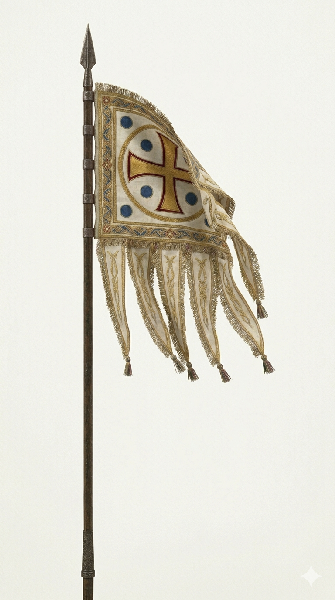 At the Battle of Hastings, the gonfanon was the tactical and spiritual heart of the Norman lines. It was not carried by William himself—who needed his hands free for his mace and reins—but by a designated standard-bearer. Historical accounts suggest the honor was offered to several high-ranking lords who declined it, preferring the glory of direct combat. Ultimately, it was likely carried by Turstin FitzRou or Count Eustace of Boulogne.
The banner’s most famous moment occurs during the "crisis" of the battle. When a rumor spread that William had been killed, the Duke famously threw back his helmet to reveal his face. In the Tapestry, Eustace of Boulogne stands beside him, holding the Papal Gonfanon high. This was the ultimate "ID check"; the presence of the holy banner confirmed that the Duke—and his divine mission—were still very much alive.
Legacy
The Papal Gonfanon was more than a flag; it was a legal document in textile form. After his victory, William reportedly sent Harold’s own royal "Fighting Man" standard to Rome as a reciprocal gift, cementing the alliance between the new English monarchy and the Papacy. Today, the image of the cross and roundels remains a haunting symbol of the moment England was pulled into the orbit of continental Europe, forever sheltered—and conquered—under the shadow of Rome.
| | |
|---|
The Fighting Man: The Personal Honor of the Godwins ▲
|
|---|
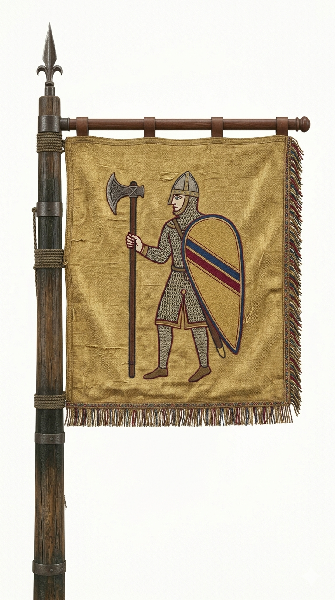 The "Fighting Man" was Harold’s personal standard, a magnificent piece of textile art that served as his tactical headquarters on the battlefield. According to chroniclers like William of Poitiers and William of Malmesbury, it was a large, rectangular banner woven with incredible skill.
The central motif was a warrior in full battle array, embroidered entirely in gold thread. This "Fighting Man" was not a generic soldier; he was a representation of the King himself—an armed defender of the English soil. To emphasize Harold’s immense wealth and status, the banner was further adorned with precious jewels that would have caught the autumn sun, making it visible from every corner of the field.
In the medieval mind, a personal standard was more than a flag; it was a physical extension of the leader’s soul. When the "Fighting Man" was captured by the Normans after Harold’s death, it was seen as the ultimate trophy. William the Conqueror, recognizing its symbolic weight, sent the blood-stained gold banner to Rome as a gift to Pope Alexander II. It was a calculated exchange: the Pope had given William a banner to start the war, and William returned Harold's banner to signal its end.
| | |
|---|
The Wessex Wyvern: The Hissing Terror of the West ▲
|
|---|
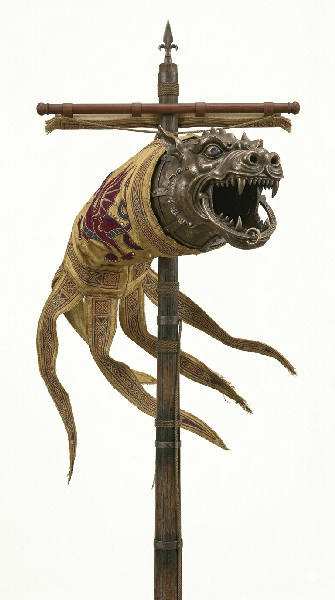 While the Fighting Man was a work of embroidery, the Wessex Wyvern (or Dragon) was a work of psychological warfare. This was the ancient "Royal Standard" of the House of Wessex, a tradition stretching back to the Roman occupation of Britain.
Unlike a flat flag, the Wyvern was a draco standard—a windsock. It consisted of a fearsome head hammered from bronze or copper, attached to a long, hollow tube of silk. As the wind whipped across the ridge, or as the King's standard-bearer moved, air was funneled through the dragon’s mouth. This caused the silk tail to inflate and writhe like a living creature.
Crucially, these standards were designed to hiss or shriek. The metal head acted as a resonator, creating a haunting, high-pitched whistle that could be heard over the clash of shields. For the Saxon Fyrd, the sight of the golden dragon "swimming" in the air and the sound of its voice provided a rallying point that felt divinely protected. For the invading Normans, it was a "barbaric" and terrifying relic of an older world.
| | |
|---|
| The Roman Legacy: The Draco ▲ |
|---|
|
The ancestor of the Wessex Dragon was the Sarmatian Draco. The Sarmatians were nomadic horsemen from the steppes of modern-day Ukraine and Russia who were recruited into the Roman cavalry. When they were stationed in Britain in the 2nd and 3rd centuries, they brought their unique standards with them.
The Roman military eventually adopted the draco for its own cavalry units (Draconarii). When the Roman legions departed Britain in 410 AD, they left behind more than just roads and forts; they left a visual language of power. The Romano-British and later the emerging Anglo-Saxon kingdoms adopted the dragon as a symbol of high-status military leadership.
| | |
|---|
| The Fall of the Twin Standards ▲ |
|---|
|
The fate of these two banners mirrored the fate of Anglo-Saxon England. As long as the Fighting Man stood upright and the Wyvern hissed in the wind, the English shield wall held. When the Norman knights finally breached the summit, their first priority was to "hew down" these symbols. The Bayeux Tapestry captures this grim moment, showing a Norman knight cutting through a standard-bearer. With the golden warrior trampled and the dragon silenced, the organized resistance of the English vanished, marking the end of an era and the beginning of the Norman age.
|
|
|
|
|
| |
|
|
Local Interest
Just click an image |
|
|
|
|
|
|
|
|
|
|
|
|
| |
|
|
;)
)
)
)