| Smallhythe the shipyard of the Kings |
|---|
If you go to Smallhythe in Kent, just south of the town of Tenterden, you would be surprised to know that the tiny hamlet of six or seven houses in a very quiet and peaceful valley with a small stream and twelve miles from the coast, was one of the major shipyards in England in the 1400's and the 1500's.
On this page I will go into what we currently know about this hamlet, and how the landscape has changed that has effected the area.
| Smallhythe views |
|---|
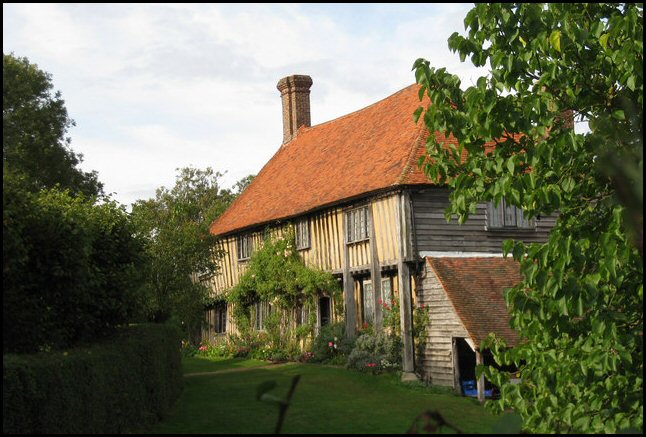
The picture above is of Smallhythe Place which is now an National Trust site and which houses the Ellen Terry Museum.
The picture above originates from Wikipedia -By Oast House Archive, CC BY-SA 2.0,
https://commons.wikimedia.org/w/index.php?curid=8397509
| Evidence of Roman occupation |
|---|
From the BBC
'There is now conclusive archaeological evidence of a previously unknown Roman settlement in Smallhythe, Kent. The discovery was made during excavations of a medieval shipyard at Smallhythe Place, a National Trust site, with results publicly announced in February 2024.'
The site is dated from the 1st Century to the 3rd Century and was run by the Channel Fleet the CLBR (Classis Britannica) who were also responsible for the Wealden Iron production in the area.
The find details again from the BBC article
An "incredibly rare" Roman head of Mercury has been discovered during an archaeological dig and is now on display at the Ellen Terry museum.
The find was made during excavations at the site of a medieval shipyard at Smallhythe Place, in Tenterden, Kent.
Roman figurines in pipeclay were mainly used for private religious practice and placed in the graves of children.
Fewer than 10 pipeclay heads are believed to have survived from Roman Britain, according to the National Trust.
| The origination of the Name |
|---|
Smallhythe is a Saxon place name, made up of two snippets, these are smæl which means small and hyþ pronounced hythe.
The Saxon translation of hyþ means a port, however there are very few in the country and the words port and harbour are also available in Saxon, so is this a harbour?
My thoughts are that a hyþ is the landing place where a Saxon tribe landed, so an important place.
Please read Saxon Place Names (hythe, hithe etc) for more details and explanation.
| | |
|---|
Possible Viking influence |
|---|
Anglo Saxon Chronicles
893AD. In this year the great army, about which we formerly spoke, came again from the eastern kingdom westward to Boulogne, and there was shipped ; so that they came over in one passage, horses and all ; and they came to land at
Limne-mouth with two hundred and fifty ships.
This port is in the eastern part of Kent, at the east end of the great wood which we call Andred ; the wood is in length from east to west one hundred and twenty miles, or longer, and thirty miles broad : the river of which we before spoke flows out of the weald.
On this river they towed up their ship as far as the weald, four miles from the outward harbour, and there stormed a fortress : within the fortress a few churls were stationed, and it was in part only constructed.
Then soon after that Hasten with eighty ships landed at the mouth of the Thames, and wrought himself a fortress at Milton ; and the other army did the like at Appledore.
| The Cinque Ports |
|---|
Smallhythe was not a Cinque Port itself, but its shipyard was directly responsible for Tenterden becoming one.
In 1449, the town of Tenterden joined the Confederation as a "limb" (a subsidiary member) of the head port of Rye.
This status and the tax privileges that came with it were granted in recognition of Tenterden's key contribution: supplying royal warships built in Smallhythe.
Please read our document on The Cinque Ports for more details.
| | |
|---|
The Smallhythe Shipyard: Building England’s Royal Navy |
|---|
From the early 15th to mid-16th centuries, the hamlet of Smallhythe on the River Rother in Kent was one of medieval England’s most significant royal shipyards. Its strategic location—with deep tidal water and proximity to the oak forests of the Weald—made it an ideal location for constructing the king’s warships. While it served multiple monarchs, the yard is best known for its work for Henry V and Henry VIII, playing a direct role in the naval ambitions of both kings.
Smallhythe’s royal service began with Henry IV, for whom the 100-ton vessel The Marie was built in 1410. Its zenith came under his son, Henry V, who personally visited the shipyard in August 1416 to inspect two vessels destined for his invasion fleets in France. One was the Jesus, the first English ship of 1,000 tons; the other was the balinger The George. The George holds a special place in naval history as the first two-masted vessel known to have been built in an English shipyard, representing a major technological leap in ship design.
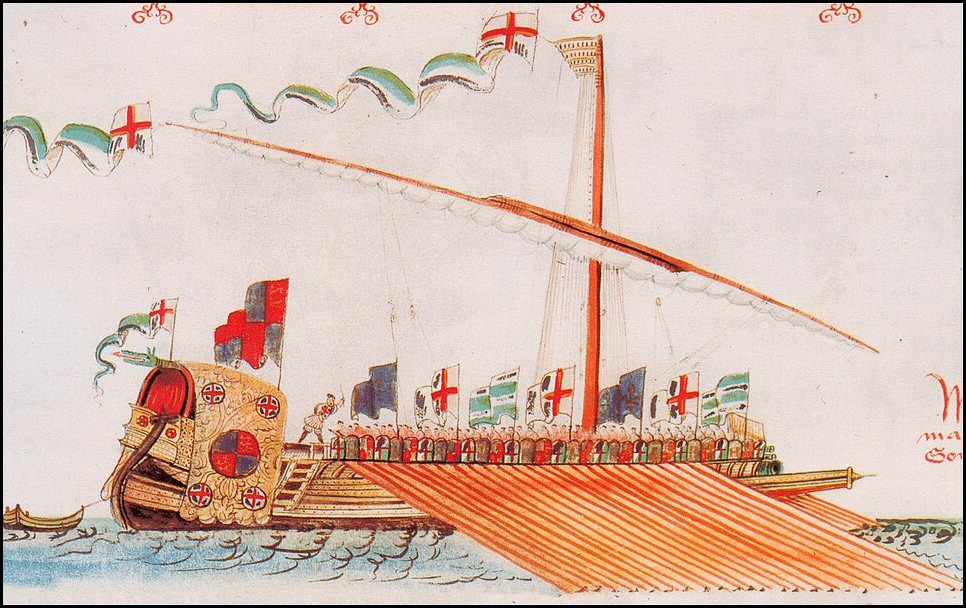
The shipyard remained vital into the Tudor era. Sir Robert Brigandyne, Clerk of the King’s Ships to both Henry VII and Henry VIII, lived and worked at Smallhythe. He supervised the design and construction of some of Henry VIII’s most famous warships, including the Mary Rose. The last royal ships built at Smallhythe were The Grand Mistress and The Great Gallyon, completed for Henry VIII in 1545-46.
The yard’s decline was sealed by environmental change. A catastrophic fire in 1514/1515 destroyed quays and warehouses. More critically, the River Rother gradually silted up, making it impossible to launch the large warships required by the Tudor navy. By the early 17th century, the bustling port community of around 200 shipbuilders had faded away, its royal legacy preserved only in scattered archaeological finds like hundreds of iron ship nails and a waterlogged timber marked with the royal “broad arrow”.
Today, landlocked and quiet, Smallhythe stands as a testament to the small communities that built England’s early naval power.
| Royal ships built at Smallhythe |
|---|
| The Marie 1410AD |
|---|
The Marie - built at Smallhythe
- Built in 1410 for Henry V
- Weight 100 tons
- Crew
|
| The George 1416AD |
|---|
The George - built at Smallhythe
- Built in 1416 for Henry V
- Weight 120 tons
- Crew
|
| The Jesus 1417AD |
|---|
The Jesus - built at Smallhythe
- Built in 1417 for Henry V
- Weight 1000 tons
- 3 guns
- Crew
- 200 mariners
- 250 soldiers
|
This ship was built before the first iron cannons in the weald were made at Buxted in 1543AD, hence was more like a floating castle with archers and soldiers.
This was the largest ship built at Smallhythe, which implies that the Rother was silting up or high tide levels dropping as later ships were smaller. Henry VIII built larger ships but not at Smallhythe.
The following show dimensions for a contemporary ship Henry V’s Grace Dieu although this is about 1.5 x The Jesus, but gives some idea of the size even if you reduce the sizes by 1/3.
While specific historical records for the draft (depth below the waterline) of Henry V’s Grace Dieu are limited, archaeological investigations and contemporary accounts provide a clear picture of its massive scale:
Estimated Draft/Depth:
Archaeological surveys of the wreckage in the River Hamble found that the surviving lower section of the hull (just above the keel) is roughly 12 feet (3.6 meters) deep. Other estimates for contemporary large carracks of a similar tonnage (800–1,400 tons) suggest a laden draft of approximately 4 to 4.5 meters (13–15 feet).
Massive Dimensions:
The ship was roughly 218 feet (66 meters) long with a beam (width) of 50 feet (15 meters).
Huge Displacement:
Its weight is estimated between 1,400 and 2,750 tons. This made it the largest ship built in England for over 200 years.
Height: The mainmast was recorded by an eyewitness as being 200 feet high
If you reduce all the dimensions by 1/3 then the Jesus would be about 44 x 10 metres with a mast 140ft high and a draft of 2.5 metres, this would mean that the Rother was at least 3 metres deep from Smallhythe to the coast at Winchelsea.
| The Galley Subtle 1544AD |
|---|
| | |
|---|
The Grand Mistress 1545AD |
|---|
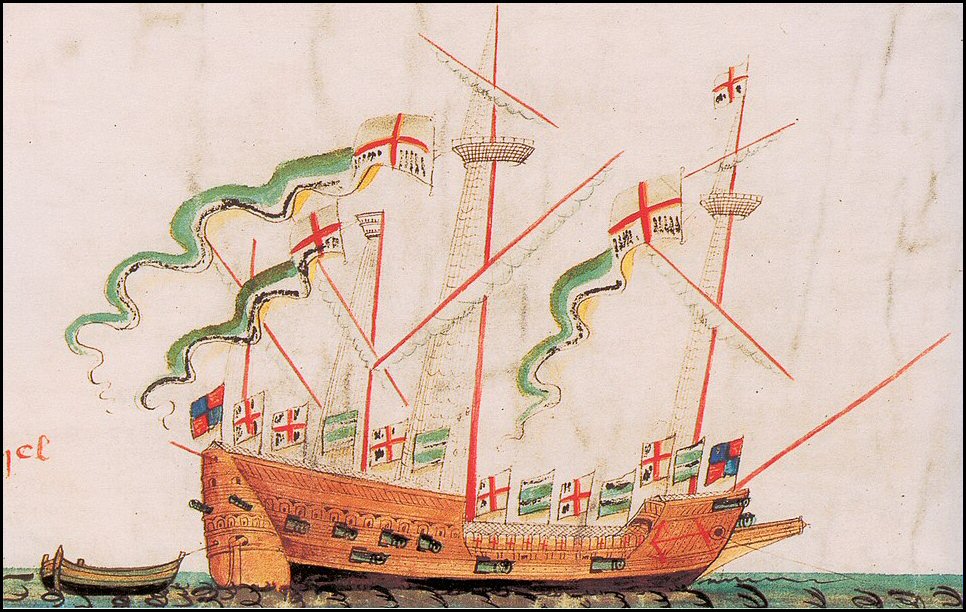
The Grand Mistress - a galleass built at Smallhythe
- Built in 1545 for Henry VIII
- Weight 450 tons
- 31 iron guns
- 7 bronze cannons
- Crew
|
Full details from Three Decks.org |
|
|
;)
)
)