|
Saxon thegn | Anglo Saxon History 
Search Pages |  | |
| | Battle of Hastings 1066AD Observations - Did the Saxons use Caltrops ? |
|---|
Please Note: I am using the term Caltrop loosely meaning a horse stopping device, not necessarily the same as the Roman Caltrop, this is because I am not sure of the term to use for this type of device, possibly a stake.
|
What is a Caltrop ▲
|
|---|
 From Wikipedia
A caltrop (also known as caltrap, galtrop, cheval trap, galthrap, galtrap, calthrop, jackrock or crow's foot) is an area denial weapon made up of usually four, but possibly more, sharp nails or spines arranged in such a manner that one of them always points upward from a stable base (for example, a tetrahedron). Historically, caltrops were part of defences that served to slow the advance of troops, especially horses, chariots, and war elephants, and were particularly effective against the soft feet of camels. In modern times, caltrops are effective when used against wheeled vehicles with pneumatic tires.
The Greek word, τρίβολος meaning 'water-chestnut', translated into Latin as tribulos. The Latin name tribulus originally meant the caltrop (a spiky weapon of similar shape), but in Classical times the word already meant this plant as well.
Tribulus terrestris is the plant that these weapons originated from, as the spiny pods penetrated through leather shoes and into feet.
|
Why do I bring this up as a subject? ▲
|
|---|
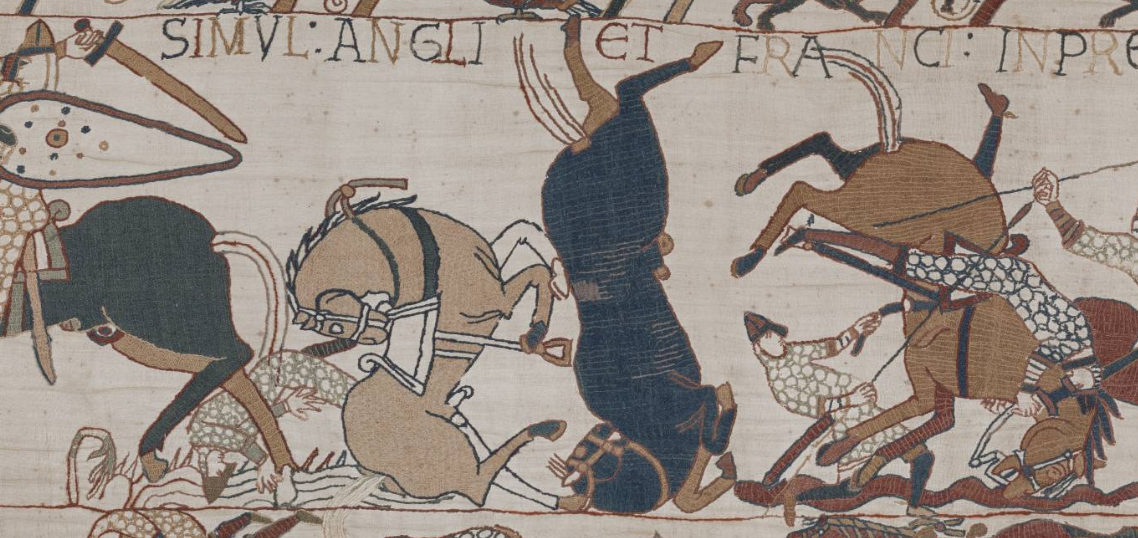
The reason I bring this up as a subject is because of the above illustration from the Bayeux Tapestry, and was trying to understand what it meant.
Why on earth are horses falling to the ground and knights falling off them ? there doesn't appear to be anyone attacking them !!
|
Then I looked more closely at the image ▲
|
|---|
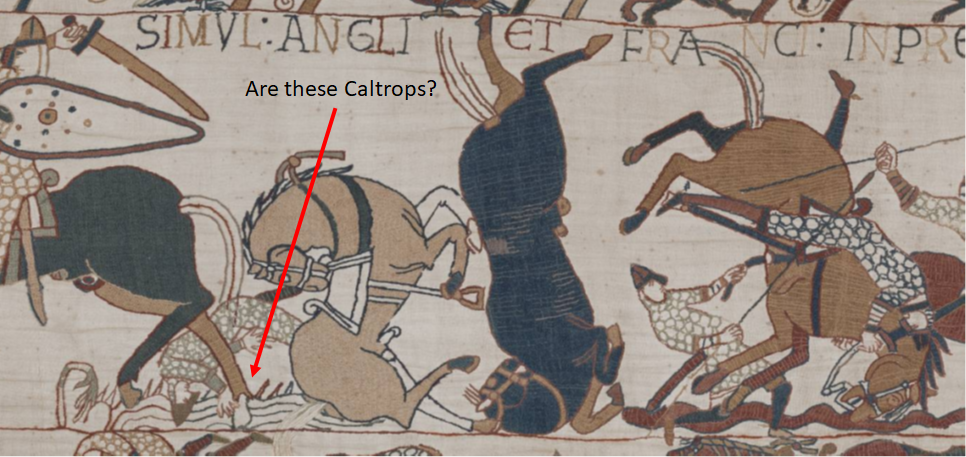
And I then noticed there were a number of pointy things on the ground, if these were a type of caltrop then the horses would be flying through the air, and throwing the knights to the ground.
The individual chronicles report differing details about the Saxon defenses, and don't mention caltrops but it is possible that a military fosse when built by the Saxons was normally defended with caltrops.
It is believed that the Bayeux may have been made by ladies from Canterbury and they perhaps were trying to tell the true story from the Saxon side.
|
Could the Saxons have learn about Caltrops from the Romans ▲ ▲
|
|---|
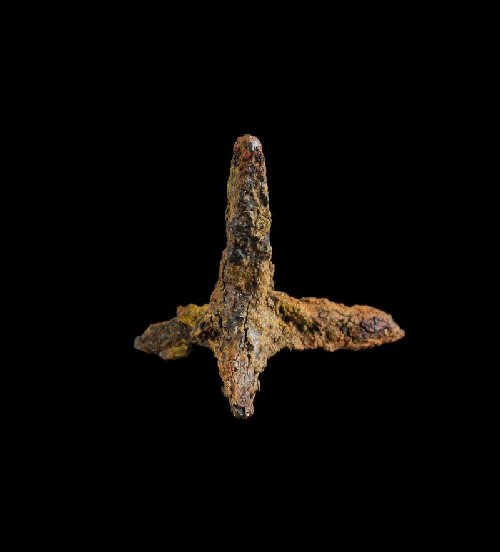
The Anglo-Saxons were familiar with Roman military tactics and equipment. The Romans had used caltrops (which they called tribulus) for centuries, including at famous battles like Carrhae in 53 BC. This knowledge would have been passed down or observed, influencing the war-making of the peoples who came after them.
We do know that the Saxons must have learned about the Roman Messenger system otherwise the messengers sent to tell Harold about the invasion and to the Shires to request troops would never have got to their destinations in time. So it is most likely they would know about these devices. If Harold had been to Normandy as the Chronicles say, then he would be aware of the way the Normans and Bretons used Cavalry. So anti-cavalry defenses would be a logical means to defend his position.
Wooden Stakes vs Iron Caltrops: While the Romans used iron caltrops, the Saxons positioned at the edge of the Andredsweald forest would more likely have used sharpened wooden stakes. These could be quickly fashioned from the abundant timber available and set into the ground or placed in defensive ditches. Wooden stakes would be: - Faster to produce in large quantities with limited preparation time
- Readily available from the surrounding forest
- Effective against horse hooves and unarmored legs
- Easier to position and conceal in a fosse or ditch system
Iron caltrops would require significant metalworking resources and time - commodities Harold did not have after his rapid march from York and overnight arrival at the battlefield.
| | |
|---|
My Conclusion ▲
|
|---|
 For the Saxons to last from the third hour of the day till dusk with the Huscarls, Thegns and Fyrd, the area must have been prepared for defence against the Norman Cavalry and also the Norman men at arms who were all more heavily armoured and had better weapons than the fyrd.
If the Saxons had built defences then a caltrop type device must have been used to prevent the Breton and Norman Cavalry. To stop the archers and crossbowmen just picking off the fyrd one at a time, then please read our malfossse page .
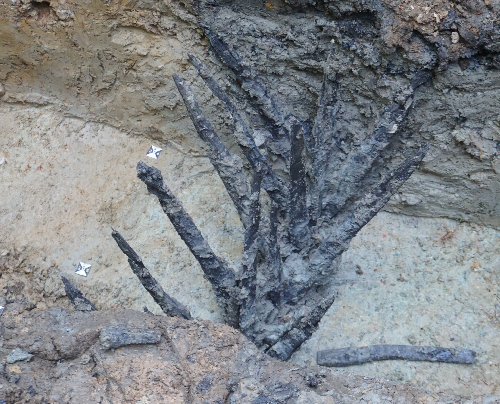
The image to the right is 'an excavated Roman ditch defence from Bad Ems, western Germany' showing how these were set into a ditch and bank defense(fosse) . (the full article is from https://www.thehistoryblog.com/archives/66552 and can be linked by clicking the image)
|
|
|
|
|
| |
|
|
Local Interest
Just click an image |
|
|
|
|
|
|
|
|
|
|
|
|
| |
|
|
;)
)