|
Saxon thegn | Anglo Saxon History 
Search Pages |  | |
| | Battle of Hastings 1066AD - V - Evidence for the Battlefield Malfosse |
|---|
| | The Malfosse - Did it exist and what was it ? |
|---|
The term the Malfosse was added to the details of the Battle of Hastings from the Chronicles of Battle Abbey.
This originated from the following:
Quod quidem baratrum sortito ex accidenti uocabulo Malfosse hodieque nuncupatu
Which translates roughly to:
This ditch has been named for the accident, and today it is called Malfosse.
From the documentation it would seem that there could have been two malfosse's or malfossei, one during the battle and a second while chasing the retreating Saxons.
A military defininition of Fossé (Fr.) is an exterior ditch fronting a rampart or curtain.
| | Documentary evidence ▲ |
|---|
William of Jumièges
However confidence returned to the fugitives when they found a good chance to renew the battle, thanks to a broken rampart and labyrinth of ditches.
Recorded as the Saxons flee
Orderic Vitalis
(The Normans, finding the English completely routed, pursued them vigorously all Sunday night, but not without suffering a great loss ; for, galloping onward in hot pursuit, they fell unawares, horses and armour, into an ancient trench, overgrown and concealed by rank grass, and men in their armour and horses rolling over each other, were crushed and smothered. This accident restored confidence to the routed English, for, perceiving the advantage given them by the mouldering rampart and a succession of ditches, they rallied in a body, and, making a sudden stand, caused the Normans severe loss.)
This again records that the malfosse was after the battle
The second part of this account could apply to the battle and not the rout as routing soldiers do not usually reform as their units are broken up and spread out by the rout.
Master Wace
(and they had moreover made a fosse, which went across the field),
this is a possibility if the Normans broke through the Shield Wall and hence into the Saxon lines, but were then pushed back into the ditch(fosse) great losses would have occurred.
Before the battle Master Wace also describes Saxon defences
(There he said he would defend himself against whoever should seek him ; and he had the place well examined, and surrounded it by a good fosse, leaving an entrance on each of three sides, which were ordered to be all well guarded.)
In his section on THE ROLL OF THE NORMAN LORDS
(And now might be heard the loud clang and cry of battle, and the clashing of lances. The English stood firm in their barricades, and shivered the lances, beating them into pieces with their bills and maces. The Normans drew their swords and hewed down the barricades, and the English in great trouble fell back upon their standard, where were collected the maimed and wounded.)
claiming that this was a Saxon made defence this potentially explains the battle ditch description.
Henry of Huntingdon
(But Harold had formed his whole army in close column, making a rampart that the Normans could not penetrate. Duke William therefore commanded his troops to make a feigned retreat. In their flight they they happened unawares of a deep trench which was treacherously covered into which numbers fell and perished. While the English were engaged in pursuit, the main body of the Normans broke the centre of the enemy's line, which being perceived by those in pursuit over the concealed trench, when they were consequently recalled most of them fell there.)
This sounds like the Normans attacked a defensive ditch, broke over the rampart then into the Saxon line, then were pushed back into the ditch and finally routed, the English then followed up but they were also cut down by the cavalry while pursuing the routed Norman men-at-arms.
Florence of Worcester
(before a third of his army was in fighting order. He gave them battle at a place nine miles from Hastings, where they had built a fort. The English being crowded in a confined position)
from this account it would seem that Harold had built a fort as the English were in a confined position, which could be a ditch on three sides as described by Master Wace(above).
The Chronicles of Battle Abbey
(here lay between the hostile armies a certain dreadful precipice, caused either by a natural chasm of the earth, or by some convulsion of the elements. It was of considerable extent, and being overgrown with bushes or brambles was not very easily seen, and great numbers of men — principally Normans in pursuit of the English — were suffocated in it).
This appears to record that the Malfosse was in the Battlefield, however it could be read as after the battle.
The Bayeux Tapestry has a scene where horses are seen vertically and a very rough piece of ground goes up to the Saxon positions, this could also be interpreted as a ditch in front of the Saxon lines with men and horses falling into it. A further interesting part of this image is that the legs of the Saxons at the top of the hill are behind the hilltop which could be interpreted as defensive shieldwall above the fosse.
|
The Norman cavalry attack on the hill and the falling horses ▲
|
|---|
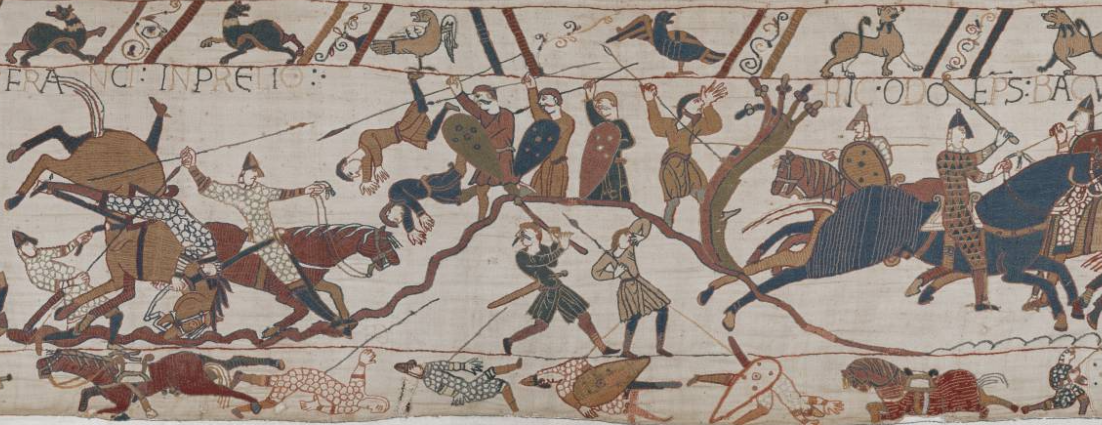
Please click the image above to go to the official Bayeux website.
| | There are a few very important facts that need to be looked at ▲ |
|---|
- Harolds army was in the majority the Fyrð who were mostly farm laborers used to digging and fence laying.
- The Fyrð would not have had training or experience against cavalry.
- Fighting against a large force of cavalry is difficult without physical defenses.
- Breton Cavalry were looked on at the time as the best cavalry in Europe.
- A Shield wall(Testudo) requires training to ensure solidity but easily breaks once a gap appears.
- In an open battle cavalry generally massacre infantry due to their mobility.
- Cavalry attacking a Shield wall(Testudo) would attack a single point and break through.
- The battle took place from morning till dusk and would appear to be stalemate until afternoon.
- A number of the reports say that the malfosse was hidden or concealed
- routing troops dont usually have time or energy to prepare traps implying the ditch was in place before the battle.
- A Shield wall(Testudo) requires close fitting shields and training, neither of which the Fyrð had access to.
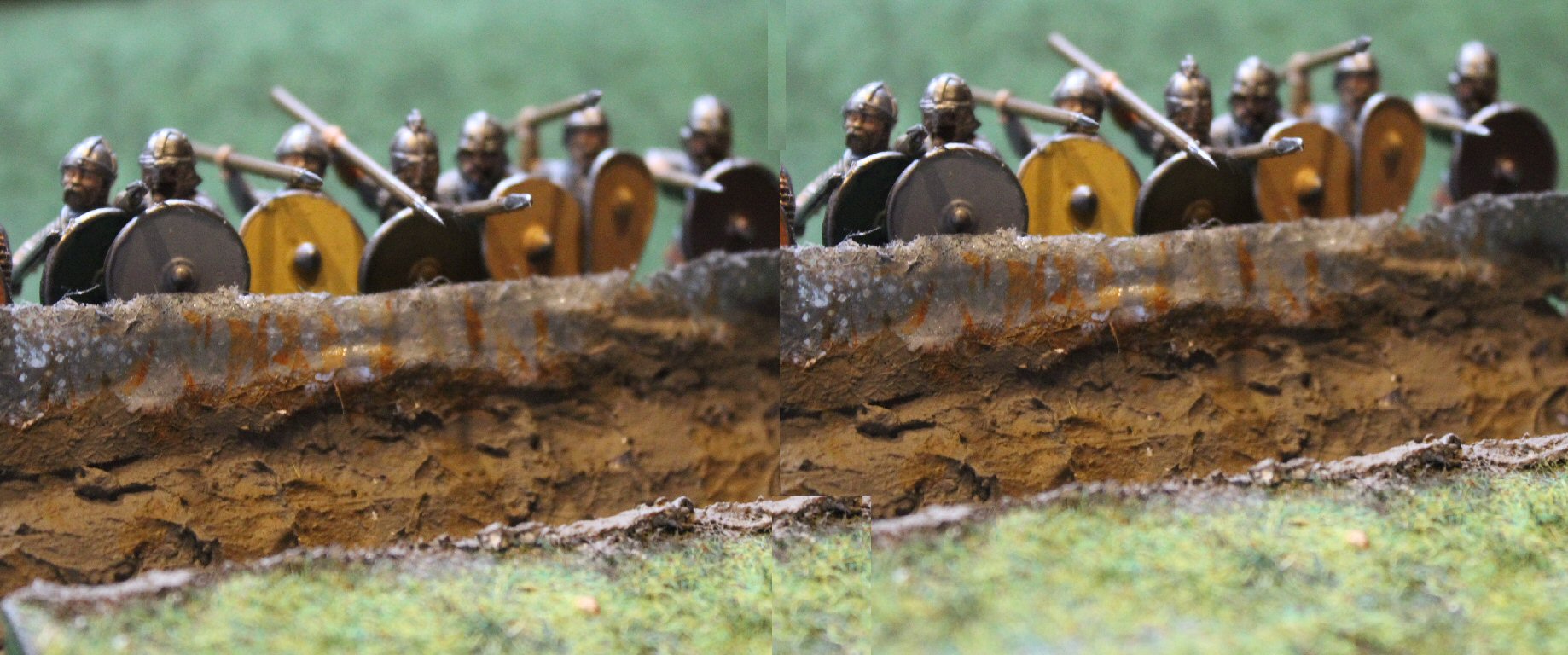
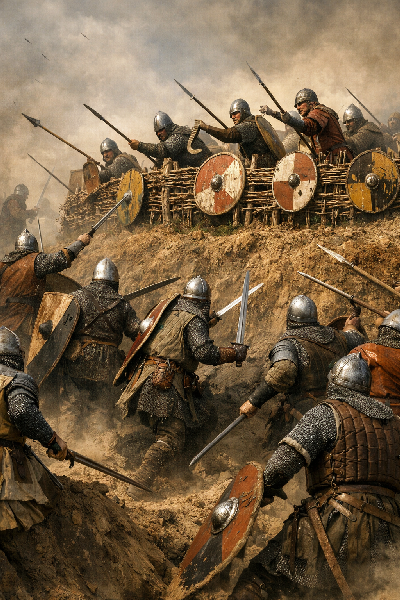
Let us for a moment assume that Master Wace's descriptions was accurate, then we would have a ditch dug around the Saxon camp with the soil thrown up on the Saxon side, wattles, wood and branches would be woven along the top and the shieldwall stood behind the wattle fence, this would make it difficult for the cavalry to cross the ditch and attack the shieldwall, so negating the cavalry's mobility advantage.
Breton Cavalry tactics:
In the Battle of Jengland 851AD King Charles of the Franks arranged his troops in two lines: at the rear were the Franks; in front were Saxon mercenaries whose role was to break the assault of the Breton cavalry, which was known for its mobility and tenacity. In the initial engagement, a javelin assault forced Saxons to retreat behind the more heavily armoured Frankish line. Rather than engage in a melée, the Bretons harassed the heavily armed Franks from a distance, in a manner comparable to Parthian tactics, but with javelins rather than archers. They alternated furious charges, feints, and sudden withdrawals, drawing out the Franks and encircling over-extended groups, needless to say the Franks were defeated.
Battle of Jengland AD851 - implies a quick defeat for Harold at Hastings 1066AD
If the Bretons could defeat the Franks on flat land where the Franks were well armoured, why couldn't they easily defeat the Saxon Fyrð who were much more lightly armoured unless they were behind defensive works.
| | Illustrations of a defensive fosse ▲ |
|---|
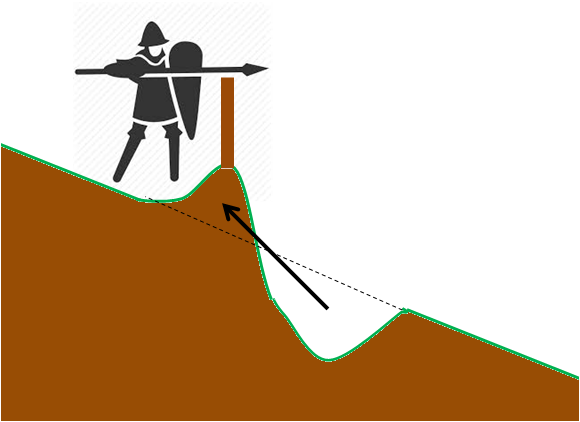 | 
|
| Fosse construction | Fyrð behind the shieldwall |
|
Close up of the Bayeux hill attack ▲
|
|---|
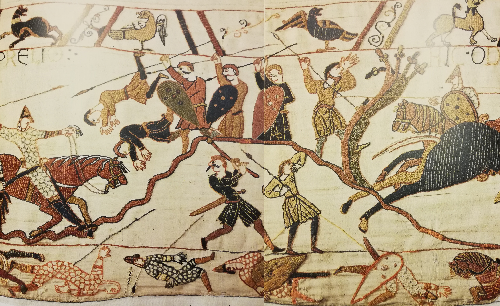
This is a closer view of the details of Senlac Hill from the Bayeux Tapestry showing either very uneven ground, or ditches such as those found on an ancient hillfort.
| | What effect could a military fosse have on the battle ▲ |
|---|
- The Normans would be forced to attack
(The Normans attacked the Saxons)
- The shieldwall would last a long time and only break with weight of numbers in one place
(The Shieldwall appeared to stay formed until the afternoon)
- The Norman archers would have to fire high in the air to hit the Saxons
(The reports are that William ordered the archers to fire high up)
- The Norman cavalry would have to throw spears until the infantry broke through
(The Shieldwall appeared to stay formed until the afternoon)
- If the Normans broke through then were pushed back large number would be killed in the Fosse
(The Normans appeared to break through the Saxon lines but were pushed back)
- If the Normans were pushed back a rout was likely
(The Normans routed but William rallied the troops)
- If the Saxons followed up the rout then the wall would be weakend
(The Saxons followed up, were cut down then the Normans started to break the shieldwall)
- The malfosse could be concealed by branches etc from the wood used to build the wattle fence
(The Normans lost cavalry in the Malfosse which could have been concealed)
- The Breton cavalry couldn't break through the shieldwall
(If they had been able to use their normal tactics the Saxon Fyrð would have been cut down)
| | |
|---|
| Could the Saxons have built a Fosse in time ▲ |
|---|
A friend of mine has asked if the Saxons had time to prepare these earthworks prior to the Battle so I will investigate\r
Firstly we need to know how long it takes to build a defensive fosse:
There is evidence from the Roman army, of building marching camp ditches 2 mtr in length x 1 mtr deep x 2.5 mtr wide with a 1 metre tall wall/fence on top of the spoil of taking about 3 hours with 8 builders, so a 100 metre defence would take 400 men about 3 hours to build, and this would have to be during daylight which in October 1066 was sunrise 05:56 and sunset 17:51, hence would need to be started about 14:00.
Please refer to the following Early Imperial Roman army campaigning: the building of marching camps.
If you look at the spreadsheet the calculations show that a 5000 marching Roman force, if all men help out, can dig a rectangular surrounding defense in 3 hours that would enclose the whole unit, this caculation allows for different arrival times of the troops as they reach the campsite.
The Saxon Fyrð would not have been so well trained so would take longer and would need more supervision probably from Thegn's and Huscarls, but even so may not have taken more than about 4 hours for defences on three sides to be created, whatever the size of the force.
|
Did the Saxons arrive in time to build a fosse:
Anglo Saxon Chronicles William, however, came against him unawares, ere his army was collected; but the king, nevertheless, very hardly encountered him with the men that would support him: and there was a great slaughter made on either side.
Battle Abbey Chronicles Harold, the usurper of the kingdom, hearing of his arrival, quickly collected his army, resolved upon driving out the duke, or rather upon utterly destroying him and his, and marched forward, with great boldness and expedition, to the place which is now called Battel, where the duke, surrounded by his battalions of cavalry, met him courageously.
The duke, then, by his heralds, thrice offered conditions of peace, which were thrice refused by the enemy; and at length, conformably to the prophecy of Merlin a Norman race in iron coats boldly cast down the pride of the English.
Master Wace states that Harold arrived and setup the base, then the following day reconnoitered the Norman camp, so had time to build the defences.
|
Descriptions of Ditch and Bank defenses ▲
|
|---|
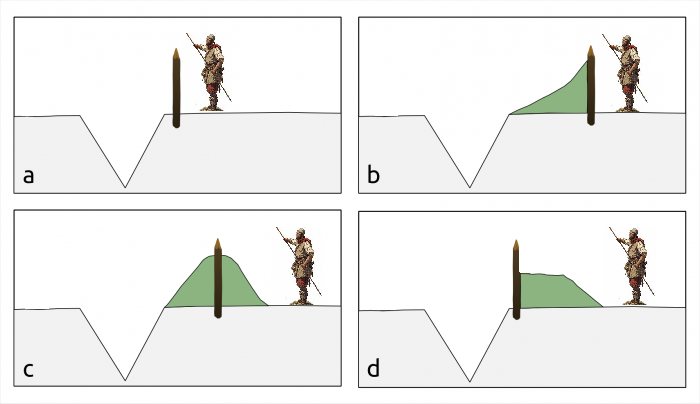
These are different types of Ditch and Bank defenses found in Neolithic Hill forts, please click on the image to see the original document or click here.
| | Was this why William instructed his archers to fire overhead ? ▲ |
|---|
Master Wace
The Norman archers with their bows shot thickly upon the English ; but they covered themselves with their shields, so that the arrows could not reach their bodies, nor do any mischief, how true soever was their aim, or however well they shot. Then the Normans determined to shoot their arrows upwards into the air, so that they might fall on their enemies' heads, and strike their faces. The archers adopted this scheme, and shot up into the air towards the English ; and the arrows in falling struck their heads and faces, and put out the eyes of many ; and all feared to open their eyes, or leave their faces unguarded.
Henry of Huntingdon
Duke William also commanded his bowmen not to aim their arrows directly at the enemy, but to shoot them in the air, that their cloud might spread darkness over the enemy's ranks; this occasioned great loss to the English.
|
So the Normans don't seem to be able to shoot the infantry in the 'shield wall', however the wall would have been made up of differing shape and size shields hence it wouldn't fully cover the infantry, therefore arrows would hit legs and arms and heads that were not covered by the shields.
This would produce numerous injured fyrd who would not be able to defend their wall and it would start to break up. Firing over the 'shield wall' means that firing at the the wall itself was a waste of time so this implies it is impenetrable to arrows.
We are told that the crossbow quarrels dissolved the shields and penetrated armour, so if this was an open standing wall then large holes would have been broken in the 'shield wall' where the fyrd were being killed by the crossbows, but it seems to have held for the day.
So a 'Shield Wall' made up of a line of Saxon Farmers holding different size and shaped shields seems to be a myth.
| 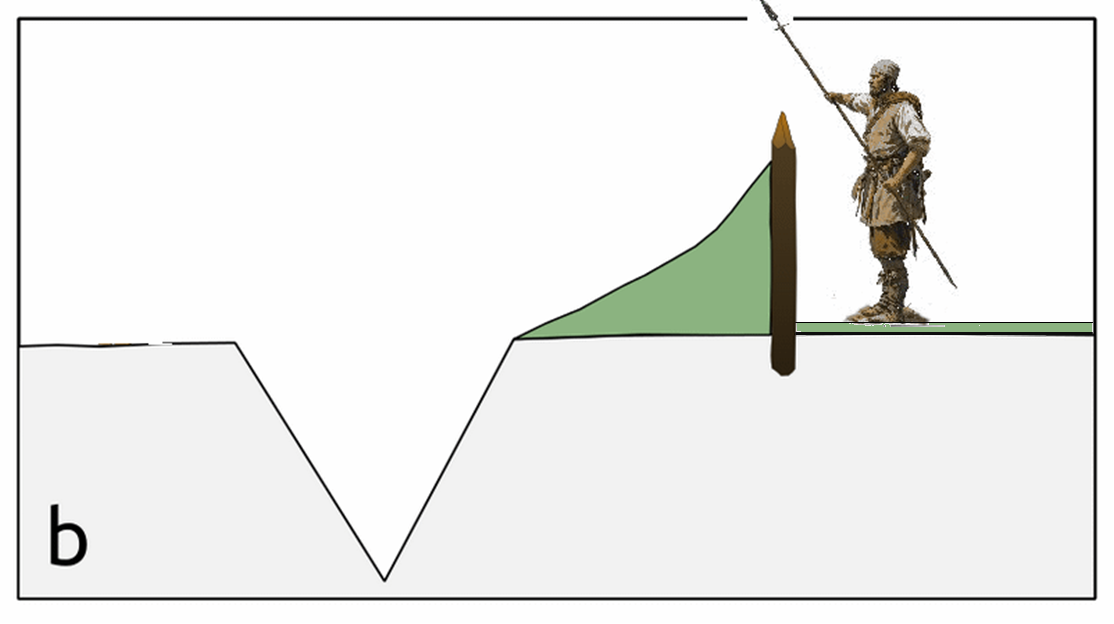
My suggestion is that the Saxons built a type b defensive position , please click on the image to see the original document or click here.
The document has been recently published by and is copyright Víctor Jiménez Jáimez and is a good read.
| | Why the fosse was Harold`s only option ▲ |
|---|
To understand why Harold built a fosse at Hastings, you need to consider the three weapons that would have destroyed his army within hours on open ground — Breton cavalry, the Norman Archers and the Norman crossbowmen.
| | The Breton cavalry threat ▲ |
|---|
To understand the cavalry problem, you need to go back 215 years to a battlefield in Brittany.
At Jengland in 851AD, the Bretons destroyed a Frankish army that was better armed, better armoured, and supported by Saxon mercenary axemen — using mobile cavalry tactics that combined javelin throws, feigned retreats, sudden charges and encirclement. The Franks had no answer to it. Their heavy infantry and armoured cavalry were useless against an enemy that refused to stand and fight, instead drawing them out of formation and cutting them down in isolated groups.
The Normans who invaded England in 1066 were not the same people who had been defeated at Jengland. By the 1050s Normandy and Brittany shared a long and violent border, and William fought the Bretons repeatedly throughout that decade. The 1064 campaign — recorded in the Bayeux Tapestry and witnessed by Harold himself — took the Norman and Breton armies deep into Brittany together. Harold saw Norman and Breton cavalry operating at close quarters. He saw exactly what they could do.
By 1066 the Breton contingent in William's army was substantial, and the tactics they brought were direct descendants of Jengland. Feigned retreats, javelin harassment from horseback, encirclement of broken infantry — these were not improvised battlefield decisions. They were a mature cavalry doctrine two centuries in development. Harold knew this. He had seen it in person.
The Saxon Fyrd were overwhelmingly farm labourers and minor freemen. They had no cavalry, limited armour, mixed weapons, and no experience fighting formed horsemen. In an open engagement on flat ground, Breton-style cavalry would have destroyed them within hours — exactly as they had destroyed the better-armoured Franks at Jengland.
The fosse at Hastings removed the threat of encirclement from the flanks. But it did not remove the threat of frontal charges, javelin harassment, or feigned retreats designed to draw the Fyrd downhill and out of formation. Harold needed something more.
"For the background to Breton cavalry tactics see Battle of Jengland 851AD"
| | The crossbow threat ▲ |
|---|
The Breton cavalry was not the only problem. William's army contained a weapon the Saxons had almost certainly never encountered — the crossbow, brought from the newly conquered Norman territories in Apulia, Calabria and Sicily. As described on the Bows and Crossbows page, crossbow quarrels at close range were powerful enough to punch straight through Saxon shields and the ring mail of the Huscarls behind them.
Against troops standing in the open, even partially sheltered by handheld shields, a concentrated crossbow barrage at close range would have collapsed the Saxon line within the morning — well before the cavalry needed to exploit the gaps.
| | The handbow threat ▲ |
|---|
The Norman handbowmen presented a different but complementary problem. Where the crossbow was a close-range armour-piercing weapon, the handbow had a longer effective range — approximately 180 metres compared to the crossbow's 120 metres — and a much faster rate of fire. A trained bowman could loose six to eight arrows per minute against the crossbowman's two.
This meant the handbowmen could maintain a sustained and continuous rain of arrows across the whole Saxon line at a range where the crossbowmen had not yet come into play. Their role was attrition — not punching through armour but steadily wounding, exhausting and demoralising the Fyrd through sheer volume of fire. Arms, legs, feet, faces — anything not covered by a shield was at risk. A man with an arrow through his foot cannot hold a line. A man watching his neighbours fall to arrows he cannot return and cannot see coming loses his nerve.
The Saxons had their own archers, but as the chronicles record, these were destroyed early in the battle by Norman javelin-armed infantry who advanced specifically to eliminate them. Once the Saxon bowmen were gone, the Norman handbowmen could operate freely with no threat of return fire at range — a decisive asymmetry.
Harold's archers could not be replaced. He had no reserve of bowmen. Once they were gone the Fyrd had no way of keeping the Norman handbowmen at a distance or disrupting their rate of fire.
The wattle fence and uphill position gave the Fyrd partial cover against flat trajectory arrows — which is why William had to resort to overhead fire, dropping arrows at a steep angle onto heads and faces that the fence could not protect. But overhead fire at range is inherently less accurate and less powerful than flat fire at close range. It was a workaround, not a solution — and it confirms that the fence was working well enough that direct fire had been abandoned as a waste of arrows.
| | The fosse as the answer to all three ▲ |
|---|
The fosse — a ditch dug across the front of the Saxon position with the spoil thrown up on the Saxon side, topped with wattle fencing — addressed all three threats simultaneously.
Against the cavalry, it broke the momentum of a charge before the horses reached the Saxon line, and made the Breton feigned retreat tactic dangerous to execute at a gallop. You cannot safely wheel and withdraw at speed if there is a ditch behind you.
Against the crossbows, the ditch forced the crossbowmen to operate further back than their optimum killing range, significantly reducing their penetrating power. The wattle fence provided additional cover against flat trajectory quarrels. William's response — ordering his handbowmen to fire in a high overhead arc to drop arrows onto exposed heads and faces — was a direct admission that flat fire through the fence was not working.
Against the handbows, the wattle fence and the uphill position gave the Fyrd enough cover that direct arrow fire was largely ineffective, hence William's order to fire overhead.
The documentary evidence above shows that five separate sources in different traditions, written at different times, all independently record a ditch or fosse at the battlefield. The probability that all five invented the same detail independently is negligible.
The battle then follows a logical sequence that maps precisely onto the chronicle accounts. Norman infantry attacks uphill and breaks over the fosse into the Saxon line, but is pushed back by weight of numbers into the ditch — causing massive casualties. The rout begins. William rallies his cavalry. Some Saxons break formation to pursue the routing infantry downhill, are surrounded by Breton cavalry using standard encirclement tactics in open ground, and are destroyed. The Saxon line is now weakened on one flank. The Norman cavalry finds its gap and breaks through to Harold.
Harold was not a passive commander waiting to be overwhelmed. He had assessed William's weapons accurately — cavalry, crossbow and bow — and built a fortification specifically designed to neutralise all three.
That he came within a few hours of succeeding against the most sophisticated combined arms force in Western Europe is a considerable military achievement that history has largely ignored.
Harold lost not because his tactics failed, but because the fosse could not protect his whole line once his own men broke it by following the feigned retreat. The Breton tactic that had destroyed the Franks at Jengland 215 years earlier finally worked — not against the fosse, but against the men who abandoned it.
| | The Malfosse as a mass grave ▲ |
|---|
This again this is supposition:
If the Malfosse was a real defence across the front of the Saxon lines, surely after the battle a large number of bodies could be buried in the fosse and the previously dug soil put back on top of the bodies, making an readily built and easily filled mass grave. This in turn would make discovery of remains much more unlikely as a large number of bodies would be in a small area.
The landscape would just appear as normal field after less than a year, and the site lost from memory. Over time the bodies would decompose and a small dent across the battlefield would appear where the topsoil from the malfosse dropped down.
Hence if the Malfosse was a man made feature it would most likely be detectable by lidar as a slight lowering across a field, the fosse itself is unlikely to have been built over in modern times as there would have been some evidence brought to light. Unless there was and it was deemed irrelevant because the official 'Battlefield' was at Battle Abbey.
So if this feature could be identified, surely there would be a large number of bodies buried, along with arrow and spear heads that were embedded in the dead bodies, depending on the depth of the topsoil, probably 2 to 3 feet below the surface, making it difficult for modern metal detectors to identify.
|
Conclusion ▲
|
|---|
 If the fosse existed — and five independent chronicle sources suggest it did — then we should be looking for filled ditches in the landscape to help identify the true location of the battlefield. As argued in the mass grave section above, a man-made fosse used as a burial trench would most likely be detectable today by LIDAR as a slight linear depression across a field, with a concentration of bodies, arrowheads and spear points a metre or two below the surface.
The shield wall of popular history — Saxon farmers holding a solid line of interlocking shields through hours of crossbow fire and cavalry charges — is a myth. What held the Norman army at bay for most of 14 October 1066 was earth, timber and the ingenuity of a king who knew exactly what was coming.
For the Breton cavalry tactics that made the fosse necessary see Battle of Jengland 851AD
For the crossbow evidence see Bows and Crossbows at the Battle of Hastings
The defensive ditch may have been protected by sharpened stakes or caltrops to disable attacking cavalry - see our Observations - Caltrops page for analysis of the Bayeux Tapestry evidence for this possibility.
|
|
|
|
|
|
| |
|
|
Local Interest
Just click an image |
|
|
|
|
|
|
|
|
|
|
|
|
| |
|
|
;)
)
)